Key ideas · Grades 10–12
Confessions
The PDF is one letter-size page (8.5 × 11 in).
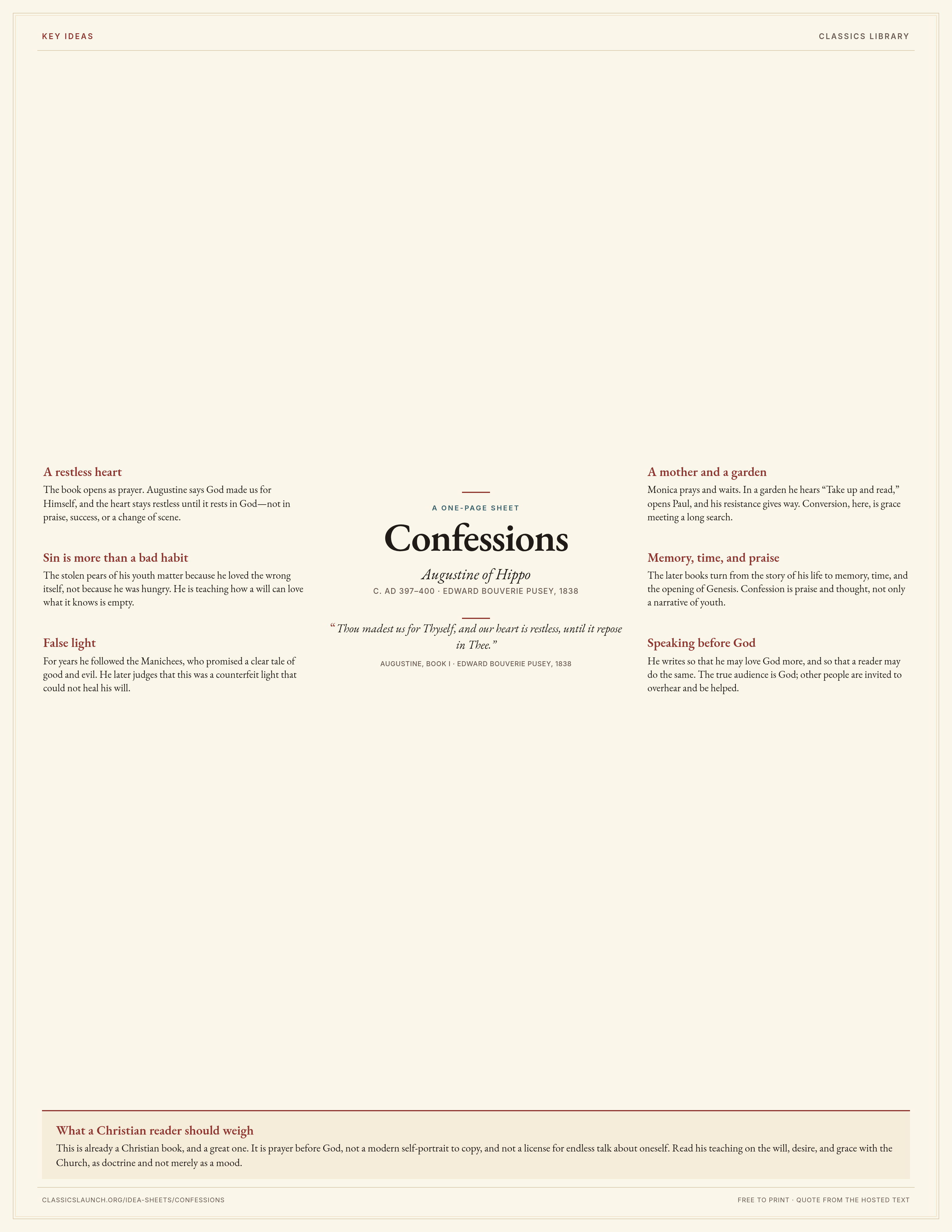
The ideas on the sheet
A restless heart
The book opens as prayer. Augustine says God made us for Himself, and the heart stays restless until it rests in God—not in praise, success, or a change of scene.
Sin is more than a bad habit
The stolen pears of his youth matter because he loved the wrong itself, not because he was hungry. He is teaching how a will can love what it knows is empty.
False light
For years he followed the Manichees, who promised a clear tale of good and evil. He later judges that this was a counterfeit light that could not heal his will.
A mother and a garden
Monica prays and waits. In a garden he hears “Take up and read,” opens Paul, and his resistance gives way. Conversion, here, is grace meeting a long search.
Memory, time, and praise
The later books turn from the story of his life to memory, time, and the opening of Genesis. Confession is praise and thought, not only a narrative of youth.
Speaking before God
He writes so that he may love God more, and so that a reader may do the same. The true audience is God; other people are invited to overhear and be helped.
What a Christian reader should weigh
This is already a Christian book, and a great one. It is prayer before God, not a modern self-portrait to copy, and not a license for endless talk about oneself. Read his teaching on the will, desire, and grace with the Church, as doctrine and not merely as a mood.
“Thou madest us for Thyself, and our heart is restless, until it repose in Thee.”
The quotation is word for word from the Edward Bouverie Pusey, 1838 text hosted in this library and is checked against that text each time the site is built.