Story maps · Grades K–5
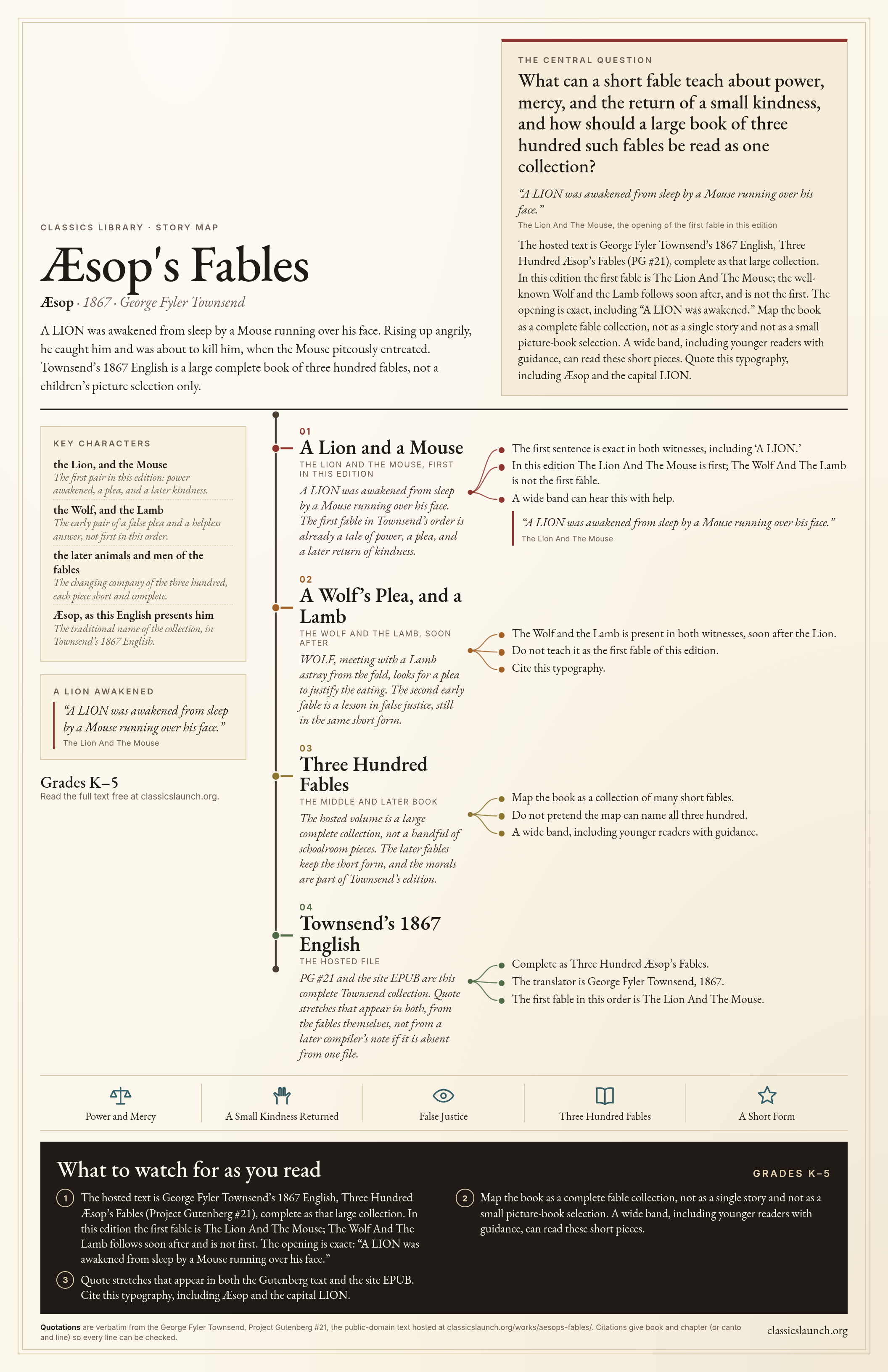
Æsop's Fables: A Story Map
The PDF is one tabloid page (11 × 17 in). On letter paper, choose “Fit to page.”
A LION was awakened from sleep by a Mouse running over his face. Rising up angrily, he caught him and was about to kill him, when the Mouse piteously entreated. Townsend’s 1867 English is a large complete book of three hundred fables, not a children’s picture selection only.
The central question
What can a short fable teach about power, mercy, and the return of a small kindness, and how should a large book of three hundred such fables be read as one collection?
“A LION was awakened from sleep by a Mouse running over his face.”
The hosted text is George Fyler Townsend’s 1867 English, Three Hundred Æsop’s Fables (PG #21), complete as that large collection. In this edition the first fable is The Lion And The Mouse; the well-known Wolf and the Lamb follows soon after, and is not the first. The opening is exact, including “A LION was awakened.” Map the book as a complete fable collection, not as a single story and not as a small picture-book selection. A wide band, including younger readers with guidance, can read these short pieces. Quote this typography, including Æsop and the capital LION.
- 01
A Lion and a Mouse
The Lion And The Mouse, first in this edition
A LION was awakened from sleep by a Mouse running over his face. The first fable in Townsend’s order is already a tale of power, a plea, and a later return of kindness.
- The first sentence is exact in both witnesses, including ‘A LION.’
- In this edition The Lion And The Mouse is first; The Wolf And The Lamb is not the first fable.
- A wide band can hear this with help.
“A LION was awakened from sleep by a Mouse running over his face.”
- 02
A Wolf’s Plea, and a Lamb
The Wolf And The Lamb, soon after
WOLF, meeting with a Lamb astray from the fold, looks for a plea to justify the eating. The second early fable is a lesson in false justice, still in the same short form.
- The Wolf and the Lamb is present in both witnesses, soon after the Lion.
- Do not teach it as the first fable of this edition.
- Cite this typography.
- 03
Three Hundred Fables
The middle and later book
The hosted volume is a large complete collection, not a handful of schoolroom pieces. The later fables keep the short form, and the morals are part of Townsend’s edition.
- Map the book as a collection of many short fables.
- Do not pretend the map can name all three hundred.
- A wide band, including younger readers with guidance.
- 04
Townsend’s 1867 English
The hosted file
PG #21 and the site EPUB are this complete Townsend collection. Quote stretches that appear in both, from the fables themselves, not from a later compiler’s note if it is absent from one file.
- Complete as Three Hundred Æsop’s Fables.
- The translator is George Fyler Townsend, 1867.
- The first fable in this order is The Lion And The Mouse.
- Power and Mercy
- A Small Kindness Returned
- False Justice
- Three Hundred Fables
- A Short Form
What to watch for as you read
Grades K–5- The hosted text is George Fyler Townsend’s 1867 English, Three Hundred Æsop’s Fables (Project Gutenberg #21), complete as that large collection. In this edition the first fable is The Lion And The Mouse; The Wolf And The Lamb follows soon after and is not first. The opening is exact: “A LION was awakened from sleep by a Mouse running over his face.”
- Map the book as a complete fable collection, not as a single story and not as a small picture-book selection. A wide band, including younger readers with guidance, can read these short pieces.
- Quote stretches that appear in both the Gutenberg text and the site EPUB. Cite this typography, including Æsop and the capital LION.
Every quotation is word for word from the George Fyler Townsend hosted in this library and is checked against that text each time the site is built. Citations give book and chapter (or canto and line).