Work record
Aesop's Fables
c. 6th century BCE (Townsend trans. 1867) · Ancient · Collection · Greek
Abstract
Background. Ancient writers from Herodotus onward name Aesop as a slave and storyteller of the sixth century BC, though no text from his hand survives. The fables reached later readers through Babrius, Phaedrus and Byzantine compilations, and Townsend, a Victorian clergyman, rendered a large selection of them into English in 1867.
Content. Beasts, gods and ordinary people meet in a few sentences. A wolf finds charges against a blameless lamb; a hare naps while a tortoise plods to victory; a dog drops his meat to snatch at its reflection; a grasshopper who sang all summer begs from industrious ants; a dying father shows quarrelling sons that bundled sticks cannot be snapped.
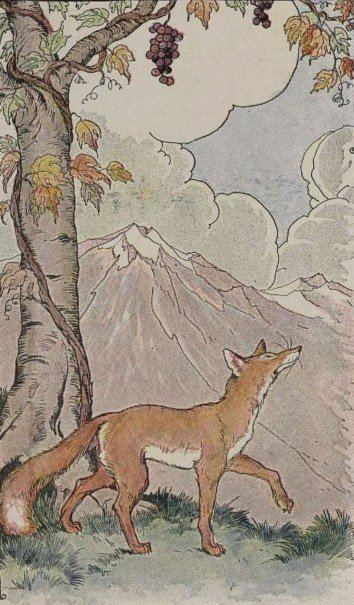
Structure. Each fable sets out a situation, a choice and its consequence, and most close with a one-line moral. Order is loose, so any fable can be read alone. Several titles, such as The Fox and the Grapes, have become proverbial.
Teaching. Prudence, industry, honesty, gratitude and moderation are commended; flattery, greed, boasting and ingratitude are shown to defeat themselves, often comically, and the weak survive by wit rather than strength.
Significance. Used in Greek and Roman rhetorical schooling, retold by medieval preachers, printed in English by Caxton in 1484 and recast by La Fontaine, the fables became a standard first reader of Western moral instruction.
Main characters
- The Fox: Clever flatterer and schemer, sometimes outwitted himself
- The Wolf: Strength that invents pretexts for injustice
- The Lion: King of beasts, by turns proud, merciful and deceived
- The Mouse: Small creature who repays a kindness
- The Ass: Dull beast whose vanity or stupidity brings trouble
- The Countryman: Recurring human figure who learns by hard experience

Watch the summary
Aesop's Fables in 113 seconds · 1:53
Summary
Aesop's Fables are short animal tales that turn ordinary encounters—a wolf and a lamb, a lion and a mouse, ants and a grasshopper—into clear morals about justice, prudence, gratitude, and folly. The Greek slave Aesop is the traditional name attached to a body of stories that circulated orally and in later collections; what survives for English readers is a tradition of brief narratives ending in a pointed lesson. George Fyler Townsend's nineteenth-century translation gathers three hundred of these fables into plain, readable prose. Each fable is usually one or two paragraphs: characters act from hunger, pride, envy, or fear; the outcome exposes the cost of that motive; a moral names the lesson. The Wolf and the Lamb shows power inventing excuses to devour the weak. The Lion and the Mouse shows that a small kindness may return when the mighty need help. The Father and His Sons uses a bundle of sticks to prove that union is strength. Because the stories are short and concrete, they suit first narrations and memory work: a child can retell the plot and then state the moral in a sentence. They also repay older reading. The fables assume a world in which character shows in action, in which flattery and force are real dangers, and in which prudence is a virtue rather than mere shrewdness. Townsend's versions keep the classical temper: they do not soften the wolf or sentimentalize the mouse. For School Launch's K–2 lists they are ideal—brief enough for a sitting, rich enough for talk about honesty, courage, gratitude, and fair dealing—and they stand behind later Western moral storytelling from medieval bestiaries to modern children's books. The collection also trains a habit of judgment. Because each fable is short, a parent or teacher can ask what the animal wanted, what he did, and what followed, and the child can answer without losing the thread. That three-part pattern—desire, act, consequence—is the seed of later moral philosophy and of narrative itself. Townsend's Victorian prose is plain rather than ornate, which suits first readers and keeps the Greek temper: the fox is cunning, the crow vain, the dog foolish over a shadow, and the moral does not apologize for naming folly. School Launch's K-2 lists rightly begin here. A child who can narrate The Lion and the Mouse and state its moral has practiced attention, memory, and ethical speech in one sitting. Later he will meet longer allegories such as The Pilgrim's Progress; Aesop is the doorway, not a substitute, and the library stores the full Townsend text so teachers may choose widely rather than depend on a handful of over-anthologized tales.
Virtues in this work
- Justice: Fables such as The Wolf and the Lamb expose false accusation and the abuse of power.
- Friendship: The Lion and the Mouse honors mercy repaid between unequal friends.
- Prudence: Many fables punish rashness and reward foresight and restraint.
Plot or Argument
- Form of the fable
A brief animal (or human) episode ends in a stated or implied moral about character and consequence.
- Power and justice
Stories such as The Wolf and the Lamb show the strong inventing charges against the weak.
- Gratitude and prudence
The Lion and the Mouse and kindred fables reward foresight, mercy, and keeping faith.
- Unity and folly
Household and social fables (The Father and His Sons, and others) warn against quarreling and vain display.
Characters
- The Wolf, predator
Appears in several fables as force without justice.
- The Lamb, victim
Answers truthfully in The Wolf and the Lamb and is eaten anyway.
- The Lion, king of beasts
Proud yet capable of mercy in The Lion and the Mouse.
- The Mouse, benefactor
Repays the lion’s mercy by gnawing the hunter’s ropes.
Lessons
Power invents its excuses
In The Wolf and the Lamb, the wolf’s charges shift when the lamb answers them; appetite, not justice, drives the end. Children can name the false charges and see how tyranny clothes itself in accusation.
- What excuses does the wolf invent?
- Why does the lamb’s truth not save him?
Small kindness can return
The Lion and the Mouse teaches that mercy toward the weak is not wasted; the mouse later frees the lion. Gratitude and humility belong together.
- Why does the lion laugh at the mouse’s promise?
- How does the ending reverse the beginning?
Union is strength
The Father and His Sons shows a bundle of sticks that cannot be broken together but snaps when taken one by one. Quarreling weakens a household.
- What does the father make his sons do?
- Where else do we see strength in staying together?
Context
Greek fable tradition associated with Aesop entered Latin through Phaedrus and others, then medieval and Renaissance schoolbooks; English versions multiplied from Caxton onward.
Composition
Townsend's Three Hundred Aesop’s Fables (1867) offers a Victorian prose corpus drawn from the Greek tradition for general readers.
Reception
Aesop remained a staple of elementary moral education in English-speaking schools and homes well into the twentieth century.
Comparisons
- black-beauty
Both teach kindness and justice through animal lives, though Sewell uses a novel and Aesop the short fable.
- characters
Theophrastus’s Characters sketches social types; Aesop’s animals likewise make vices visible in brief compass.
- grimms-fairy-tales
The Grimms' household tales share the fable's talking animals and plain moral turns, but tell longer stories of trials, enchantments and rewards drawn from German oral tradition.
Quotes
“WOLF, meeting with a Lamb astray from the fold, resolved not to lay violent hands on him, but to find some plea to justify to the Lamb the Wolf’s right to eat him.”
“A LION was awakened from sleep by a Mouse running over his face.”
“A FATHER had a family of sons who were perpetually quarreling among themselves.”
For Students
A reading companion for classical Christian high school students. See the student guide.
Reading Guide
Watch for
- How often a stronger animal invents a reason before doing harm (Wolf and Lamb).
- Moments when a weak character’s earlier mercy returns as help (Lion and Mouse).
- Fables that end with a household or city lesson, not only a forest one (Father and His Sons).
- Whether the moral is stated at the end or left for the reader to name.
- Repeated animal types—fox, crow, dog—and what vice or virtue each usually carries.
Key terms and names
- Fable
- A short story, often with animals, that teaches a moral about how to act.
- Moral
- The lesson named or implied at the end of a fable.
- Townsend
- George Fyler Townsend, whose 1867 English prose version is the library’s full text.
- Personification
- Giving animals human speech and motives so character can be seen clearly.
Seminar Questions
- Comprehension In The Wolf and the Lamb, what charges does the wolf make, and how does the lamb answer each one?
- Comprehension What does the mouse promise the lion, and how is the promise kept?
- Comprehension What object does the father use to teach his quarreling sons, and what happens when the sticks are separated?
- Interpretation Why do so many fables use animals instead of named human characters?
- Interpretation Is the moral of The Wolf and the Lamb mainly about justice, or about the danger of the weak trusting the strong?
- Interpretation Which fable in this collection best teaches gratitude, and why?
- Big Question Can a very short story form character as well as a long novel can? What can Aesop do that a novel cannot, and what can he not do?
Faith Connections
- Proverbs 26:4-5 (Scripture)
Proverbs often answers folly with brief, memorable sayings; Aesop’s morals work in a similar short form, training the ear for wisdom literature.
- Proverbs 6:6-8 (Scripture)
Go to the ant—Scripture itself uses animal examples for industry, as several ant-and-grasshopper traditions do in Aesop.
- Aristotle, Rhetoric (on example and fable) (Great Conversation)
Classical rhetoric treated fables as persuasive examples; Aesop sits behind later Christian and school uses of moral story.
Logic and Rhetoric
Central argument: Actions spring from character traits—greed, pride, prudence, gratitude—and those traits reliably bring consequences that a brief story can make visible.
Rhetorical device: exemplum (moral example). Each fable offers a concrete case rather than an abstract lecture; the wolf’s shifting accusations show injustice more clearly than a definition would.
Debate: Resolved: that mercy toward the weak is a duty even for the strong (affirm with Lion and Mouse; challenge with worlds where mercy is betrayed—and answer from the fable’s own logic of return).
Memory Work
A LION was awakened from sleep by a Mouse running over his face.
Writing Prompts
Essay: Choose three fables about justice or injustice and explain how each shows the difference between might and right.
Comparison with Black Beauty: Compare one Aesop fable with a proverb from Proverbs that teaches a similar lesson. How does story differ from saying?
Medical Lens
Fables occasionally turn on hunger, thirst, or injury (the wolf’s appetite; animals trapped or wounded). They are useful for talking about bodily need as a motive without modern clinical framing.
- The Wolf And The Lamb
The wolf’s hunger drives the invented charges against the lamb.
Listen to the book
Public-domain audiobook from LibriVox, read by Rosslyn Carlyle, translated by V. S. Vernon Jones. Recording: Aesop's Fables - new translation on LibriVox (Internet Archive).
LibriVox recordings are volunteer readings released into the public domain. The reading may follow a different edition or translation from the text in this library.
Creative Prompts
- Fiction
Write a new fable of 150–200 words with animal characters and a clear moral about honesty.
- Classroom
Have students narrate a fable from memory, then write the moral in one sentence of their own words.
- Essay
Is Aesop too harsh for young children, or is the harshness part of the moral training?
Further Reading
- Proverbs, Biblical wisdom literature
Short moral sayings that pair well with fable reading.
Verification notes
Plot summaries of individual fables follow Townsend’s text. Aesop’s biography remains legendary; dates are traditional.
No verification flags recorded.