Story maps · Grades 9–12
All Quiet on the Western Front: A Story Map
The PDF is one tabloid page (11 × 17 in). On letter paper, choose “Fit to page.”
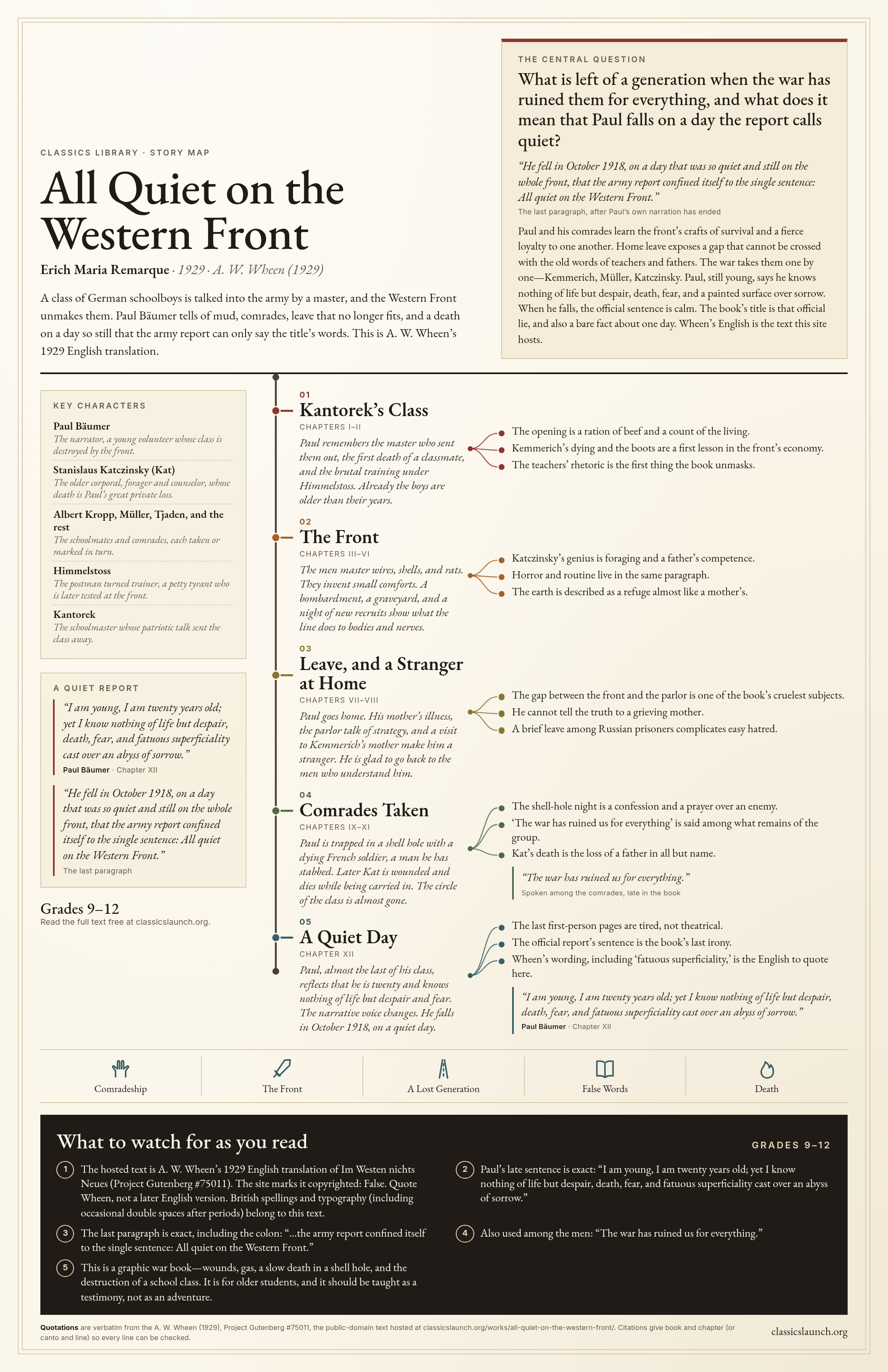
A class of German schoolboys is talked into the army by a master, and the Western Front unmakes them. Paul Bäumer tells of mud, comrades, leave that no longer fits, and a death on a day so still that the army report can only say the title’s words. This is A. W. Wheen’s 1929 English translation.
The central question
What is left of a generation when the war has ruined them for everything, and what does it mean that Paul falls on a day the report calls quiet?
“He fell in October 1918, on a day that was so quiet and still on the whole front, that the army report confined itself to the single sentence: All quiet on the Western Front.”
Paul and his comrades learn the front’s crafts of survival and a fierce loyalty to one another. Home leave exposes a gap that cannot be crossed with the old words of teachers and fathers. The war takes them one by one—Kemmerich, Müller, Katczinsky. Paul, still young, says he knows nothing of life but despair, death, fear, and a painted surface over sorrow. When he falls, the official sentence is calm. The book’s title is that official lie, and also a bare fact about one day. Wheen’s English is the text this site hosts.
- 01
Kantorek’s Class
Chapters I–II
Paul remembers the master who sent them out, the first death of a classmate, and the brutal training under Himmelstoss. Already the boys are older than their years.
- The opening is a ration of beef and a count of the living.
- Kemmerich’s dying and the boots are a first lesson in the front’s economy.
- The teachers’ rhetoric is the first thing the book unmasks.
- 02
The Front
Chapters III–VI
The men master wires, shells, and rats. They invent small comforts. A bombardment, a graveyard, and a night of new recruits show what the line does to bodies and nerves.
- Katczinsky’s genius is foraging and a father’s competence.
- Horror and routine live in the same paragraph.
- The earth is described as a refuge almost like a mother’s.
- 03
Leave, and a Stranger at Home
Chapters VII–VIII
Paul goes home. His mother’s illness, the parlor talk of strategy, and a visit to Kemmerich’s mother make him a stranger. He is glad to go back to the men who understand him.
- The gap between the front and the parlor is one of the book’s cruelest subjects.
- He cannot tell the truth to a grieving mother.
- A brief leave among Russian prisoners complicates easy hatred.
- 04
Comrades Taken
Chapters IX–XI
Paul is trapped in a shell hole with a dying French soldier, a man he has stabbed. Later Kat is wounded and dies while being carried in. The circle of the class is almost gone.
- The shell-hole night is a confession and a prayer over an enemy.
- ‘The war has ruined us for everything’ is said among what remains of the group.
- Kat’s death is the loss of a father in all but name.
“The war has ruined us for everything.”
- 05
A Quiet Day
Chapter XII
Paul, almost the last of his class, reflects that he is twenty and knows nothing of life but despair and fear. The narrative voice changes. He falls in October 1918, on a quiet day.
- The last first-person pages are tired, not theatrical.
- The official report’s sentence is the book’s last irony.
- Wheen’s wording, including ‘fatuous superficiality,’ is the English to quote here.
“I am young, I am twenty years old; yet I know nothing of life but despair, death, fear, and fatuous superficiality cast over an abyss of sorrow.”
- Comradeship
- The Front
- A Lost Generation
- False Words
- Death
What to watch for as you read
Grades 9–12- The hosted text is A. W. Wheen’s 1929 English translation of Im Westen nichts Neues (Project Gutenberg #75011). The site marks it copyrighted: False. Quote Wheen, not a later English version. British spellings and typography (including occasional double spaces after periods) belong to this text.
- Paul’s late sentence is exact: “I am young, I am twenty years old; yet I know nothing of life but despair, death, fear, and fatuous superficiality cast over an abyss of sorrow.”
- The last paragraph is exact, including the colon: “…the army report confined itself to the single sentence: All quiet on the Western Front.”
- Also used among the men: “The war has ruined us for everything.”
- This is a graphic war book—wounds, gas, a slow death in a shell hole, and the destruction of a school class. It is for older students, and it should be taught as a testimony, not as an adventure.
Every quotation is word for word from the A. W. Wheen (1929) hosted in this library and is checked against that text each time the site is built. Citations give book and chapter (or canto and line).