Work record
All Quiet on the Western Front
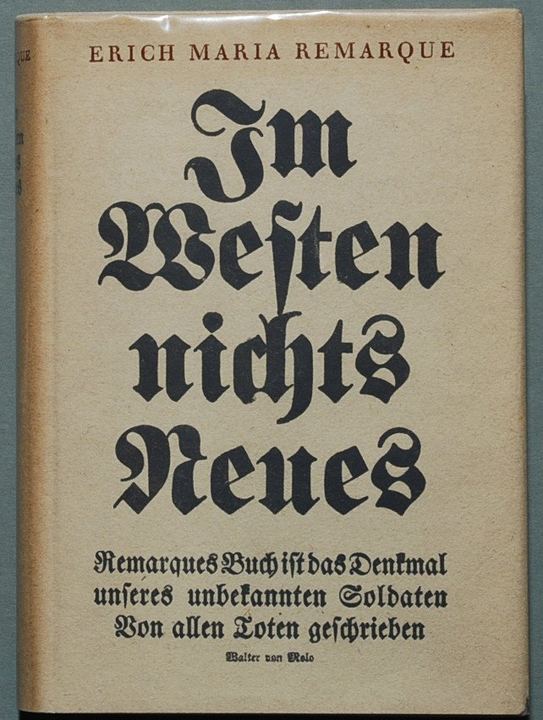
1929 (German, Im Westen nichts Neues, serialized 1928) · Early 20th Century · Novel · German
Abstract
Background. A veteran wounded in 1917, Remarque drafted the book a decade after the armistice in Berlin. Wheen, himself an Australian infantry veteran of the Somme and Ypres, rendered it into English within months.
Plot. A company of schoolboy volunteers and older conscripts moves between rest billets and the line. Paul watches a friend die after an amputation, survives gas and a long offensive, goes home on leave as a stranger, and kneels for hours beside a Frenchman he has knifed. Hospital, desertion and the hunger of 1918 thin the group until Kat, carried on Paul's back, is killed by a stray fragment and Paul himself dies weeks before the armistice.
Structure. The episodes are loosely joined, alternating combat with interludes of food, jokes and talk, so that each death lands among scenes of ordinary fellowship. Paul speaks in the present tense throughout until a closing paragraph, in an unnamed outside voice, reports his end.
Themes. The gulf between home-front rhetoric and the front's reality, comradeship, the common humanity of enemies, the body under modern weapons, and a youth cut off from any future.
Significance. An immediate international best seller, filmed by Milestone in 1930 and burned by the Nazis in 1933, it fixed for many readers the image of the Great War as the destruction of a generation.
Main characters
- Paul Bäumer: Young infantryman and narrator, the last of his school class
- Stanislaus Katczinsky (Kat): Resourceful older soldier and Paul's dearest friend
- Albert Kropp: Thoughtful classmate who loses a leg
- Müller: Classmate who covets the dead man's boots
- Tjaden: Ravenous locksmith with a score to settle
- Haie Westhus: Giant peat-cutter fatally hit in the back
- Kantorek: Schoolmaster who talked the boys into volunteering
- Himmelstoss: Bullying drill corporal from the training camp
- Gérard Duval: French printer killed by Paul in a crater

Summary
Paul Bäumer, a young German infantryman not yet twenty, tells in the present tense of his last two years in the Great War. He and his classmates Albert Kropp, Müller and Leer enlisted together, urged on by their schoolmaster Kantorek, and now serve in a company that has just come out of the line with eighty men left of a hundred and fifty. Their comrades include the shrewd older forager Stanislaus Katczinsky, called Kat, the farmer Detering, the peat-digger Haie Westhus and the hungry Tjaden. In the first chapters Paul's schoolfriend Franz Kemmerich dies in a field hospital after his leg is amputated, while Müller waits for his fine boots; the friends remember their training under the petty corporal Himmelstoss and take revenge by throwing a bed-cover over him and beating him on his way home from the pub. Going up to lay wire, the company is shelled, hears wounded horses screaming, and is caught by gas in a graveyard where the shells throw up coffins. A long offensive follows: rats in the dugout, a recruit who breaks down and tries to run out under fire, attack and counter-attack over cratered ground, and Haie's mortal wound in the back; when the roll is called, thirty-two men answer. On leave Paul finds that he cannot speak to his family or to the beer-hall patriots, that his mother is ill with cancer, and that his old books no longer reach him. He lies to Kemmerich's mother that her son died instantly. At a training camp he guards Russian prisoners and sees in their hunger the same men as himself. Back at the front, on patrol, he stabs a French soldier who falls into his shell-hole, and spends hours beside him as he dies; finding that he was Gérard Duval, a printer with a wife and child, Paul promises to write to them. Wounded while evacuating a village, Paul and Albert are sent to a Catholic hospital, where Albert's leg is amputated and the men learn of the Dying Room from which patients rarely return. In 1918, as Germany is starved and outgunned, the friends fall one by one: Detering deserts after seeing a cherry tree in blossom and is caught; Müller dies of a flare in the stomach; Leer bleeds to death; and Kat, whom Paul carries to a dressing station with a shattered shin, is killed on the way by a tiny splinter in the head. In the last pages Paul, resting after a whiff of gas, waits alone for the armistice. A final paragraph in another voice records that he fell in October 1918 on a day so quiet that the army report said only: All quiet on the Western Front. The novel was serialized in the Vossische Zeitung in 1928 and published as a book in Berlin in January 1929; A. W. Wheen's English translation followed in 1929.
Virtues in this work
- Friendship: Paul carries the wounded Kat on his back toward the dressing station, refusing to leave him.
- Charity: In the shell-hole Paul bandages and gives water to the Frenchman he has stabbed and asks his forgiveness.
- Fortitude: The men endure days of bombardment, gas and hunger and still go back into the line.
- Justice: Paul sees the starving Russian prisoners as men like himself and shares his cigarettes with them.
Plot or Argument
- Prefatory note and Chapter I: Behind the lines
The book disclaims accusation and adventure. Double rations for a decimated company; Kantorek's patriotism remembered; Kemmerich lies with an amputated leg.
- Chapters II-III: Training and revenge
Kemmerich dies and Müller inherits his boots; memories of Himmelstoss's drill; Kat forages; the friends ambush Himmelstoss under a bed-cover.
- Chapter IV: Wiring party and gas
Shelling in the dark, the screaming horses, a gas attack in a cemetery, a recruit with a smashed hip.
- Chapters V-VI: The great offensive
Talk of what they will do in peacetime and a stolen goose; then rats, bombardment, a recruit's breakdown, attack and counter-attack, Haie's death, and thirty-two men at roll-call.
- Chapters VII-VIII: Leave and the Russians
French girls across the canal; home, a sick mother, a father and townsmen who do not understand; Kemmerich's mother; Russian prisoners at the training camp.
- Chapter IX: The shell-hole
The Kaiser's inspection and talk about who makes wars; Paul kills Gérard Duval and keeps vigil over him.
- Chapter X: The village and the hospital
A feast in an abandoned village; Paul and Albert wounded; the Catholic hospital, the Dying Room, Albert's amputation, Paul's convalescent leave.
- Chapter XI: 1918
Detering deserts; Müller, Berger, Leer and the company commander Bertinck die; Paul carries the wounded Kat, who dies of a splinter on the way.
- Chapter XII: Autumn
Paul, alone of his class, waits for peace, and falls in October 1918.
Characters
- Paul Bäumer, narrator
A schoolboy volunteer, once a would-be poet, who becomes a hardened and lonely soldier.
- Stanislaus Katczinsky (Kat), comrade
A forty-year-old cobbler and genius at finding food, shelter and safety, Paul's closest friend.
- Albert Kropp, classmate
The clearest thinker of the group, who loses a leg.
- Müller, classmate
A practical boy who carries his school textbooks and wants Kemmerich's boots.
- Leer, classmate
Bearded, fond of girls and good at mathematics; killed in 1918.
- Tjaden, comrade
A skinny, insatiable locksmith with a grudge against Himmelstoss.
- Haie Westhus, comrade
A huge, good-natured peat-digger, mortally wounded in the back.
- Detering, comrade
A peasant who thinks only of his farm and wife and deserts at the sight of cherry blossom.
- Franz Kemmerich, classmate
Dies after an amputation early in the book.
- Kantorek, schoolmaster
The patriotic teacher who urged the class to enlist, later conscripted himself.
- Himmelstoss, corporal
A former postman turned petty tyrant of the training ground.
- Gérard Duval, French soldier
A printer whom Paul kills in a shell-hole and mourns.
Lessons
Words and things
Kantorek and the men of the home town speak of duty, glory and the Iron Youth; Paul and his friends meet shell-fire, gas, amputation and rats. The book sets the phrases of the schoolroom against the facts of the front and asks what a teacher owes the young before sending them to die.
- Why does Paul say the first bombardment showed them their mistake about their elders?
- What does Paul find he cannot say to his father and the men in the beer garden?
- Is Kantorek a villain, a fool, or something else?
The enemy is a man
In the shell-hole Paul learns the name, trade and family of the man he has stabbed. The enemy as an idea gives way to Gérard Duval, a printer, and Paul begs his forgiveness. The scene is the moral centre of the novel.
- Why does Paul talk to the dead Frenchman?
- Why does his resolve to write to Duval's wife fade when he is back with Kat and Albert?
- What does the Russian prisoners' episode add to the shell-hole?
Comradeship
Kat finds food for everyone, the friends share boots, cigarettes and a stolen goose, and Paul carries Kat on his back to the dressing station. Remarque shows friendship as the one good thing the war gives, and its loss as the deepest wound.
- What makes Kat a leader without any rank?
- How do the boots pass from Kemmerich to Müller to Paul, and what does that mean?
- Why is Kat's death the turning point for Paul?
A lost generation
Paul says that he and his friends were cut off from life just as they began to love it, and that they no longer know how to go home. The novel is less about a single battle than about young men emptied of their future.
- What does Paul mean when he says they are old folk at twenty?
- Why is the final paragraph written in a different voice?
Context
The novel covers roughly 1916 to October 1918 on the Western Front in France and Flanders, the static war of trenches, artillery barrages, poison gas and, by 1918, tanks and Allied superiority in men and supplies, while the British blockade starved Germany. About two million German soldiers died in the war. Remarque's company is never placed in a named battle; the book generalizes the experience of the ordinary infantryman.
Composition
Remarque wrote the book in Berlin in 1927-28, about a decade after his own service. It was serialized in the Vossische Zeitung from November 1928 and published by Propyläen in January 1929. Arthur Wesley Wheen, an Australian who had served with the Australian Imperial Force on the Western Front, translated it the same year; the London edition by G. P. Putnam's Sons, reproduced in the library text, chose the English title, and Little, Brown published it in the United States.
Reception
The book sold over a million copies in Germany within its first year and was translated into dozens of languages. Lewis Milestone's American film of 1930 won the Academy Award for best picture. Nationalists attacked the novel as defeatist; the National Socialists banned it and burned it in May 1933. It remains the best-known novel of the First World War and has been filmed again, most recently in German in 2022.
Comparisons
- the-red-badge-of-courage
Crane's young soldier seeks to prove his courage and finds a kind of manhood in battle; Paul has courage enough but finds that the war has used up his life.
- testament-of-youth
Vera Brittain's memoir gives the English, and the nurse's, side of the same war and the same loss of a generation, including the hospitals Paul lies in.
- in-flanders-fields
McCrae's poem asks the living to take up the quarrel with the foe; Remarque's shell-hole scene asks how the foe could be an enemy at all.
- the-iliad
Homer's warriors seek undying glory and Priam and Achilles weep together over the dead; Paul's war offers no glory, but his vigil over Duval echoes that moment of shared grief.
- henry-v
Henry's band of brothers is promised remembrance on St. Crispin's Day; Remarque's brothers in arms die one by one and are forgotten in an army report.
- a-farewell-to-arms
Hemingway's novel, published the same year (1929), sets the war on the Italian front and the retreat from Caporetto, told by an American ambulance officer rather than a German infantryman.
Quotes
Frequently cited
“This book is to be neither an accusation nor a confession, and least of all an adventure, for death is not an adventure to those who stand face to face with it.”
Frequently cited
“We were eighteen and had begun to love life and the world; and we had to shoot it to pieces.”
Frequently cited
“Comrade, I did not want to kill you.”
Frequently cited
“A hospital alone shows what war is.”
Frequently cited
“He fell in October 1918, on a day that was so quiet and still on the whole front, that the army report confined itself to the single sentence: All quiet on the Western Front.”
“The first bombardment showed us our mistake, and under it the world as they had taught it to us broke in pieces.”
“We are none of us more than twenty years old. But young? Youth? That is long ago. We are old folk.”
“To no man does the earth mean so much as to the soldier.”
For Students
A reading companion for classical Christian high school students. See the student guide.
Reading Guide
Watch for
- The boots that pass from Kemmerich to Müller and finally to Paul, and what happens to each owner.
- Paul's leave in Chapter VII: his room, his books, his mother's illness and the men who explain the war to him.
- The night in the shell-hole with Gérard Duval in Chapter IX and the promises Paul makes there.
- How the friends' talk about the future changes from Chapter V to Chapter XII.
- The sudden change of voice in the last paragraph of the book.
Key terms and names
- Iron Youth
- Kantorek's patriotic phrase for his former pupils at the front; Paul and Kropp repeat it bitterly in Chapter I.
- Western Front
- The line of trenches through Belgium and France where German armies faced the French, British and later American armies from 1914 to 1918.
- Dressing station
- The first medical post behind the line, where wounds were bandaged and urgent operations done; Paul carries Kat toward one in Chapter XI.
- Dying Room
- In the Catholic hospital of Chapter X, the small room where patients near death are moved; little Peter is taken there and returns.
- Shooting licence
- Josef Hamacher's joking name for the certificate he received after a head wound, declaring him not always responsible for his actions.
- Gas mask
- The respirator worn against poison gas; in Chapter IV Paul pulls one over the head of a recruit who has not understood the alarm.
Seminar Questions
- Comprehension Why did Paul and his classmates enlist, and what part did Kantorek play?
- Comprehension What happens to Paul in the shell-hole in Chapter IX, and what does he learn from the dead man's papers?
- Comprehension How does Kat die, and why does Paul not realize it at first?
- Interpretation Why can Paul not talk to his family or to the men in the beer garden during his leave?
- Interpretation What does the scene with the Russian prisoners in Chapter VIII teach Paul about who the enemy is?
- Interpretation Why does Remarque end the book with a paragraph in a different voice, and what does the army report's sentence mean there?
- Big Question Does a soldier who kills in war bear guilt, and if so, what can he do with it?
- Big Question What do the old owe the young they send to war?
Faith Connections
- Matthew 5:43-45 (Scripture)
Christ commands love of enemies, for the Father sends rain on the just and the unjust. In the shell-hole Paul discovers Duval's wife, child and trade, and sees that the enemy was a man like himself.
- John 15:13 (Scripture)
Greater love hath no man than this, that a man lay down his life for his friends. Kat's care for the company and Paul's carrying of the wounded Kat show the love among comrades that the novel honours.
- Ecclesiastes 1:2-4 (Scripture)
The Preacher sees one generation pass away and another come. Paul's sense that his whole generation has been emptied of its future converses with this ancient lament, though the novel finds no answer beyond comradeship.
- Wilfred Owen, Dulce et Decorum Est (Great Conversation)
Owen, a British officer killed in November 1918, describes a gas attack and calls Horace's line about the sweetness of dying for one's country the old Lie. Remarque's gas scene and his attack on Kantorek's phrases make the same protest from the German side.
Logic and Rhetoric
Central argument: The elders taught that duty and glory justify the war. At the front the young men find only death, wounds, hunger and the loss of their future, and they discover that the enemy is a man like themselves. Therefore the novel argues that the war destroyed a generation, even those who survived the shells, and that the words used to send them were false.
Rhetorical device: irony of understatement. The final paragraph in Chapter XII reports Paul's death in one plain sentence and sets it beside the army report's All quiet on the Western Front, so that the title itself becomes the book's sharpest irony.
Debate: Resolved: that Kantorek bears moral responsibility for the deaths of his pupils.
Memory Work
We were eighteen and had begun to love life and the world; and we had to shoot it to pieces.
Comrade, I did not want to kill you.
Writing Prompts
Essay: Paul says the war has ruined his generation for everything. Using his leave, the shell-hole and the final chapter, argue whether the novel leaves any hope for those who survive.
Comparison with The Red Badge of Courage: Henry Fleming and Paul Bäumer are both young volunteers in modern wars. Compare what each learns about courage and fear, and argue which book gives the truer picture of a soldier's growth.
Medical Lens
Few novels give so full a picture of First World War military medicine from the patient's side. Kemmerich's amputation and death, the orderly who refuses him morphia because there is not enough for everyone, and the dressing-station surgeons who, the soldiers believe, amputate at the slightest provocation show triage under pressure. Chapter IV gives the gas drill and its terror, with a reference to gas patients coughing up their lungs; Chapter X lists the wards of a Catholic hospital run by nuns, with tetanus deaths, limbs in traction, X-ray plates, and a Dying Room for those not expected to live; Albert's leg is amputated and he is tempted to despair. The recruit in Chapter VI who panics in the dugout, Paul's numbness on leave, and his sense that his generation can never go home are often read now as descriptions of combat stress; in the period they fell under the contested category of shell shock or war neurosis, and Remarque uses neither term. Josef Hamacher's certificate after a head wound, his shooting licence, touches on wartime ideas of diminished responsibility. Hunger in the 1918 chapters reflects the blockade of Germany.
- Chapters I-II
Kemmerich in the field hospital after the amputation of his leg; the orderly refuses morphia; Kemmerich's death and the passing on of his boots.
- Chapter IV
The gas attack in the graveyard, the struggle to get a mask onto a recruit, and the recruit with the smashed hip whom the veterans think it would be kinder to shoot.
- Chapter VI
Under days of bombardment a recruit is seized by a panic of suffocation and tries to rush out of the dugout; the men hold him down.
- Chapter IX
Paul tends the French soldier he has wounded, bandaging him and giving him water through hours of dying.
- Chapter X
The surgeons' table, Paul's fear of chloroform and amputation, the nuns' ward, the Dying Room, tetanus deaths, traction, X-rays, and Albert's amputation.
- Chapter XI
Staff surgeons pass half-recovered men as fit; hunger and dysentery in 1918; Kat's shin wound and death from a splinter in the head.
Listen to the book
Public-domain audiobook from LibriVox, read by Atul Sharma, translated by Arthur Wesley Wheen. Recording: All Quiet on the Western Front on LibriVox (Internet Archive).
LibriVox recordings are volunteer readings released into the public domain. The reading may follow a different edition or translation from the text in this library.
Creative Prompts
- Fiction
Write the letter Paul promised to send to Gérard Duval's wife, in the voice of a German soldier who knows he may never send it.
- Essay
Compare Paul's leave in Chapter VII with his time in the hospital in Chapter X. Where does he feel more at home, and why?
- Classroom
Trace the boots from Kemmerich to Müller to Paul. Have students list each death that moves them and discuss what the boots come to mean.
Further Reading
- The Road Back, Erich Maria Remarque
Remarque's 1931 sequel about soldiers returning to postwar Germany.
- Storm of Steel, Ernst Jünger
A German officer's very different memoir of the same front.
- Goodbye to All That, Robert Graves
- The Great War and Modern Memory, Paul Fussell
- Shell Shock to PTSD: Military Psychiatry from 1900 to the Gulf War, Edgar Jones and Simon Wessely
Verification notes
Plot, names and chapter locators follow the attached Project Gutenberg text (#75011), which reproduces the London edition by G. P. Putnam's Sons of Wheen's 1929 translation. Wheen's Australian service and the US Little, Brown publication were confirmed by web search (https://en.wikipedia.org/wiki/All_Quiet_on_the_Western_Front and the AustLit entry https://cirrus.austlit.edu.au/austlit/page/A43130). Remarque's dates, the serialization and the 1930 and 2022 films are standard facts. All quotes were found by grep in the attached text.
- The American Little, Brown edition of 1929 is reported to have cut or softened some passages found in the London text; check before comparing the library text with US school editions.
- Confirm the dates of the Vossische Zeitung serialization (usually given as 10 November to 9 December 1928).