Story maps · Grades 11–12
The Roman History: A Story Map
The PDF is one tabloid page (11 × 17 in). On letter paper, choose “Fit to page.”
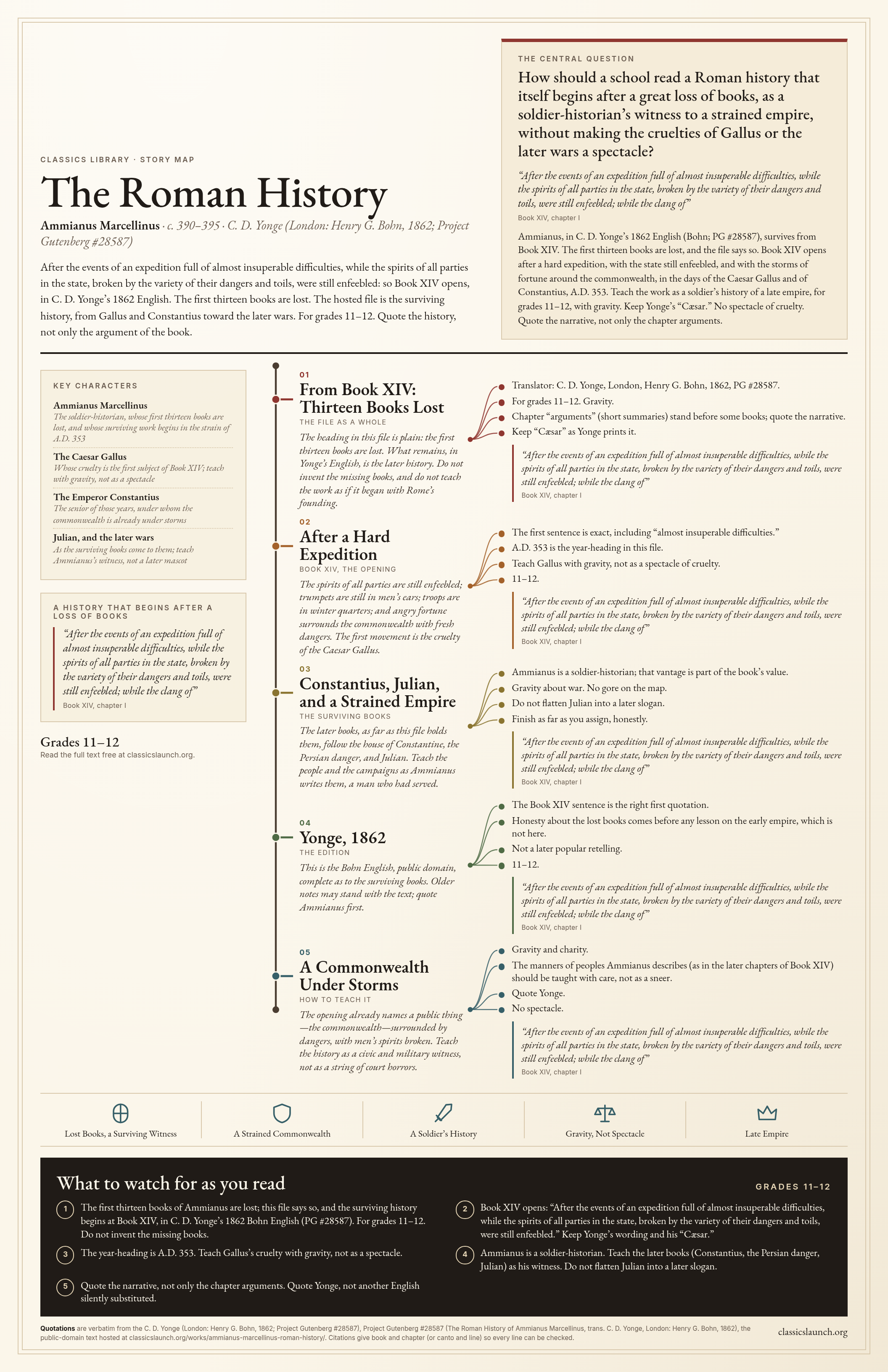
After the events of an expedition full of almost insuperable difficulties, while the spirits of all parties in the state, broken by the variety of their dangers and toils, were still enfeebled: so Book XIV opens, in C. D. Yonge’s 1862 English. The first thirteen books are lost. The hosted file is the surviving history, from Gallus and Constantius toward the later wars. For grades 11–12. Quote the history, not only the argument of the book.
The central question
How should a school read a Roman history that itself begins after a great loss of books, as a soldier-historian’s witness to a strained empire, without making the cruelties of Gallus or the later wars a spectacle?
“After the events of an expedition full of almost insuperable difficulties, while the spirits of all parties in the state, broken by the variety of their dangers and toils, were still enfeebled; while the clang of”
Ammianus, in C. D. Yonge’s 1862 English (Bohn; PG #28587), survives from Book XIV. The first thirteen books are lost, and the file says so. Book XIV opens after a hard expedition, with the state still enfeebled, and with the storms of fortune around the commonwealth, in the days of the Caesar Gallus and of Constantius, A.D. 353. Teach the work as a soldier’s history of a late empire, for grades 11–12, with gravity. Keep Yonge’s “Cæsar.” No spectacle of cruelty. Quote the narrative, not only the chapter arguments.
- 01
From Book XIV: Thirteen Books Lost
The file as a whole
The heading in this file is plain: the first thirteen books are lost. What remains, in Yonge’s English, is the later history. Do not invent the missing books, and do not teach the work as if it began with Rome’s founding.
- Translator: C. D. Yonge, London, Henry G. Bohn, 1862, PG #28587.
- For grades 11–12. Gravity.
- Chapter “arguments” (short summaries) stand before some books; quote the narrative.
- Keep “Cæsar” as Yonge prints it.
“After the events of an expedition full of almost insuperable difficulties, while the spirits of all parties in the state, broken by the variety of their dangers and toils, were still enfeebled; while the clang of”
- 02
After a Hard Expedition
Book XIV, the opening
The spirits of all parties are still enfeebled; trumpets are still in men’s ears; troops are in winter quarters; and angry fortune surrounds the commonwealth with fresh dangers. The first movement is the cruelty of the Caesar Gallus.
- The first sentence is exact, including “almost insuperable difficulties.”
- A.D. 353 is the year-heading in this file.
- Teach Gallus with gravity, not as a spectacle of cruelty.
- 11–12.
“After the events of an expedition full of almost insuperable difficulties, while the spirits of all parties in the state, broken by the variety of their dangers and toils, were still enfeebled; while the clang of”
- 03
Constantius, Julian, and a Strained Empire
The surviving books
The later books, as far as this file holds them, follow the house of Constantine, the Persian danger, and Julian. Teach the people and the campaigns as Ammianus writes them, a man who had served.
- Ammianus is a soldier-historian; that vantage is part of the book’s value.
- Gravity about war. No gore on the map.
- Do not flatten Julian into a later slogan.
- Finish as far as you assign, honestly.
“After the events of an expedition full of almost insuperable difficulties, while the spirits of all parties in the state, broken by the variety of their dangers and toils, were still enfeebled; while the clang of”
- 04
Yonge, 1862
The edition
This is the Bohn English, public domain, complete as to the surviving books. Older notes may stand with the text; quote Ammianus first.
- The Book XIV sentence is the right first quotation.
- Honesty about the lost books comes before any lesson on the early empire, which is not here.
- Not a later popular retelling.
- 11–12.
“After the events of an expedition full of almost insuperable difficulties, while the spirits of all parties in the state, broken by the variety of their dangers and toils, were still enfeebled; while the clang of”
- 05
A Commonwealth Under Storms
How to teach it
The opening already names a public thing—the commonwealth—surrounded by dangers, with men’s spirits broken. Teach the history as a civic and military witness, not as a string of court horrors.
- Gravity and charity.
- The manners of peoples Ammianus describes (as in the later chapters of Book XIV) should be taught with care, not as a sneer.
- Quote Yonge.
- No spectacle.
“After the events of an expedition full of almost insuperable difficulties, while the spirits of all parties in the state, broken by the variety of their dangers and toils, were still enfeebled; while the clang of”
- Lost Books, a Surviving Witness
- A Strained Commonwealth
- A Soldier’s History
- Gravity, Not Spectacle
- Late Empire
What to watch for as you read
Grades 11–12- The first thirteen books of Ammianus are lost; this file says so, and the surviving history begins at Book XIV, in C. D. Yonge’s 1862 Bohn English (PG #28587). For grades 11–12. Do not invent the missing books.
- Book XIV opens: “After the events of an expedition full of almost insuperable difficulties, while the spirits of all parties in the state, broken by the variety of their dangers and toils, were still enfeebled.” Keep Yonge’s wording and his “Cæsar.”
- The year-heading is A.D. 353. Teach Gallus’s cruelty with gravity, not as a spectacle.
- Ammianus is a soldier-historian. Teach the later books (Constantius, the Persian danger, Julian) as his witness. Do not flatten Julian into a later slogan.
- Quote the narrative, not only the chapter arguments. Quote Yonge, not another English silently substituted.
Every quotation is word for word from the C. D. Yonge (London: Henry G. Bohn, 1862; Project Gutenberg #28587) hosted in this library and is checked against that text each time the site is built. Citations give book and chapter (or canto and line).