Story maps · Grades 11–12
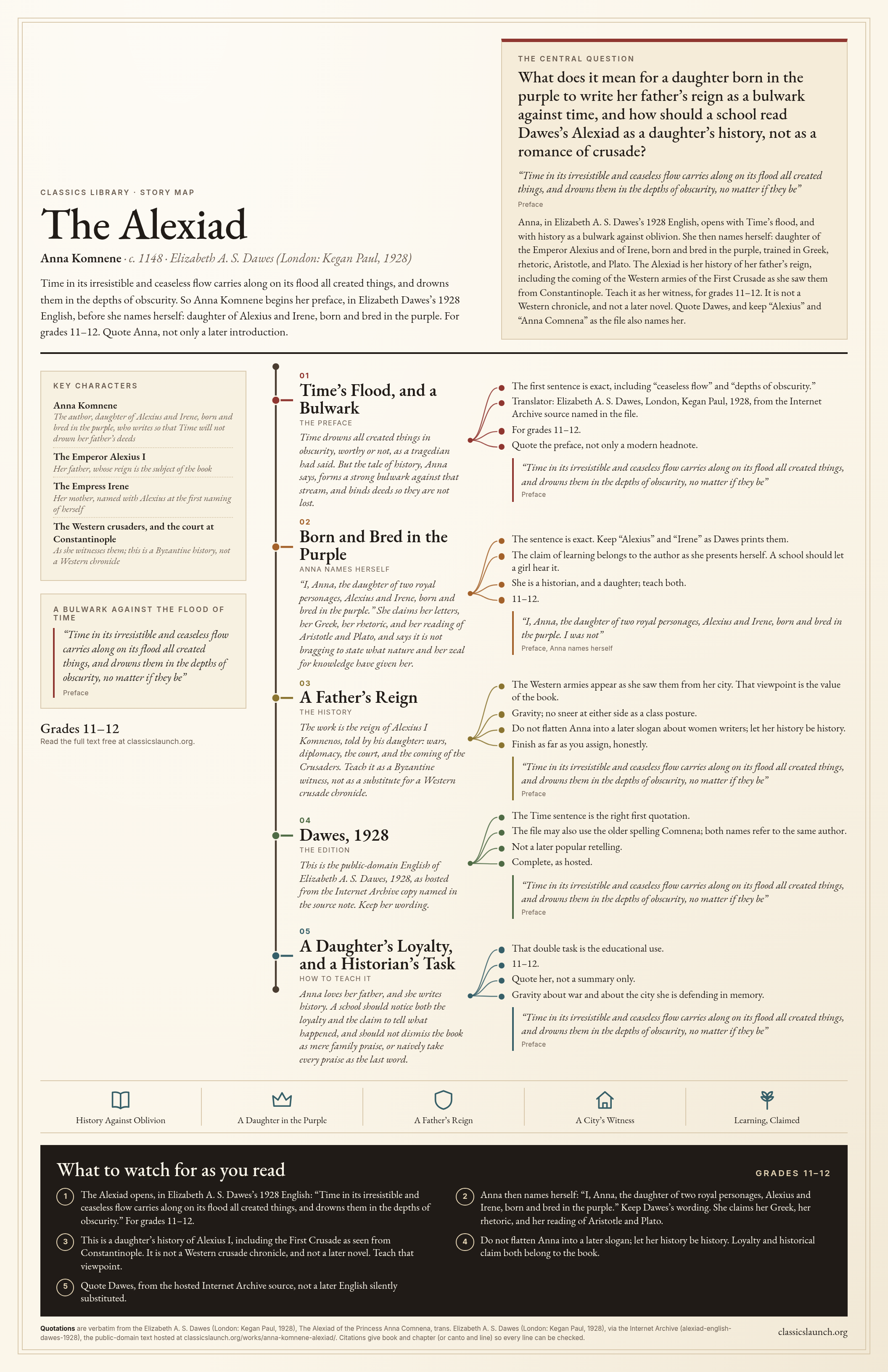
The Alexiad: A Story Map
The PDF is one tabloid page (11 × 17 in). On letter paper, choose “Fit to page.”
Time in its irresistible and ceaseless flow carries along on its flood all created things, and drowns them in the depths of obscurity. So Anna Komnene begins her preface, in Elizabeth Dawes’s 1928 English, before she names herself: daughter of Alexius and Irene, born and bred in the purple. For grades 11–12. Quote Anna, not only a later introduction.
The central question
What does it mean for a daughter born in the purple to write her father’s reign as a bulwark against time, and how should a school read Dawes’s Alexiad as a daughter’s history, not as a romance of crusade?
“Time in its irresistible and ceaseless flow carries along on its flood all created things, and drowns them in the depths of obscurity, no matter if they be”
Anna, in Elizabeth A. S. Dawes’s 1928 English, opens with Time’s flood, and with history as a bulwark against oblivion. She then names herself: daughter of the Emperor Alexius and of Irene, born and bred in the purple, trained in Greek, rhetoric, Aristotle, and Plato. The Alexiad is her history of her father’s reign, including the coming of the Western armies of the First Crusade as she saw them from Constantinople. Teach it as her witness, for grades 11–12. It is not a Western chronicle, and not a later novel. Quote Dawes, and keep “Alexius” and “Anna Comnena” as the file also names her.
- 01
Time’s Flood, and a Bulwark
The preface
Time drowns all created things in obscurity, worthy or not, as a tragedian had said. But the tale of history, Anna says, forms a strong bulwark against that stream, and binds deeds so they are not lost.
- The first sentence is exact, including “ceaseless flow” and “depths of obscurity.”
- Translator: Elizabeth A. S. Dawes, London, Kegan Paul, 1928, from the Internet Archive source named in the file.
- For grades 11–12.
- Quote the preface, not only a modern headnote.
“Time in its irresistible and ceaseless flow carries along on its flood all created things, and drowns them in the depths of obscurity, no matter if they be”
- 02
Born and Bred in the Purple
Anna names herself
“I, Anna, the daughter of two royal personages, Alexius and Irene, born and bred in the purple.” She claims her letters, her Greek, her rhetoric, and her reading of Aristotle and Plato, and says it is not bragging to state what nature and her zeal for knowledge have given her.
- The sentence is exact. Keep “Alexius” and “Irene” as Dawes prints them.
- The claim of learning belongs to the author as she presents herself. A school should let a girl hear it.
- She is a historian, and a daughter; teach both.
- 11–12.
“I, Anna, the daughter of two royal personages, Alexius and Irene, born and bred in the purple. I was not”
- 03
A Father’s Reign
The history
The work is the reign of Alexius I Komnenos, told by his daughter: wars, diplomacy, the court, and the coming of the Crusaders. Teach it as a Byzantine witness, not as a substitute for a Western crusade chronicle.
- The Western armies appear as she saw them from her city. That viewpoint is the value of the book.
- Gravity; no sneer at either side as a class posture.
- Do not flatten Anna into a later slogan about women writers; let her history be history.
- Finish as far as you assign, honestly.
“Time in its irresistible and ceaseless flow carries along on its flood all created things, and drowns them in the depths of obscurity, no matter if they be”
- 04
Dawes, 1928
The edition
This is the public-domain English of Elizabeth A. S. Dawes, 1928, as hosted from the Internet Archive copy named in the source note. Keep her wording.
- The Time sentence is the right first quotation.
- The file may also use the older spelling Comnena; both names refer to the same author.
- Not a later popular retelling.
- Complete, as hosted.
“Time in its irresistible and ceaseless flow carries along on its flood all created things, and drowns them in the depths of obscurity, no matter if they be”
- 05
A Daughter’s Loyalty, and a Historian’s Task
How to teach it
Anna loves her father, and she writes history. A school should notice both the loyalty and the claim to tell what happened, and should not dismiss the book as mere family praise, or naively take every praise as the last word.
- That double task is the educational use.
- 11–12.
- Quote her, not a summary only.
- Gravity about war and about the city she is defending in memory.
“Time in its irresistible and ceaseless flow carries along on its flood all created things, and drowns them in the depths of obscurity, no matter if they be”
- History Against Oblivion
- A Daughter in the Purple
- A Father’s Reign
- A City’s Witness
- Learning, Claimed
What to watch for as you read
Grades 11–12- The Alexiad opens, in Elizabeth A. S. Dawes’s 1928 English: “Time in its irresistible and ceaseless flow carries along on its flood all created things, and drowns them in the depths of obscurity.” For grades 11–12.
- Anna then names herself: “I, Anna, the daughter of two royal personages, Alexius and Irene, born and bred in the purple.” Keep Dawes’s wording. She claims her Greek, her rhetoric, and her reading of Aristotle and Plato.
- This is a daughter’s history of Alexius I, including the First Crusade as seen from Constantinople. It is not a Western crusade chronicle, and not a later novel. Teach that viewpoint.
- Do not flatten Anna into a later slogan; let her history be history. Loyalty and historical claim both belong to the book.
- Quote Dawes, from the hosted Internet Archive source, not a later English silently substituted.
Every quotation is word for word from the Elizabeth A. S. Dawes (London: Kegan Paul, 1928) hosted in this library and is checked against that text each time the site is built. Citations give book and chapter (or canto and line).