Story maps · Grades 11–12
Apologia Pro Vita Sua: A Story Map
The PDF is one tabloid page (11 × 17 in). On letter paper, choose “Fit to page.”
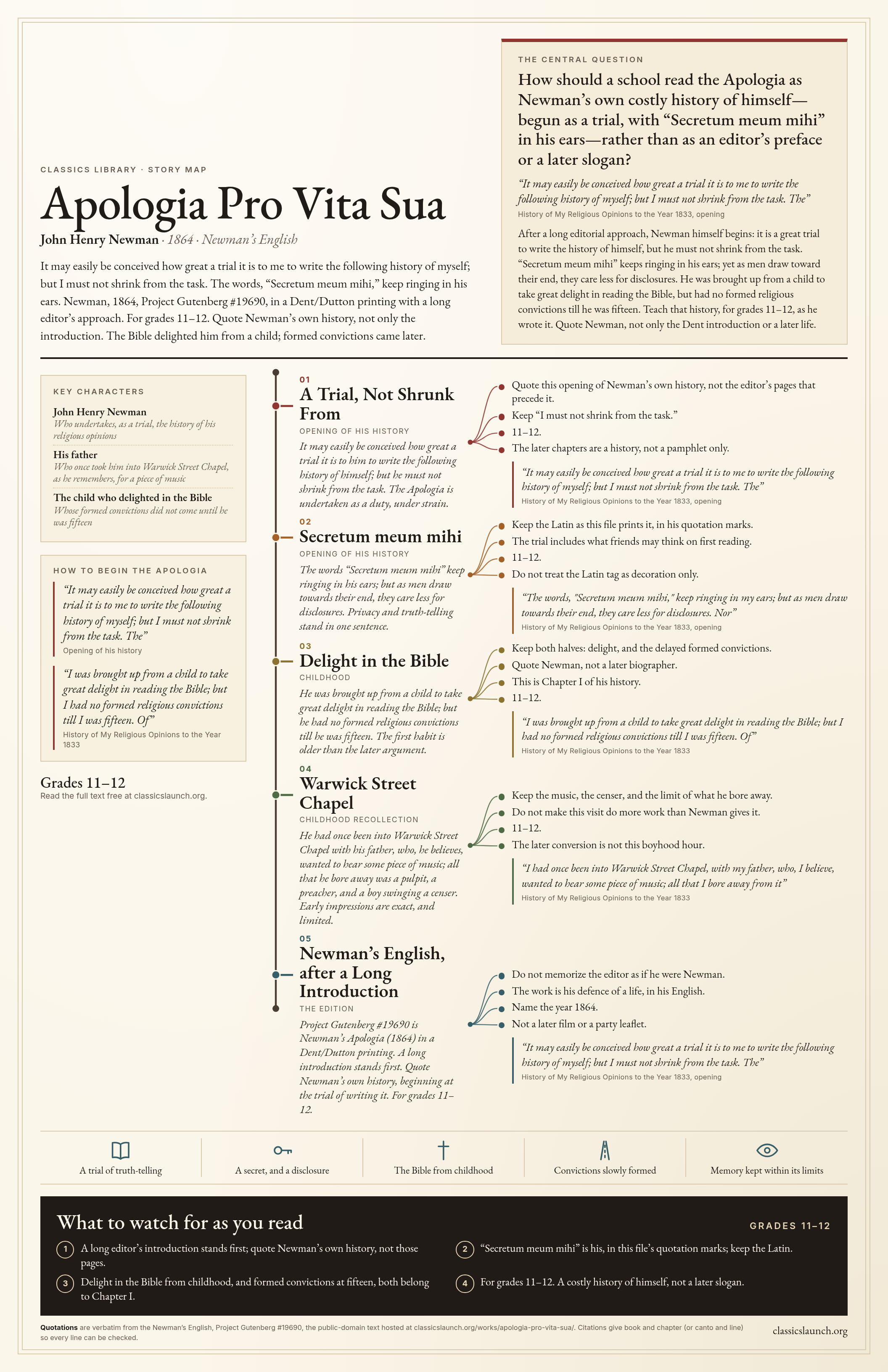
It may easily be conceived how great a trial it is to me to write the following history of myself; but I must not shrink from the task. The words, “Secretum meum mihi,” keep ringing in his ears. Newman, 1864, Project Gutenberg #19690, in a Dent/Dutton printing with a long editor’s approach. For grades 11–12. Quote Newman’s own history, not only the introduction. The Bible delighted him from a child; formed convictions came later.
The central question
How should a school read the Apologia as Newman’s own costly history of himself—begun as a trial, with “Secretum meum mihi” in his ears—rather than as an editor’s preface or a later slogan?
“It may easily be conceived how great a trial it is to me to write the following history of myself; but I must not shrink from the task. The”
After a long editorial approach, Newman himself begins: it is a great trial to write the history of himself, but he must not shrink from the task. “Secretum meum mihi” keeps ringing in his ears; yet as men draw toward their end, they care less for disclosures. He was brought up from a child to take great delight in reading the Bible, but had no formed religious convictions till he was fifteen. Teach that history, for grades 11–12, as he wrote it. Quote Newman, not only the Dent introduction or a later life.
- 01
A Trial, Not Shrunk From
Opening of his history
It may easily be conceived how great a trial it is to him to write the following history of himself; but he must not shrink from the task. The Apologia is undertaken as a duty, under strain.
- Quote this opening of Newman’s own history, not the editor’s pages that precede it.
- Keep “I must not shrink from the task.”
- 11–12.
- The later chapters are a history, not a pamphlet only.
“It may easily be conceived how great a trial it is to me to write the following history of myself; but I must not shrink from the task. The”
- 02
Secretum meum mihi
Opening of his history
The words “Secretum meum mihi” keep ringing in his ears; but as men draw towards their end, they care less for disclosures. Privacy and truth-telling stand in one sentence.
- Keep the Latin as this file prints it, in his quotation marks.
- The trial includes what friends may think on first reading.
- 11–12.
- Do not treat the Latin tag as decoration only.
“The words, "Secretum meum mihi," keep ringing in my ears; but as men draw towards their end, they care less for disclosures. Nor”
- 03
Delight in the Bible
Childhood
He was brought up from a child to take great delight in reading the Bible; but he had no formed religious convictions till he was fifteen. The first habit is older than the later argument.
- Keep both halves: delight, and the delayed formed convictions.
- Quote Newman, not a later biographer.
- This is Chapter I of his history.
- 11–12.
“I was brought up from a child to take great delight in reading the Bible; but I had no formed religious convictions till I was fifteen. Of”
- 04
Warwick Street Chapel
Childhood recollection
He had once been into Warwick Street Chapel with his father, who, he believes, wanted to hear some piece of music; all that he bore away was a pulpit, a preacher, and a boy swinging a censer. Early impressions are exact, and limited.
- Keep the music, the censer, and the limit of what he bore away.
- Do not make this visit do more work than Newman gives it.
- 11–12.
- The later conversion is not this boyhood hour.
“I had once been into Warwick Street Chapel, with my father, who, I believe, wanted to hear some piece of music; all that I bore away from it”
- 05
Newman’s English, after a Long Introduction
The edition
Project Gutenberg #19690 is Newman’s Apologia (1864) in a Dent/Dutton printing. A long introduction stands first. Quote Newman’s own history, beginning at the trial of writing it. For grades 11–12.
- Do not memorize the editor as if he were Newman.
- The work is his defence of a life, in his English.
- Name the year 1864.
- Not a later film or a party leaflet.
“It may easily be conceived how great a trial it is to me to write the following history of myself; but I must not shrink from the task. The”
- A trial of truth-telling
- A secret, and a disclosure
- The Bible from childhood
- Convictions slowly formed
- Memory kept within its limits
What to watch for as you read
Grades 11–12- A long editor’s introduction stands first; quote Newman’s own history, not those pages.
- “Secretum meum mihi” is his, in this file’s quotation marks; keep the Latin.
- Delight in the Bible from childhood, and formed convictions at fifteen, both belong to Chapter I.
- For grades 11–12. A costly history of himself, not a later slogan.
Every quotation is word for word from the Newman’s English hosted in this library and is checked against that text each time the site is built. Citations give book and chapter (or canto and line).