Story maps · Grades 9–12
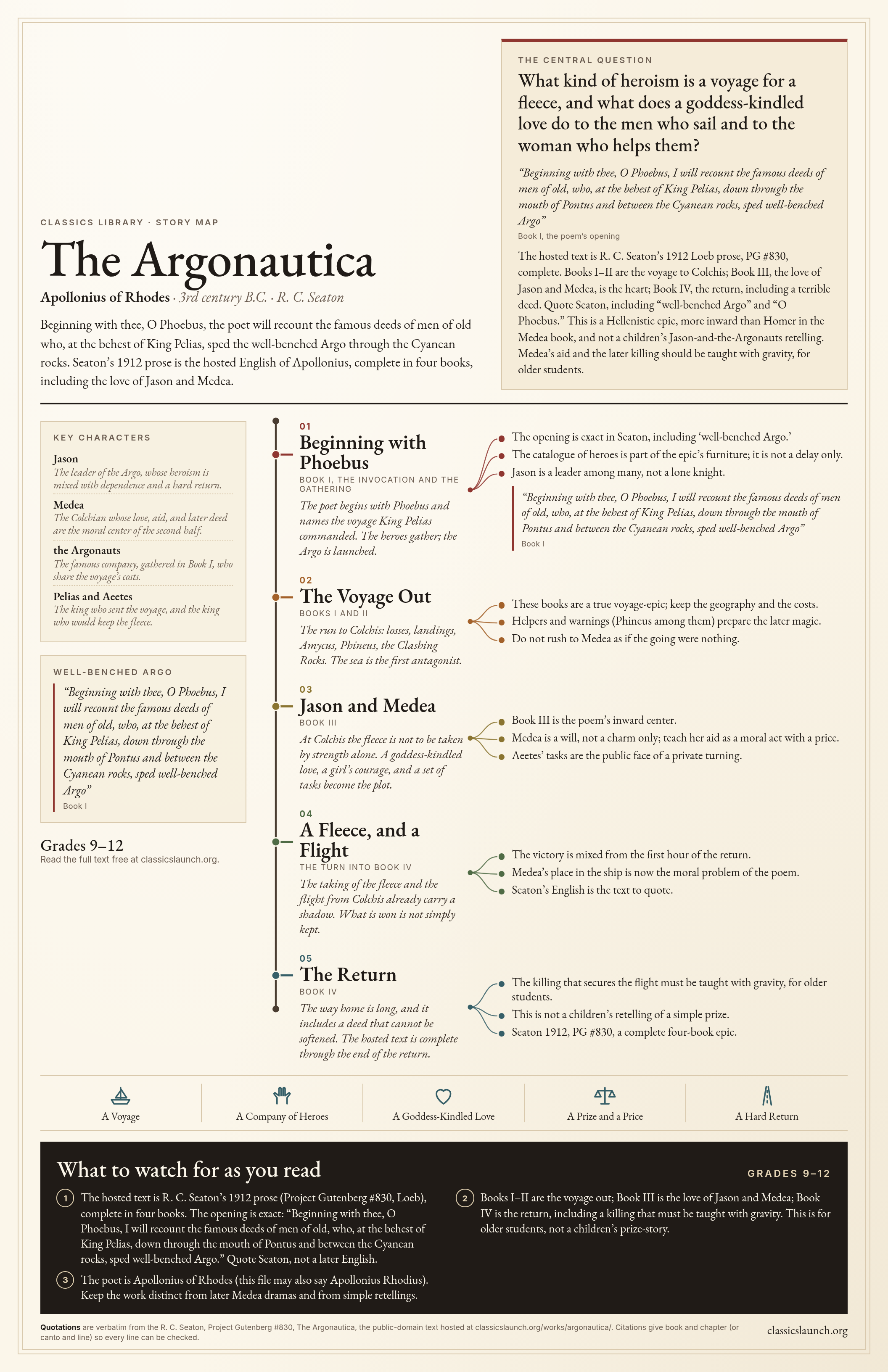
The Argonautica: A Story Map
The PDF is one tabloid page (11 × 17 in). On letter paper, choose “Fit to page.”
Beginning with thee, O Phoebus, the poet will recount the famous deeds of men of old who, at the behest of King Pelias, sped the well-benched Argo through the Cyanean rocks. Seaton’s 1912 prose is the hosted English of Apollonius, complete in four books, including the love of Jason and Medea.
The central question
What kind of heroism is a voyage for a fleece, and what does a goddess-kindled love do to the men who sail and to the woman who helps them?
“Beginning with thee, O Phoebus, I will recount the famous deeds of men of old, who, at the behest of King Pelias, down through the mouth of Pontus and between the Cyanean rocks, sped well-benched Argo”
The hosted text is R. C. Seaton’s 1912 Loeb prose, PG #830, complete. Books I–II are the voyage to Colchis; Book III, the love of Jason and Medea, is the heart; Book IV, the return, including a terrible deed. Quote Seaton, including “well-benched Argo” and “O Phoebus.” This is a Hellenistic epic, more inward than Homer in the Medea book, and not a children’s Jason-and-the-Argonauts retelling. Medea’s aid and the later killing should be taught with gravity, for older students.
- 01
Beginning with Phoebus
Book I, the invocation and the gathering
The poet begins with Phoebus and names the voyage King Pelias commanded. The heroes gather; the Argo is launched.
- The opening is exact in Seaton, including ‘well-benched Argo.’
- The catalogue of heroes is part of the epic’s furniture; it is not a delay only.
- Jason is a leader among many, not a lone knight.
“Beginning with thee, O Phoebus, I will recount the famous deeds of men of old, who, at the behest of King Pelias, down through the mouth of Pontus and between the Cyanean rocks, sped well-benched Argo”
- 02
The Voyage Out
Books I and II
The run to Colchis: losses, landings, Amycus, Phineus, the Clashing Rocks. The sea is the first antagonist.
- These books are a true voyage-epic; keep the geography and the costs.
- Helpers and warnings (Phineus among them) prepare the later magic.
- Do not rush to Medea as if the going were nothing.
- 03
Jason and Medea
Book III
At Colchis the fleece is not to be taken by strength alone. A goddess-kindled love, a girl’s courage, and a set of tasks become the plot.
- Book III is the poem’s inward center.
- Medea is a will, not a charm only; teach her aid as a moral act with a price.
- Aeetes’ tasks are the public face of a private turning.
- 04
A Fleece, and a Flight
The turn into Book IV
The taking of the fleece and the flight from Colchis already carry a shadow. What is won is not simply kept.
- The victory is mixed from the first hour of the return.
- Medea’s place in the ship is now the moral problem of the poem.
- Seaton’s English is the text to quote.
- 05
The Return
Book IV
The way home is long, and it includes a deed that cannot be softened. The hosted text is complete through the end of the return.
- The killing that secures the flight must be taught with gravity, for older students.
- This is not a children’s retelling of a simple prize.
- Seaton 1912, PG #830, a complete four-book epic.
- A Voyage
- A Company of Heroes
- A Goddess-Kindled Love
- A Prize and a Price
- A Hard Return
What to watch for as you read
Grades 9–12- The hosted text is R. C. Seaton’s 1912 prose (Project Gutenberg #830, Loeb), complete in four books. The opening is exact: “Beginning with thee, O Phoebus, I will recount the famous deeds of men of old, who, at the behest of King Pelias, down through the mouth of Pontus and between the Cyanean rocks, sped well-benched Argo.” Quote Seaton, not a later English.
- Books I–II are the voyage out; Book III is the love of Jason and Medea; Book IV is the return, including a killing that must be taught with gravity. This is for older students, not a children’s prize-story.
- The poet is Apollonius of Rhodes (this file may also say Apollonius Rhodius). Keep the work distinct from later Medea dramas and from simple retellings.
Every quotation is word for word from the R. C. Seaton hosted in this library and is checked against that text each time the site is built. Citations give book and chapter (or canto and line).