Story maps · Grades 6–8
Around the World in Eighty Days: A Story Map
The PDF is one tabloid page (11 × 17 in). On letter paper, choose “Fit to page.”
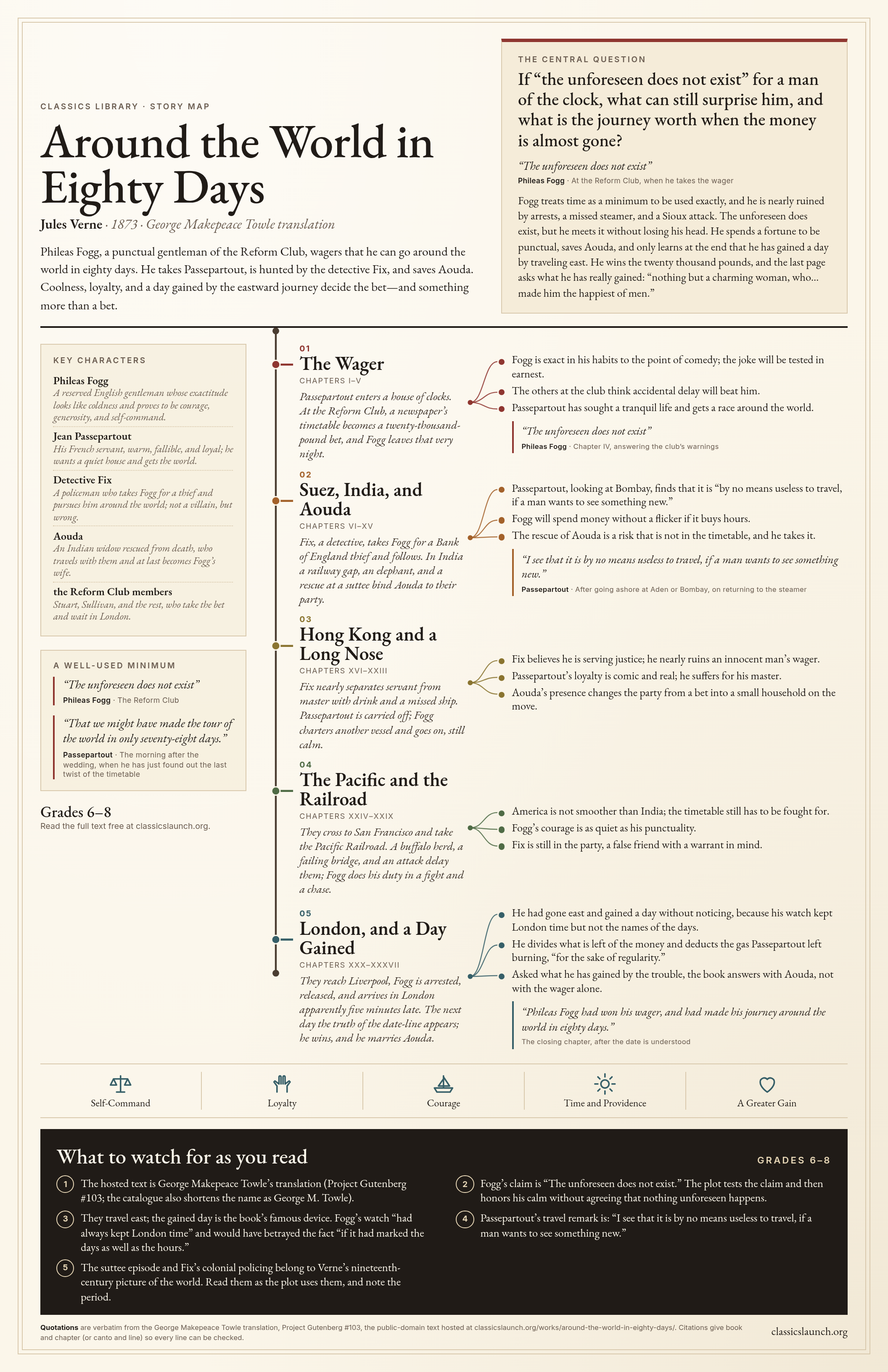
Phileas Fogg, a punctual gentleman of the Reform Club, wagers that he can go around the world in eighty days. He takes Passepartout, is hunted by the detective Fix, and saves Aouda. Coolness, loyalty, and a day gained by the eastward journey decide the bet—and something more than a bet.
The central question
If “the unforeseen does not exist” for a man of the clock, what can still surprise him, and what is the journey worth when the money is almost gone?
“The unforeseen does not exist”
Fogg treats time as a minimum to be used exactly, and he is nearly ruined by arrests, a missed steamer, and a Sioux attack. The unforeseen does exist, but he meets it without losing his head. He spends a fortune to be punctual, saves Aouda, and only learns at the end that he has gained a day by traveling east. He wins the twenty thousand pounds, and the last page asks what he has really gained: “nothing but a charming woman, who… made him the happiest of men.”
- 01
The Wager
Chapters I–V
Passepartout enters a house of clocks. At the Reform Club, a newspaper’s timetable becomes a twenty-thousand-pound bet, and Fogg leaves that very night.
- Fogg is exact in his habits to the point of comedy; the joke will be tested in earnest.
- The others at the club think accidental delay will beat him.
- Passepartout has sought a tranquil life and gets a race around the world.
“The unforeseen does not exist”
- 02
Suez, India, and Aouda
Chapters VI–XV
Fix, a detective, takes Fogg for a Bank of England thief and follows. In India a railway gap, an elephant, and a rescue at a suttee bind Aouda to their party.
- Passepartout, looking at Bombay, finds that it is “by no means useless to travel, if a man wants to see something new.”
- Fogg will spend money without a flicker if it buys hours.
- The rescue of Aouda is a risk that is not in the timetable, and he takes it.
“I see that it is by no means useless to travel, if a man wants to see something new.”
- 03
Hong Kong and a Long Nose
Chapters XVI–XXIII
Fix nearly separates servant from master with drink and a missed ship. Passepartout is carried off; Fogg charters another vessel and goes on, still calm.
- Fix believes he is serving justice; he nearly ruins an innocent man’s wager.
- Passepartout’s loyalty is comic and real; he suffers for his master.
- Aouda’s presence changes the party from a bet into a small household on the move.
- 04
The Pacific and the Railroad
Chapters XXIV–XXIX
They cross to San Francisco and take the Pacific Railroad. A buffalo herd, a failing bridge, and an attack delay them; Fogg does his duty in a fight and a chase.
- America is not smoother than India; the timetable still has to be fought for.
- Fogg’s courage is as quiet as his punctuality.
- Fix is still in the party, a false friend with a warrant in mind.
- 05
London, and a Day Gained
Chapters XXX–XXXVII
They reach Liverpool, Fogg is arrested, released, and arrives in London apparently five minutes late. The next day the truth of the date-line appears; he wins, and he marries Aouda.
- He had gone east and gained a day without noticing, because his watch kept London time but not the names of the days.
- He divides what is left of the money and deducts the gas Passepartout left burning, “for the sake of regularity.”
- Asked what he has gained by the trouble, the book answers with Aouda, not with the wager alone.
“Phileas Fogg had won his wager, and had made his journey around the world in eighty days.”
- Self-Command
- Loyalty
- Courage
- Time and Providence
- A Greater Gain
What to watch for as you read
Grades 6–8- The hosted text is George Makepeace Towle’s translation (Project Gutenberg #103; the catalogue also shortens the name as George M. Towle).
- Fogg’s claim is “The unforeseen does not exist.” The plot tests the claim and then honors his calm without agreeing that nothing unforeseen happens.
- They travel east; the gained day is the book’s famous device. Fogg’s watch “had always kept London time” and would have betrayed the fact “if it had marked the days as well as the hours.”
- Passepartout’s travel remark is: “I see that it is by no means useless to travel, if a man wants to see something new.”
- The suttee episode and Fix’s colonial policing belong to Verne’s nineteenth-century picture of the world. Read them as the plot uses them, and note the period.
Every quotation is word for word from the George Makepeace Towle translation hosted in this library and is checked against that text each time the site is built. Citations give book and chapter (or canto and line).