Story maps · Grades 9–12
As You Like It: A Story Map
The PDF is one tabloid page (11 × 17 in). On letter paper, choose “Fit to page.”
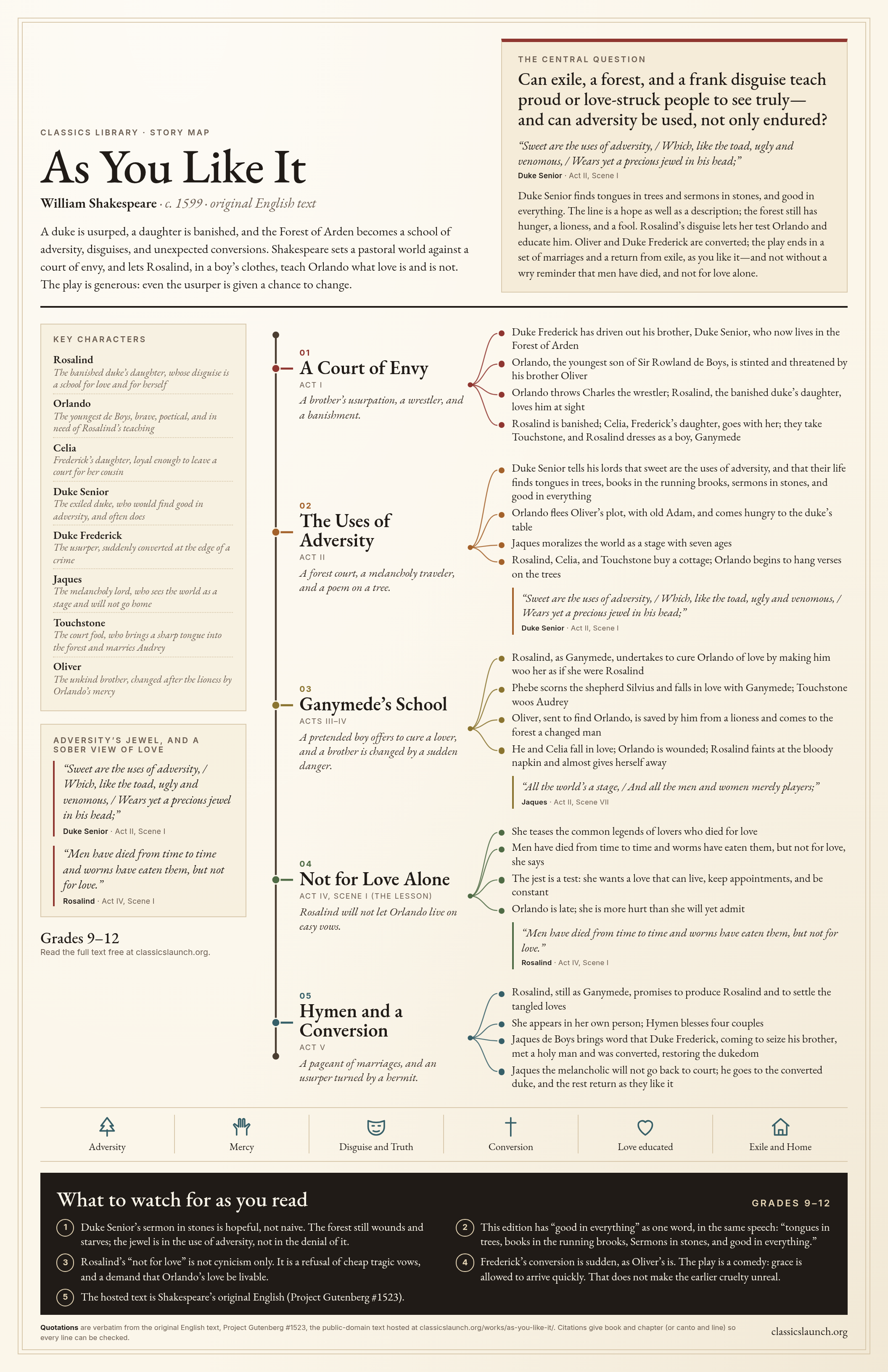
A duke is usurped, a daughter is banished, and the Forest of Arden becomes a school of adversity, disguises, and unexpected conversions. Shakespeare sets a pastoral world against a court of envy, and lets Rosalind, in a boy’s clothes, teach Orlando what love is and is not. The play is generous: even the usurper is given a chance to change.
The central question
Can exile, a forest, and a frank disguise teach proud or love-struck people to see truly—and can adversity be used, not only endured?
“Sweet are the uses of adversity, / Which, like the toad, ugly and venomous, / Wears yet a precious jewel in his head;”
Duke Senior finds tongues in trees and sermons in stones, and good in everything. The line is a hope as well as a description; the forest still has hunger, a lioness, and a fool. Rosalind’s disguise lets her test Orlando and educate him. Oliver and Duke Frederick are converted; the play ends in a set of marriages and a return from exile, as you like it—and not without a wry reminder that men have died, and not for love alone.
- 01
A Court of Envy
Act I
A brother’s usurpation, a wrestler, and a banishment.
- Duke Frederick has driven out his brother, Duke Senior, who now lives in the Forest of Arden
- Orlando, the youngest son of Sir Rowland de Boys, is stinted and threatened by his brother Oliver
- Orlando throws Charles the wrestler; Rosalind, the banished duke’s daughter, loves him at sight
- Rosalind is banished; Celia, Frederick’s daughter, goes with her; they take Touchstone, and Rosalind dresses as a boy, Ganymede
- 02
The Uses of Adversity
Act II
A forest court, a melancholy traveler, and a poem on a tree.
- Duke Senior tells his lords that sweet are the uses of adversity, and that their life finds tongues in trees, books in the running brooks, sermons in stones, and good in everything
- Orlando flees Oliver’s plot, with old Adam, and comes hungry to the duke’s table
- Jaques moralizes the world as a stage with seven ages
- Rosalind, Celia, and Touchstone buy a cottage; Orlando begins to hang verses on the trees
“Sweet are the uses of adversity, / Which, like the toad, ugly and venomous, / Wears yet a precious jewel in his head;”
- 03
Ganymede’s School
Acts III–IV
A pretended boy offers to cure a lover, and a brother is changed by a sudden danger.
- Rosalind, as Ganymede, undertakes to cure Orlando of love by making him woo her as if she were Rosalind
- Phebe scorns the shepherd Silvius and falls in love with Ganymede; Touchstone woos Audrey
- Oliver, sent to find Orlando, is saved by him from a lioness and comes to the forest a changed man
- He and Celia fall in love; Orlando is wounded; Rosalind faints at the bloody napkin and almost gives herself away
“All the world’s a stage, / And all the men and women merely players;”
- 04
Not for Love Alone
Act IV, Scene I (the lesson)
Rosalind will not let Orlando live on easy vows.
- She teases the common legends of lovers who died for love
- Men have died from time to time and worms have eaten them, but not for love, she says
- The jest is a test: she wants a love that can live, keep appointments, and be constant
- Orlando is late; she is more hurt than she will yet admit
“Men have died from time to time and worms have eaten them, but not for love.”
- 05
Hymen and a Conversion
Act V
A pageant of marriages, and an usurper turned by a hermit.
- Rosalind, still as Ganymede, promises to produce Rosalind and to settle the tangled loves
- She appears in her own person; Hymen blesses four couples
- Jaques de Boys brings word that Duke Frederick, coming to seize his brother, met a holy man and was converted, restoring the dukedom
- Jaques the melancholic will not go back to court; he goes to the converted duke, and the rest return as they like it
- Adversity
- Mercy
- Disguise and Truth
- Conversion
- Love educated
- Exile and Home
What to watch for as you read
Grades 9–12- Duke Senior’s sermon in stones is hopeful, not naive. The forest still wounds and starves; the jewel is in the use of adversity, not in the denial of it.
- This edition has “good in everything” as one word, in the same speech: “tongues in trees, books in the running brooks, Sermons in stones, and good in everything.”
- Rosalind’s “not for love” is not cynicism only. It is a refusal of cheap tragic vows, and a demand that Orlando’s love be livable.
- Frederick’s conversion is sudden, as Oliver’s is. The play is a comedy: grace is allowed to arrive quickly. That does not make the earlier cruelty unreal.
- The hosted text is Shakespeare’s original English (Project Gutenberg #1523).
Every quotation is word for word from the original English text hosted in this library and is checked against that text each time the site is built. Citations give book and chapter (or canto and line).