Work record
As You Like It
c. 1599 (First Folio 1623) · Renaissance Early Modern · Drama · English (Early Modern)
Abstract
Background. Shakespeare adapted Thomas Lodge's euphuistic romance Rosalynde (1590) during the busy year that also produced Henry V and Julius Caesar, inventing Jaques, Touchstone and Audrey for the stage.
Plot. After defeating the wrestler Charles, Orlando must escape his brother's murderous jealousy, while Rosalind, exiled by her uncle, takes refuge in Arden dressed as a boy alongside Celia and the fool. Among the trees she discovers Orlando's love poems and, still disguised, persuades him to rehearse his courtship on her each day. Oliver, pursuing his brother, is spared death by him, repents and falls for Celia; Hymen's masque then unites four couples, and word comes that the usurper has renounced his crown for a religious life.
Structure. Court scenes frame a long forest middle in which encounters, songs and debates take the place of intrigue. Contrasting couples comment on one another, and the heroine closes the evening by addressing the audience directly.
Themes. Exile as education, the testing of romantic speech against plain truth, loyal service across ranks, the follies of melancholy and of pastoral fashion, and repentance leading to restored order.
Significance. Rosalind, written for a boy actor and one of the longest female parts in Shakespeare, remains a summit of comic writing for performers, and the seven ages speech has entered common English.
Main characters
- Rosalind: Banished duke's daughter who, as the youth Ganymede, schools her lover
- Orlando: Defrauded younger brother, wrestler and writer of verses on trees
- Celia: Usurper's daughter who follows her cousin into exile as Aliena
- Oliver: Envious elder brother rescued from a lioness and reformed
- Duke Senior: Exiled ruler holding a cheerful court under the greenwood
- Duke Frederick: Usurper turned from his purpose by a hermit
- Jaques: Melancholy traveller and moralist of the seven ages
- Touchstone: Court fool who tests pastoral ideals and marries Audrey
- Adam: Aged servant who spends his savings on his young master
- Silvius and Phoebe: Doting shepherd and disdainful shepherdess

Summary
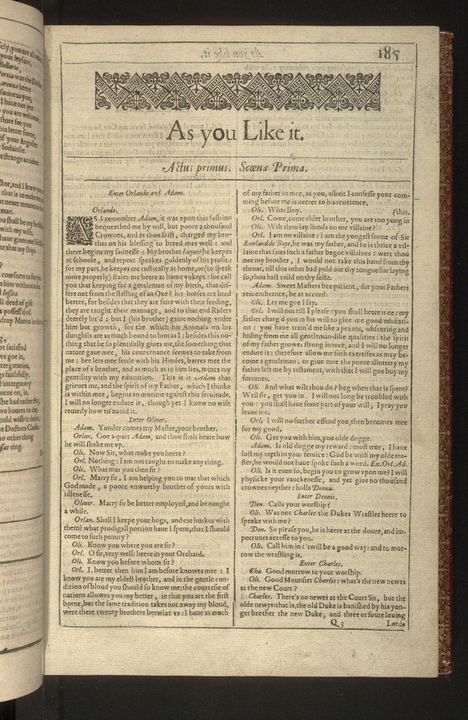
As You Like It begins with two households divided by envy. Orlando, youngest son of the late Sir Rowland de Boys, complains to the old servant Adam that his elder brother Oliver keeps him like a peasant and denies him the education his father willed him. Oliver, who hates Orlando without knowing why, encourages the court wrestler Charles to break his neck. At the court of Duke Frederick, who has usurped the dukedom and banished his elder brother, Duke Senior, to the Forest of Arden, Orlando throws Charles in front of the court. Rosalind, Duke Senior's daughter, kept at court only for the love of her cousin Celia, falls in love with him at first sight and gives him a chain. Frederick soon banishes Rosalind as well. Celia refuses to be parted from her: Rosalind disguises herself as a youth named Ganymede, Celia becomes his sister Aliena, and with the clown Touchstone they flee to Arden. Warned by Adam that Oliver means to burn his lodging, Orlando also flees, and the old man gives him his life's savings and goes with him. In the forest Duke Senior praises the sweet uses of adversity, while the melancholy lord Jaques weeps over a wounded deer and moralizes on the seven ages of man. Orlando, near starving, draws his sword on the Duke's feast and is welcomed with courtesy; he carries the fainting Adam in to eat. Orlando hangs love poems to Rosalind on the trees. Meeting him, Ganymede offers to cure his love if he will come every day and woo Ganymede as if he were Rosalind, and the mock courtship becomes the heart of the play: Rosalind teases, tests and instructs Orlando in what love and marriage really ask. Around them other lovers mirror and parody the central pair: the shepherd Silvius pines for the scornful shepherdess Phoebe, who falls in love with Ganymede; Touchstone courts the goatherd Audrey and nearly marries her before the hedge-priest Sir Oliver Martext. Oliver, sent by Frederick to hunt his brother down, arrives in the forest, where Orlando, finding him asleep with a snake about his neck and a lioness waiting, saves his life and is wounded. Oliver repents, tells the story to Ganymede, who faints at the bloody napkin, and falls in love with Celia. Rosalind promises to set everything right, and in the last scene the god Hymen brings her in as herself: four couples are married, Rosalind and Orlando, Celia and Oliver, Phoebe and Silvius, Touchstone and Audrey. News arrives that Duke Frederick, marching on the forest, met an old religious man and was converted, restoring the dukedom to his brother. Jaques leaves the dance to join the convert, and Rosalind speaks the Epilogue. The play was probably written in 1599, was entered in the Stationers' Register in August 1600 to be stayed from printing, and was first published in the First Folio of 1623.
Virtues in this work
- Friendship: Celia leaves her father's court and her inheritance rather than be parted from the banished Rosalind.
- Charity: Adam gives Orlando his life's savings, and Orlando risks his life to save Oliver from the lioness.
- Fortitude: Duke Senior and his lords endure winter exile in Arden without bitterness.
- Prudence: Rosalind tests Orlando's love under her disguise before she reveals herself and marries him.
- Humility: Orlando, met with courtesy after drawing his sword at the Duke's feast, puts it away and asks pardon.
Plot or Argument
- Act I: Envy at home and at court
Orlando quarrels with Oliver and wrestles Charles before the court; Rosalind and Orlando fall in love; Duke Frederick banishes Rosalind, and she, Celia and Touchstone flee in disguise.
- Act II: Into Arden
Duke Senior praises the forest life; Adam warns Orlando and flees with him; Rosalind, Celia and Touchstone meet the shepherds; Orlando begs food at the Duke's table and Jaques speaks of the seven ages of man.
- Act III: Verses on the trees
Frederick seizes Oliver's lands and sends him after Orlando; Rosalind finds Orlando's poems and, as Ganymede, offers to cure his love; Touchstone courts Audrey; Phoebe scorns Silvius and falls for Ganymede.
- Act IV: The mock wooing and the lioness
Rosalind spars with Jaques and stages a mock wedding with Orlando; Oliver arrives with the story of his rescue from the snake and lioness and the bloody napkin, and Rosalind faints.
- Act V and Epilogue: Four weddings
Oliver and Celia fall in love; Rosalind promises to satisfy every lover; Hymen presents her as herself and four couples marry; Frederick's conversion restores the dukedom; Jaques departs and Rosalind speaks the Epilogue.
Characters
- Rosalind, heroine; disguised as Ganymede
Duke Senior's witty daughter, who in disguise tutors Orlando in love and arranges the play's resolution.
- Orlando, hero
Youngest son of Sir Rowland de Boys, wronged by his brother, brave, generous and an indifferent poet.
- Celia, Rosalind's cousin; disguised as Aliena
Duke Frederick's daughter, who leaves her father's court out of loyalty to Rosalind.
- Oliver, Orlando's elder brother
Plots against Orlando, is saved by him from a lioness, repents and marries Celia.
- Duke Senior, banished duke
Lives contentedly in exile in Arden with his loyal lords.
- Duke Frederick, usurping duke
Seizes his brother's dukedom, banishes Rosalind, and is converted at the end.
- Jaques, melancholy lord
A traveller and satirist in Duke Senior's company who speaks the seven ages of man.
- Touchstone, court clown
Follows the princesses into the forest, mocks pastoral and courtly manners, and weds Audrey.
- Adam, old servant
Faithful servant of the de Boys family who gives Orlando his savings and follows him into exile.
- Silvius and Phoebe, shepherd and shepherdess
A lovesick swain and the proud girl who scorns him until Rosalind brings them together.
- Audrey, goatherd
A plain country girl whom Touchstone marries.
- Corin, old shepherd
An honest laborer who defends the shepherd's life against Touchstone's wit.
Lessons
Adversity as a teacher
Duke Senior opens Act 2 by thanking the winter wind for telling him the truth that courtiers never did. Exile strips away flattery and leaves the exiles with friendship, music and plain food. Shakespeare does not pretend the forest is comfortable; Adam nearly starves there. But he shows how a good man can find good in everything without denying that the cold bites.
- What does Duke Senior say the winter wind teaches him?
- Is the Duke's contentment wisdom or wishful thinking? How does Touchstone's view of the forest test it?
- Which characters are changed for the better by their time in Arden?
Love that can bear the truth
Disguised as Ganymede, Rosalind lets Orlando court her while she mocks the poses of lovers: that men die for love, that wives stay as sweet as on the wedding day. Her teasing does not kill his love but tests whether it is real. The play suggests that love worth marrying on can survive honest speech about time, temper and human weakness.
- Why does Rosalind keep her disguise after she knows Orlando loves her?
- What does she teach him when she says men have died and worms have eaten them, but not for love?
- How does Silvius's love for Phoebe differ from Orlando's for Rosalind?
Old service and new fashions
Adam offers Orlando his savings and his strength, and Orlando praises him as a servant of the antique world who worked for duty, not reward. Orlando repays him by carrying him to the Duke's table. Loyalty across age and rank is one of the steadiest goods in the play.
- What does Adam give up to follow Orlando?
- Why does Orlando say Adam is not for the fashion of these times?
- How does the Duke's welcome of Orlando and Adam answer Orlando's drawn sword?
Conversion and restoration
Two villains are changed in the forest: Oliver, after his brother risks his life for him, and Duke Frederick, after he meets an old religious man. The comedy ends not only with marriages but with repentance and the return of what was stolen. Jaques chooses to go and learn from the convert rather than join the dance.
- What changes Oliver, and how does he describe the change?
- Is Frederick's sudden conversion believable, or does it belong to the world of romance?
- Why does Jaques leave the celebration?
Context
As You Like It belongs to the late-Elizabethan vogue for pastoral, the literary convention in which courtiers and shepherds meet in an idealized countryside. Shakespeare plays the convention both straight and for laughs: his Arden has real cold, hunger and wild beasts as well as love poems on the trees. The forest's name recalls both the Ardennes of the source and the Forest of Arden in Warwickshire near Stratford, the home country of Shakespeare's mother, Mary Arden. On the Elizabethan stage boys played the women's parts, so Rosalind was a boy playing a girl playing a boy who pretends to be a girl.
Composition
The main source is Thomas Lodge's prose romance Rosalynde, or Euphues' Golden Legacy (1590); Shakespeare added Jaques, Touchstone, Audrey and William. Phoebe quotes a line from Christopher Marlowe's Hero and Leander (published 1598) and calls its author the dead shepherd. The play is usually dated 1599; it is not in Francis Meres's list of 1598, and it was entered in the Stationers' Register on 4 August 1600 as a book to be stayed. It was first printed in the First Folio of 1623.
Reception
Rosalind has long been considered one of Shakespeare's greatest comic roles, and Jaques's seven ages speech is among the most quoted passages in English. Its songs, among them Under the Greenwood Tree, Blow, Blow, Thou Winter Wind and It Was a Lover and His Lass, have been set by many composers.
Comparisons
- twelfth-night
Both comedies have a heroine in boy's disguise who wins the man she loves and draws the love of another woman by mistake; Viola suffers her disguise, while Rosalind uses hers to direct the action.
- much-ado-about-nothing
Written in the same years, both plays turn on witty lovers; Beatrice and Benedick fence with each other, while Rosalind fences with Orlando from behind a mask.
- a-midsummer-nights-dream
Lovers flee court into a forest where confusion leads to marriages; the Athenian wood is ruled by fairies, Arden by human wit and chance.
- king-lear
Both plays send a wronged ruler and his loyal followers out into the weather; Duke Senior finds counsel in the winter wind, Lear finds madness in the storm.
- the-anatomy-of-melancholy
Robert Burton's treatise (1621) catalogues the kinds of melancholy that Jaques lists in Act 4, Scene 1, from the scholar's to the lover's.
- the-faerie-queene
Spenser's Book I, published nine years earlier, also sends its characters through a forest where they meet false friends and true hermits; Spenser allegorizes the pastoral, Shakespeare laughs with it.
Quotes
Frequently cited
“Sweet are the uses of adversity, Which, like the toad, ugly and venomous, Wears yet a precious jewel in his head”
Frequently cited
“Finds tongues in trees, books in the running brooks, Sermons in stones, and good in everything.”
Frequently cited
“All the world’s a stage, And all the men and women merely players; They have their exits and their entrances, And one man in his time plays many parts”
Frequently cited
“Last scene of all, That ends this strange eventful history, Is second childishness and mere oblivion, Sans teeth, sans eyes, sans taste, sans everything.”
Frequently cited
“Love is merely a madness, and, I tell you, deserves as well a dark house and a whip as madmen do”
Frequently cited
“Men have died from time to time and worms have eaten them, but not for love.”
“He that doth the ravens feed, Yea, providently caters for the sparrow, Be comfort to my age.”
“it is a melancholy of mine own, compounded of many simples, extracted from many objects”
For Students
A reading companion for classical Christian high school students. See the student guide.
Reading Guide
Watch for
- Duke Senior's speech on the uses of adversity at the opening of Act 2, and how Touchstone and Adam test it.
- The moment in Act 2, Scene 7 when Orlando enters carrying Adam just as Jaques finishes the seven ages.
- Every scene in which Rosalind, as Ganymede, makes Orlando woo her, and what she teaches him each time.
- The pairs of lovers who mirror Rosalind and Orlando: Silvius and Phoebe, Touchstone and Audrey, Oliver and Celia.
- The two conversions near the end, Oliver's in Act 4, Scene 3 and Duke Frederick's reported in Act 5, Scene 4.
Key terms and names
- Arden
- The forest where the exiles live; it recalls both the Ardennes of Lodge's story and the Warwickshire forest near Stratford.
- Ganymede and Aliena
- The names Rosalind and Celia take in disguise; Ganymede was Jupiter's cupbearer, Aliena means the stranger.
- Pastoral
- A literary convention picturing shepherds' lives as simple and loving; Shakespeare both uses and mocks it.
- Melancholy
- In Elizabethan thought, a sad and brooding temper thought to come from black bile; Jaques makes a fashion of it.
- Hymen
- The classical god of marriage, who appears in Act 5 to join the four couples.
- Touchstone
- A stone used to test gold; the clown's name hints that his jokes test the worth of everyone he meets.
Seminar Questions
- Comprehension Why do Rosalind, Celia and Orlando each end up in the Forest of Arden?
- Comprehension What bargain does Ganymede make with Orlando in Act 3, Scene 2?
- Comprehension How does Orlando save Oliver, and what happens to Oliver afterward?
- Interpretation Why does Shakespeare have Orlando carry Adam onstage right after Jaques ends his speech with second childishness?
- Interpretation Rosalind mocks lovers' exaggerations but is deeply in love herself. Is she more honest or less honest than Orlando?
- Interpretation Is Jaques a wise critic of the others or simply in love with his own sadness?
- Big Question Can hardship make a person better, and what has to be true of the person for that to happen?
Faith Connections
- Luke 12:24 and Matthew 10:29 (Scripture)
Adam's trust in him that feeds the ravens and cares for the sparrow echoes Christ's teaching on providence, and the play rewards that trust with food and welcome in the forest.
- Romans 8:28 (Scripture)
Duke Senior's good in everything is a pastoral cousin of Paul's claim that all things work together for good to them that love God; the play lets the audience ask whether the Duke's version has the same ground.
- Luke 15:11-32 (Scripture)
Oliver's repentance and his brother's mercy recall the parable of the prodigal son and the elder brother, with the roles of the brothers reversed.
- Boethius, The Consolation of Philosophy II (Church Fathers)
Lady Philosophy teaches that adverse fortune reveals true friends and true goods better than prosperity; the exiled Duke's court in the forest acts out the lesson.
Logic and Rhetoric
Central argument: Envy at court drives the good into exile. In exile, stripped of flattery and comfort, they meet hardship, test their loves, and practise courtesy and service. Hardship and honest testing make love true and hearts soft enough for repentance. Therefore the forest restores what the court corrupted: marriages are made, enemies are converted and the rightful order returns.
Rhetorical device: extended metaphor (conceit). In Act 2, Scene 7 Jaques builds the whole of human life on the image that all the world's a stage, giving each of the seven ages its costume and lines.
Debate: Resolved: that Duke Senior is right that exile has been sweeter than life at court.
Memory Work
All the world’s a stage, And all the men and women merely players; They have their exits and their entrances, And one man in his time plays many parts
Finds tongues in trees, books in the running brooks, Sermons in stones, and good in everything.
Writing Prompts
Essay: Rosalind says she will cure Orlando of love but instead makes him a better lover. Trace her lessons through Acts 3 and 4 and argue what she thinks a good husband must understand.
Comparison with Twelfth Night: Compare Rosalind as Ganymede with Viola as Cesario. Which heroine's disguise gives her more freedom, and which costs her more?
Medical Lens
Written about two decades before Robert Burton's Anatomy of Melancholy, the play is a small anthology of Elizabethan ideas about melancholy. Jaques is the stage type of the melancholic traveller: he sucks melancholy out of a song, weeps over a wounded deer, and in Act 4 describes his sadness as a compound of many simples, in the apothecary's language of the day; humoral theory held melancholy to arise from black bile and to be fed by study, travel and solitude. Rosalind's joke that lovers deserve a dark house and a whip reflects how the mad were in fact treated, by confinement and beating, and her offer to cure love by counsel is an early comic picture of talking a patient out of an obsession. Jaques's seven ages describe the senses failing in second childishness, which modern readers may connect with dementia; the play's own answer is old Adam, who credits his vigorous age to a temperate youth. Adam's collapse from hunger, Orlando's wound from the lioness with its bleeding, fainting and binding, and Rosalind's swoon at the bloody napkin round out the bodily detail.
- Act 2, Scene 1 and Act 2, Scene 5
Jaques weeps over a wounded stag and asks Amiens for more song to feed his melancholy.
- Act 2, Scene 3 and Act 2, Scene 6
Adam attributes his healthy old age to avoiding hot liquors in youth, then collapses from hunger in the forest.
- Act 2, Scene 7
The seven ages of man, ending in second childishness and the loss of the senses.
- Act 3, Scene 2
Rosalind calls love a madness deserving the dark house and whip, and claims to have cured a lover by counsel.
- Act 4, Scene 1
Jaques's catalogue of the kinds of melancholy and Rosalind's reply.
- Act 4, Scene 3
Oliver tells how the lioness tore Orlando's arm, how he bled and fainted and had the wound bound; Rosalind swoons at the bloody napkin.
Listen to the book
Public-domain audiobook from LibriVox, read by Various volunteers. Recording: As You Like It (version 3) on LibriVox (Internet Archive).
LibriVox recordings are volunteer readings released into the public domain. The reading may follow a different edition from the text in this library.
Creative Prompts
- Classroom
Assign each of Jaques's seven ages to a student, have each find one person in the play who fits that age, and then ask whether the play agrees with Jaques's last line.
- Dialogue
Write the conversation between Jaques and the converted Duke Frederick after Jaques arrives at the abandoned cave.
- Poetry
Orlando's verses are famously bad. Write the love poem he should have hung on the trees, in pentameter couplets.
- Essay
Is the Forest of Arden a paradise, a school or a prison? Argue from Duke Senior's, Touchstone's and Adam's experience of it.
Further Reading
- Rosalynde, Thomas Lodge
Shakespeare's source.
- Twelfth Night, William Shakespeare
- Shakespeare's Festive Comedy, C. L. Barber
- 1599: A Year in the Life of William Shakespeare, James Shapiro
- The Anatomy of Melancholy, Robert Burton
Verification notes
Plot, characters and act/scene locators follow the attached Project Gutenberg text (#1523). The source in Lodge's Rosalynde, the Stationers' Register entry of 4 August 1600 to be stayed, the absence from Meres's 1598 list and the 1599 dating are standard and were checked against the Wikipedia article on the play. The link between the forest's name and Mary Arden's family is commonly stated rather than documented as Shakespeare's intention. All quotes were found in the attached text.
No verification flags recorded.