Story maps · Grades 8–12
Autobiography of Andrew Carnegie: A Story Map
The PDF is one tabloid page (11 × 17 in). On letter paper, choose “Fit to page.”
If the story of any man’s life, truly told, must be interesting, as some sage avers, relatives and friends who insisted upon an account of mine may not be unduly disappointed. I was born in Dunfermline, in the attic of the small one-story house, corner of Moodie Street and Priory Lane, on the 25th of November, 1835, “of poor but honest parents, of good kith and kin.” The 1920 autobiography, Project Gutenberg #17976. For grades 8–12. Quote him, not only a later legend of steel and gifts.
The central question
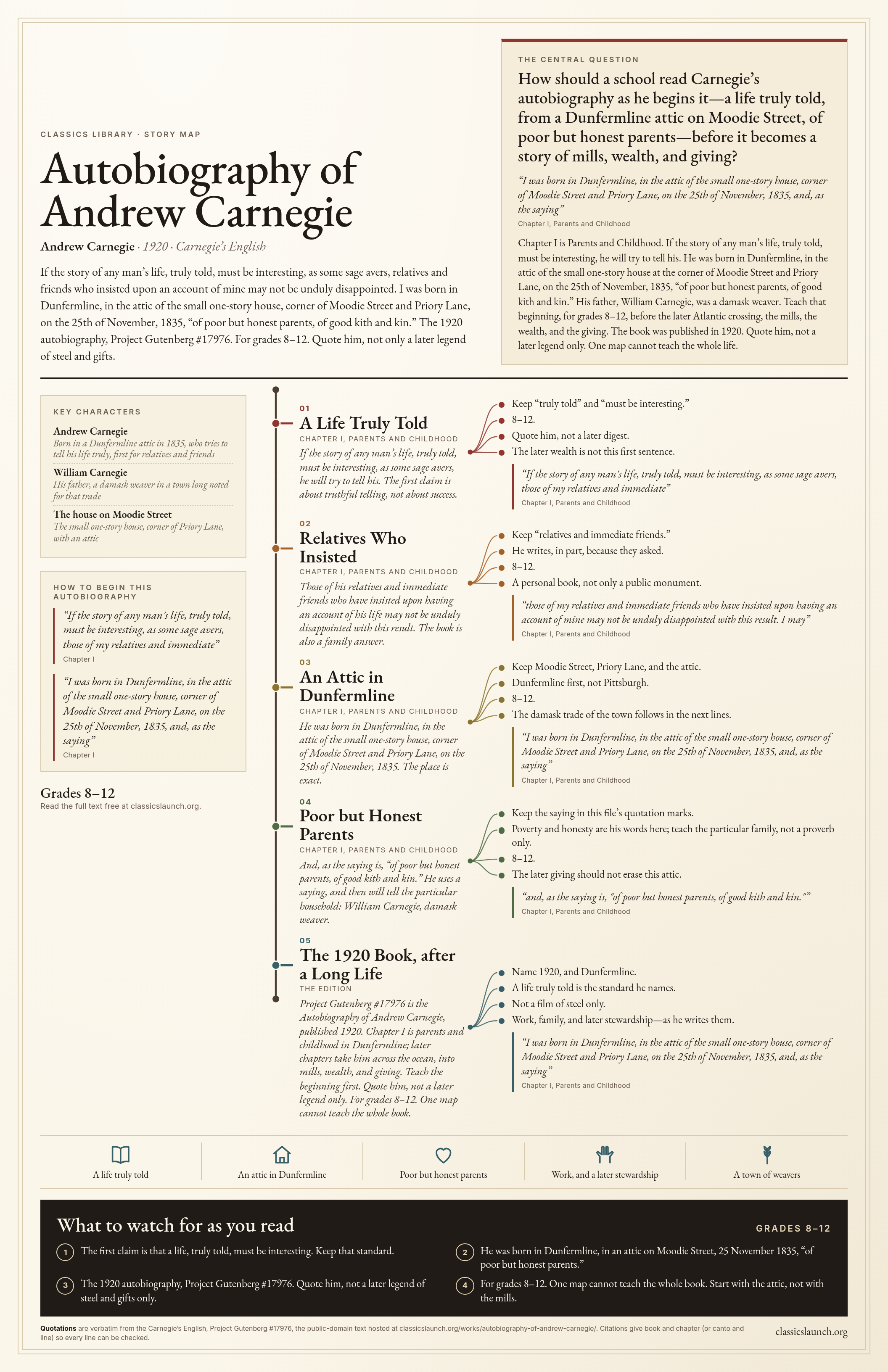
How should a school read Carnegie’s autobiography as he begins it—a life truly told, from a Dunfermline attic on Moodie Street, of poor but honest parents—before it becomes a story of mills, wealth, and giving?
“I was born in Dunfermline, in the attic of the small one-story house, corner of Moodie Street and Priory Lane, on the 25th of November, 1835, and, as the saying”
Chapter I is Parents and Childhood. If the story of any man’s life, truly told, must be interesting, he will try to tell his. He was born in Dunfermline, in the attic of the small one-story house at the corner of Moodie Street and Priory Lane, on the 25th of November, 1835, “of poor but honest parents, of good kith and kin.” His father, William Carnegie, was a damask weaver. Teach that beginning, for grades 8–12, before the later Atlantic crossing, the mills, the wealth, and the giving. The book was published in 1920. Quote him, not a later legend only. One map cannot teach the whole life.
- 01
A Life Truly Told
Chapter I, Parents and Childhood
If the story of any man’s life, truly told, must be interesting, as some sage avers, he will try to tell his. The first claim is about truthful telling, not about success.
- Keep “truly told” and “must be interesting.”
- 8–12.
- Quote him, not a later digest.
- The later wealth is not this first sentence.
“If the story of any man's life, truly told, must be interesting, as some sage avers, those of my relatives and immediate”
- 02
Relatives Who Insisted
Chapter I, Parents and Childhood
Those of his relatives and immediate friends who have insisted upon having an account of his life may not be unduly disappointed with this result. The book is also a family answer.
- Keep “relatives and immediate friends.”
- He writes, in part, because they asked.
- 8–12.
- A personal book, not only a public monument.
“those of my relatives and immediate friends who have insisted upon having an account of mine may not be unduly disappointed with this result. I may”
- 03
An Attic in Dunfermline
Chapter I, Parents and Childhood
He was born in Dunfermline, in the attic of the small one-story house, corner of Moodie Street and Priory Lane, on the 25th of November, 1835. The place is exact.
- Keep Moodie Street, Priory Lane, and the attic.
- Dunfermline first, not Pittsburgh.
- 8–12.
- The damask trade of the town follows in the next lines.
“I was born in Dunfermline, in the attic of the small one-story house, corner of Moodie Street and Priory Lane, on the 25th of November, 1835, and, as the saying”
- 04
Poor but Honest Parents
Chapter I, Parents and Childhood
And, as the saying is, “of poor but honest parents, of good kith and kin.” He uses a saying, and then will tell the particular household: William Carnegie, damask weaver.
- Keep the saying in this file’s quotation marks.
- Poverty and honesty are his words here; teach the particular family, not a proverb only.
- 8–12.
- The later giving should not erase this attic.
“and, as the saying is, "of poor but honest parents, of good kith and kin."”
- 05
The 1920 Book, after a Long Life
The edition
Project Gutenberg #17976 is the Autobiography of Andrew Carnegie, published 1920. Chapter I is parents and childhood in Dunfermline; later chapters take him across the ocean, into mills, wealth, and giving. Teach the beginning first. Quote him, not a later legend only. For grades 8–12. One map cannot teach the whole book.
- Name 1920, and Dunfermline.
- A life truly told is the standard he names.
- Not a film of steel only.
- Work, family, and later stewardship—as he writes them.
“I was born in Dunfermline, in the attic of the small one-story house, corner of Moodie Street and Priory Lane, on the 25th of November, 1835, and, as the saying”
- A life truly told
- An attic in Dunfermline
- Poor but honest parents
- Work, and a later stewardship
- A town of weavers
What to watch for as you read
Grades 8–12- The first claim is that a life, truly told, must be interesting. Keep that standard.
- He was born in Dunfermline, in an attic on Moodie Street, 25 November 1835, “of poor but honest parents.”
- The 1920 autobiography, Project Gutenberg #17976. Quote him, not a later legend of steel and gifts only.
- For grades 8–12. One map cannot teach the whole book. Start with the attic, not with the mills.
Every quotation is word for word from the Carnegie’s English hosted in this library and is checked against that text each time the site is built. Citations give book and chapter (or canto and line).