Story maps · Grades 3–5
Thirty More Famous Stories Retold: A Story Map
The PDF is one tabloid page (11 × 17 in). On letter paper, choose “Fit to page.”
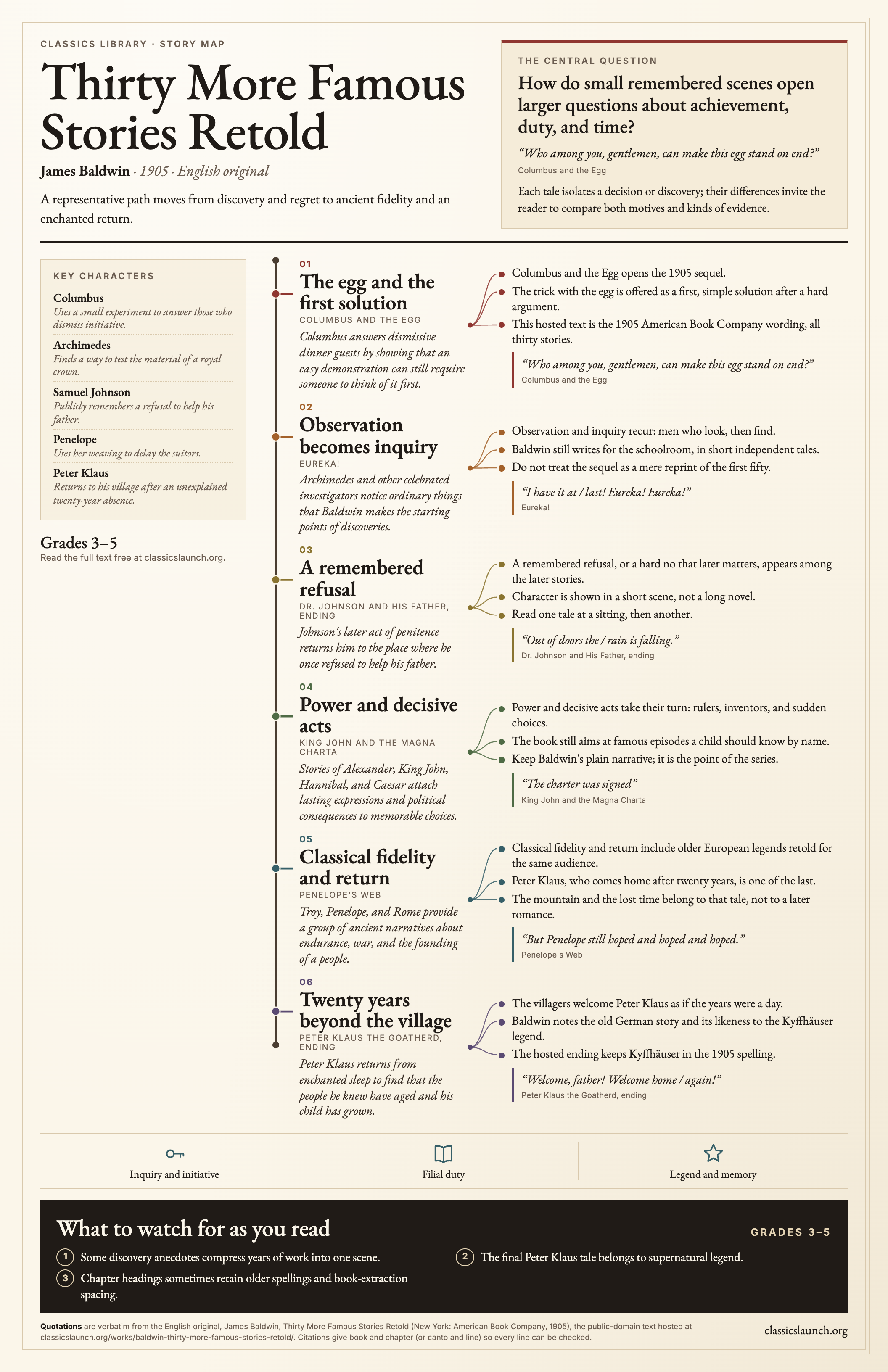
A representative path moves from discovery and regret to ancient fidelity and an enchanted return.
The central question
How do small remembered scenes open larger questions about achievement, duty, and time?
“Who among you, gentlemen, can make this egg stand on end?”
Each tale isolates a decision or discovery; their differences invite the reader to compare both motives and kinds of evidence.
- 01
The egg and the first solution
Columbus and the Egg
Columbus answers dismissive dinner guests by showing that an easy demonstration can still require someone to think of it first.
- Columbus and the Egg opens the 1905 sequel.
- The trick with the egg is offered as a first, simple solution after a hard argument.
- This hosted text is the 1905 American Book Company wording, all thirty stories.
“Who among you, gentlemen, can make this egg stand on end?”
- 02
Observation becomes inquiry
Eureka!
Archimedes and other celebrated investigators notice ordinary things that Baldwin makes the starting points of discoveries.
- Observation and inquiry recur: men who look, then find.
- Baldwin still writes for the schoolroom, in short independent tales.
- Do not treat the sequel as a mere reprint of the first fifty.
“I have it at / last! Eureka! Eureka!”
- 03
A remembered refusal
Dr. Johnson and His Father, ending
Johnson's later act of penitence returns him to the place where he once refused to help his father.
- A remembered refusal, or a hard no that later matters, appears among the later stories.
- Character is shown in a short scene, not a long novel.
- Read one tale at a sitting, then another.
“Out of doors the / rain is falling.”
- 04
Power and decisive acts
King John and the Magna Charta
Stories of Alexander, King John, Hannibal, and Caesar attach lasting expressions and political consequences to memorable choices.
- Power and decisive acts take their turn: rulers, inventors, and sudden choices.
- The book still aims at famous episodes a child should know by name.
- Keep Baldwin's plain narrative; it is the point of the series.
“The charter was signed”
- 05
Classical fidelity and return
Penelope's Web
Troy, Penelope, and Rome provide a group of ancient narratives about endurance, war, and the founding of a people.
- Classical fidelity and return include older European legends retold for the same audience.
- Peter Klaus, who comes home after twenty years, is one of the last.
- The mountain and the lost time belong to that tale, not to a later romance.
“But Penelope still hoped and hoped and hoped.”
- 06
Twenty years beyond the village
Peter Klaus the Goatherd, ending
Peter Klaus returns from enchanted sleep to find that the people he knew have aged and his child has grown.
- The villagers welcome Peter Klaus as if the years were a day.
- Baldwin notes the old German story and its likeness to the Kyffhäuser legend.
- The hosted ending keeps Kyffhäuser in the 1905 spelling.
“Welcome, father! Welcome home / again!”
- Inquiry and initiative
- Filial duty
- Legend and memory
What to watch for as you read
Grades 3–5- Some discovery anecdotes compress years of work into one scene.
- The final Peter Klaus tale belongs to supernatural legend.
- Chapter headings sometimes retain older spellings and book-extraction spacing.
Every quotation is word for word from the English original hosted in this library and is checked against that text each time the site is built. Citations give book and chapter (or canto and line).