Work record
Thirty More Famous Stories Retold
James BaldwinThirty More Famous Stories Retold by James Baldwin (1905)Thirty More Famous Stories Retold extends Baldwin's school-reader project with another varied set of memorable episodes.1905 · Early 20th Century · Collection · English
Read this when an egg, a swinging lamp, or an old village can start a larger inquiry.
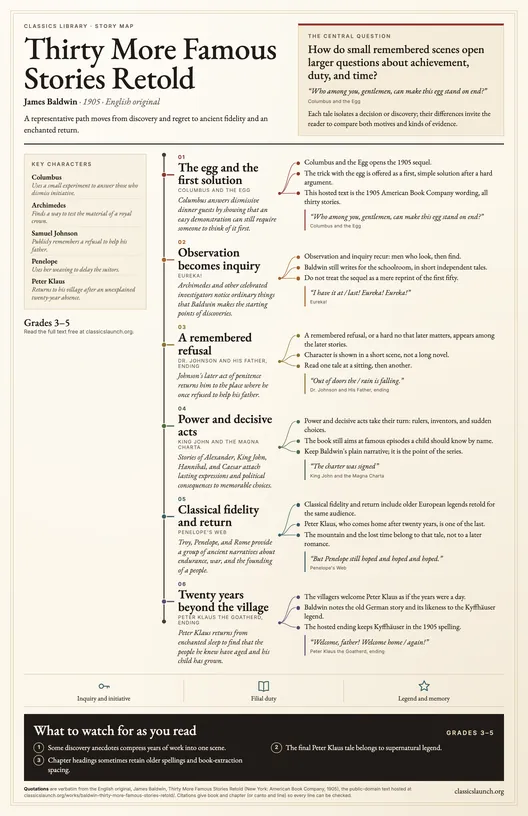 Story mapSee the story mapThe whole book on one page: the story in movements, the characters, and what to watch for. Free to print.
Abstract
Background. American Book Company issued Baldwin's sequel in 1905. It continues his effort to give children access to episodes often assumed by later literature and conversation. The hosted text preserves that book's wording rather than a modern surrounding edition. Its thirty selections reach beyond historical anecdote into classical narrative and mountain legend.
Content. Columbus uses an egg to answer dismissive guests, and stories of Archimedes, Galileo, Newton, and Watt associate inquiry with commonplace observations. Johnson returns to an old failure of duty. Rulers and generals face decisive moments, while Troy, Rome, and Persian legend widen the geographical range. Peter Klaus concludes the collection with a strange homecoming.
Themes. Intelligence appears as attention, invention, and decisive action, but it does not exhaust the book's interests. Filial obligation, political power, faithful waiting, and the passage of years receive separate treatment. The contrast among these subjects gives teachers reason to compare different motives instead of extracting one identical rule from every chapter.
Significance. Clear situations and concrete objects support retelling by younger readers. At the same time, the collection offers a useful first exercise in distinguishing kinds of narrative evidence. Familiar discovery anecdotes compress long processes into single scenes, whereas the enchanted sleeper belongs plainly to wonder. Naming those differences preserves both the pleasure of the stories and the beginnings of sound historical judgment.
Main characters
- Columbus: Uses a small experiment to answer those who dismiss initiative.
- Archimedes: Finds a way to test the material of a royal crown.
- Samuel Johnson: Publicly remembers a refusal to help his father.
- Penelope: Uses her weaving to delay the suitors.
- Peter Klaus: Returns to his village after an unexplained twenty-year absence.
Summary
Thirty More Famous Stories Retold extends Baldwin's school-reader project with another varied set of memorable episodes. The opening story presents Columbus answering guests who belittle his voyage. He asks them to stand an egg on its end, then makes the task easy by gently breaking the shell. The point concerns the difference between seeing a solution and following one after somebody else has demonstrated it. A very small object introduces the collection's interest in intelligence, initiative, and reputation. Several early chapters turn toward inquiry and invention. Archimedes considers a crown whose material may be less valuable than promised, and an observation in his bath suggests a test. Galileo watches swinging lamps, while Newton and Watt appear in familiar stories associated with an apple and a kettle. Baldwin makes discovery dramatic by connecting large ideas with ordinary things. These episodes are retellings of well-known traditions, and their neat scenes should not be mistaken for complete histories of the scientific achievements attached to them. The book's range is wider than invention. Samuel Johnson's refusal to help his father returns years later as an occasion for public penitence. Political and military chapters follow Alexander, King John, Hannibal, and Caesar. The cutting of the Gordian knot and the crossing of the Rubicon show actions whose remembered names became expressions for decisive choices. Other selections retell the fall of Troy, Penelope's work at her loom, the founding of Rome, and the story of the white-haired Zal. The closing tale, Peter Klaus the Goatherd, carries the reader into a German mountain legend. A mysterious encounter and enchanted sleep separate Peter from ordinary time. Returning to his village, he finds recognition difficult until his daughter welcomes him home after twenty years. Its length and wonder give a different cadence to the collection's ending. Across all thirty tales, Baldwin favors recognizable motives and scenes that invite narration. Curiosity, regret, endurance, ambition, and homecoming do not collapse into one lesson. The sequence gives children a store of stories while also encouraging them to ask what kind of account they are hearing: a historical episode, a traditional anecdote, or a marvel openly belonging to legend.
Virtues in this work
- Industry: The discovery stories praise sustained attention and the willingness to pursue a question.
- Piety: Johnson's penitence gives filial duty a lasting claim on an accomplished adult.
- Prudence: The collection invites judgment about the relation between a memorable scene and a larger historical process.
Plot or Argument
- The egg and the first solution
Columbus answers dismissive dinner guests by showing that an easy demonstration can still require someone to think of it first.
- Observation becomes inquiry
Archimedes and other celebrated investigators notice ordinary things that Baldwin makes the starting points of discoveries.
- A remembered refusal
Johnson's later act of penitence returns him to the place where he once refused to help his father.
- Power and decisive acts
Stories of Alexander, King John, Hannibal, and Caesar attach lasting expressions and political consequences to memorable choices.
- Classical fidelity and return
Troy, Penelope, and Rome provide a group of ancient narratives about endurance, war, and the founding of a people.
- Twenty years beyond the village
Peter Klaus returns from enchanted sleep to find that the people he knew have aged and his child has grown.
Characters
- Columbus, Navigator in an anecdote
Uses a small experiment to answer those who dismiss initiative.
- Archimedes, Investigator
Finds a way to test the material of a royal crown.
- Samuel Johnson, Penitent son
Publicly remembers a refusal to help his father.
- Penelope, Faithful wife
Uses her weaving to delay the suitors.
- Peter Klaus, Enchanted sleeper
Returns to his village after an unexplained twenty-year absence.
Lessons
Ask how an answer began
The egg story distinguishes invention from imitation. The science anecdotes also make ordinary observation the start of a question.
- What can the guests do after seeing the egg?
- Why does a small object make a useful opening?
Remember duties personally
Johnson's return is more than a statement of regret. He makes his memory visible through a deliberate act at his father's former workplace.
- What old action does Johnson remember?
- Why does he return to that particular place?
Keep different kinds of story distinct
The book places famous anecdotes beside openly wonderful legends. Readers can enjoy both while asking different questions about their claims.
- Which tales include impossible events?
- How would you check a claim about an invention?
Context
Baldwin wrote for an American educational setting in which reading lessons often supplied a foundation of literary allusions and moral examples. This sequel broadens that foundation through discovery stories, royal anecdotes, and legends.
Composition
Thirty More Famous Stories Retold was published by American Book Company in 1905. The hosted text represents that edition's narrative wording.
Reception
The volume can be read alongside Baldwin's earlier collection as a second store of narratable episodes, with special attention to the difference between anecdote and a full historical account.
Comparisons
- Aesop's Fables
Baldwin's short illustrative incidents can be compared with fables, especially where a physical action supplies the conclusion.
- The Aeneid
The Troy and Rome selections offer a brief entry into subjects developed with much greater scope in Virgil's epic.
Quotes
“Who among you, gentlemen, can make this egg stand on end?”
“I have it at last! Eureka! Eureka!”
“Out of doors the rain is falling.”
“The charter was signed”
“But Penelope still hoped and hoped and hoped.”
“Welcome, father! Welcome home again!”
For Students
A reading companion for classical Christian high school students. See the student guide.
Reading Guide
Watch for
- Some discovery anecdotes compress years of work into one scene.
- The final Peter Klaus tale belongs to supernatural legend.
- Chapter headings sometimes retain older spellings and book-extraction spacing.
Key terms and names
- anecdote
- A short narrative organized around one memorable incident.
- penitence
- Sorrow for wrongdoing expressed through a deliberate response.
- pendulum
- A suspended weight that swings regularly from side to side.
- allusion
- A reference to a known incident, person, or literary work.
Seminar Questions
- Comprehension How does Columbus make the egg stand?
- Comprehension Who finally recognizes Peter Klaus?
- Interpretation Why does the Johnson chapter repeat the rain?
- Interpretation What do household objects contribute to the discovery stories?
- Big Question What is lost when a long achievement becomes one neat anecdote?
- Big Question Can an old refusal remain important after worldly success?
Faith Connections
- Sirach 3:12–14 (Scripture)
The care owed to an aging father supplies a close companion to Johnson's memory of his own refusal.
- Proverbs 25:2 (Scripture)
The value assigned to searching matters out can introduce discussion of observation and inquiry in the discovery chapters.
Logic and Rhetoric
Central argument: Familiar scenes give children memorable entrances into larger subjects, provided that the kind and limits of each retelling remain clear.
Rhetorical device: framing repetition. Weather returns at the close of the Johnson narrative, linking a youthful refusal with an adult act of penitence.
Debate: Resolved: discovery anecdotes are most useful when they lead readers to further inquiry.
Memory Work
Who among you, gentlemen, can make this egg stand on end?
Writing Prompts
Essay: Compare the role of one ordinary object in a discovery anecdote with the role of the market stall in Johnson's story.
Comparison with Aesop's Fables: Compare the way a Baldwin anecdote and an Aesop fable turn a brief incident into a lasting example.
Creative Prompts
- Classroom
Sort six tales into historical anecdote, ancient legend, and supernatural story, explaining any uncertain choices.
- Dialogue
Write a conversation between two dinner guests before and after the egg demonstration.
- Fiction
Imagine returning to a familiar street after twenty years and describe recognition through three small details.
Further Reading
- Fifty Famous Stories Retold, James Baldwin
- The Life of Samuel Johnson, James Boswell
Verification notes
The 1905 hosted book supplies the text and all quotations. Scientific discovery scenes are identified as Baldwin's familiar anecdotes rather than complete or independently verified accounts of invention; no technical priority claims are adopted.
No verification flags recorded.