Story maps · Grades 3–8
Beauty and the Beast: A Story Map
The PDF is one tabloid page (11 × 17 in). On letter paper, choose “Fit to page.”
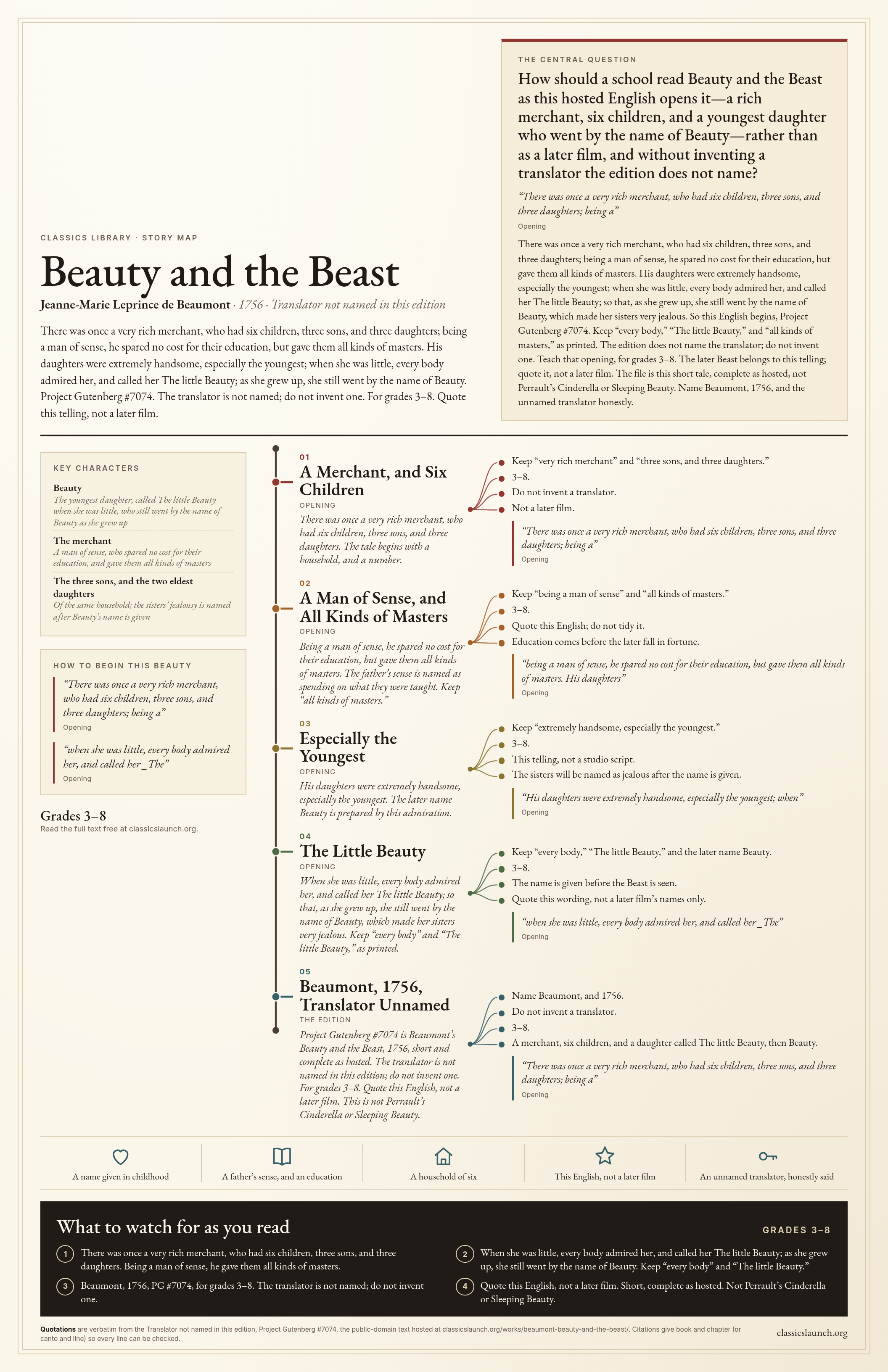
There was once a very rich merchant, who had six children, three sons, and three daughters; being a man of sense, he spared no cost for their education, but gave them all kinds of masters. His daughters were extremely handsome, especially the youngest; when she was little, every body admired her, and called her The little Beauty; as she grew up, she still went by the name of Beauty. Project Gutenberg #7074. The translator is not named; do not invent one. For grades 3–8. Quote this telling, not a later film.
The central question
How should a school read Beauty and the Beast as this hosted English opens it—a rich merchant, six children, and a youngest daughter who went by the name of Beauty—rather than as a later film, and without inventing a translator the edition does not name?
“There was once a very rich merchant, who had six children, three sons, and three daughters; being a”
There was once a very rich merchant, who had six children, three sons, and three daughters; being a man of sense, he spared no cost for their education, but gave them all kinds of masters. His daughters were extremely handsome, especially the youngest; when she was little, every body admired her, and called her The little Beauty; so that, as she grew up, she still went by the name of Beauty, which made her sisters very jealous. So this English begins, Project Gutenberg #7074. Keep “every body,” “The little Beauty,” and “all kinds of masters,” as printed. The edition does not name the translator; do not invent one. Teach that opening, for grades 3–8. The later Beast belongs to this telling; quote it, not a later film. The file is this short tale, complete as hosted, not Perrault’s Cinderella or Sleeping Beauty. Name Beaumont, 1756, and the unnamed translator honestly.
- 01
A Merchant, and Six Children
Opening
There was once a very rich merchant, who had six children, three sons, and three daughters. The tale begins with a household, and a number.
- Keep “very rich merchant” and “three sons, and three daughters.”
- 3–8.
- Do not invent a translator.
- Not a later film.
“There was once a very rich merchant, who had six children, three sons, and three daughters; being a”
- 02
A Man of Sense, and All Kinds of Masters
Opening
Being a man of sense, he spared no cost for their education, but gave them all kinds of masters. The father’s sense is named as spending on what they were taught. Keep “all kinds of masters.”
- Keep “being a man of sense” and “all kinds of masters.”
- 3–8.
- Quote this English; do not tidy it.
- Education comes before the later fall in fortune.
“being a man of sense, he spared no cost for their education, but gave them all kinds of masters. His daughters”
- 03
Especially the Youngest
Opening
His daughters were extremely handsome, especially the youngest. The later name Beauty is prepared by this admiration.
- Keep “extremely handsome, especially the youngest.”
- 3–8.
- This telling, not a studio script.
- The sisters will be named as jealous after the name is given.
“His daughters were extremely handsome, especially the youngest; when”
- 04
The Little Beauty
Opening
When she was little, every body admired her, and called her The little Beauty; so that, as she grew up, she still went by the name of Beauty, which made her sisters very jealous. Keep “every body” and “The little Beauty,” as printed.
- Keep “every body,” “The little Beauty,” and the later name Beauty.
- 3–8.
- The name is given before the Beast is seen.
- Quote this wording, not a later film’s names only.
“when she was little, every body admired her, and called her _The”
- 05
Beaumont, 1756, Translator Unnamed
The edition
Project Gutenberg #7074 is Beaumont’s Beauty and the Beast, 1756, short and complete as hosted. The translator is not named in this edition; do not invent one. For grades 3–8. Quote this English, not a later film. This is not Perrault’s Cinderella or Sleeping Beauty.
- Name Beaumont, and 1756.
- Do not invent a translator.
- 3–8.
- A merchant, six children, and a daughter called The little Beauty, then Beauty.
“There was once a very rich merchant, who had six children, three sons, and three daughters; being a”
- A name given in childhood
- A father’s sense, and an education
- A household of six
- This English, not a later film
- An unnamed translator, honestly said
What to watch for as you read
Grades 3–8- There was once a very rich merchant, who had six children, three sons, and three daughters. Being a man of sense, he gave them all kinds of masters.
- When she was little, every body admired her, and called her The little Beauty; as she grew up, she still went by the name of Beauty. Keep “every body” and “The little Beauty.”
- Beaumont, 1756, PG #7074, for grades 3–8. The translator is not named; do not invent one.
- Quote this English, not a later film. Short, complete as hosted. Not Perrault’s Cinderella or Sleeping Beauty.
Every quotation is word for word from the Translator not named in this edition hosted in this library and is checked against that text each time the site is built. Citations give book and chapter (or canto and line).