Story maps · Grades 9–12
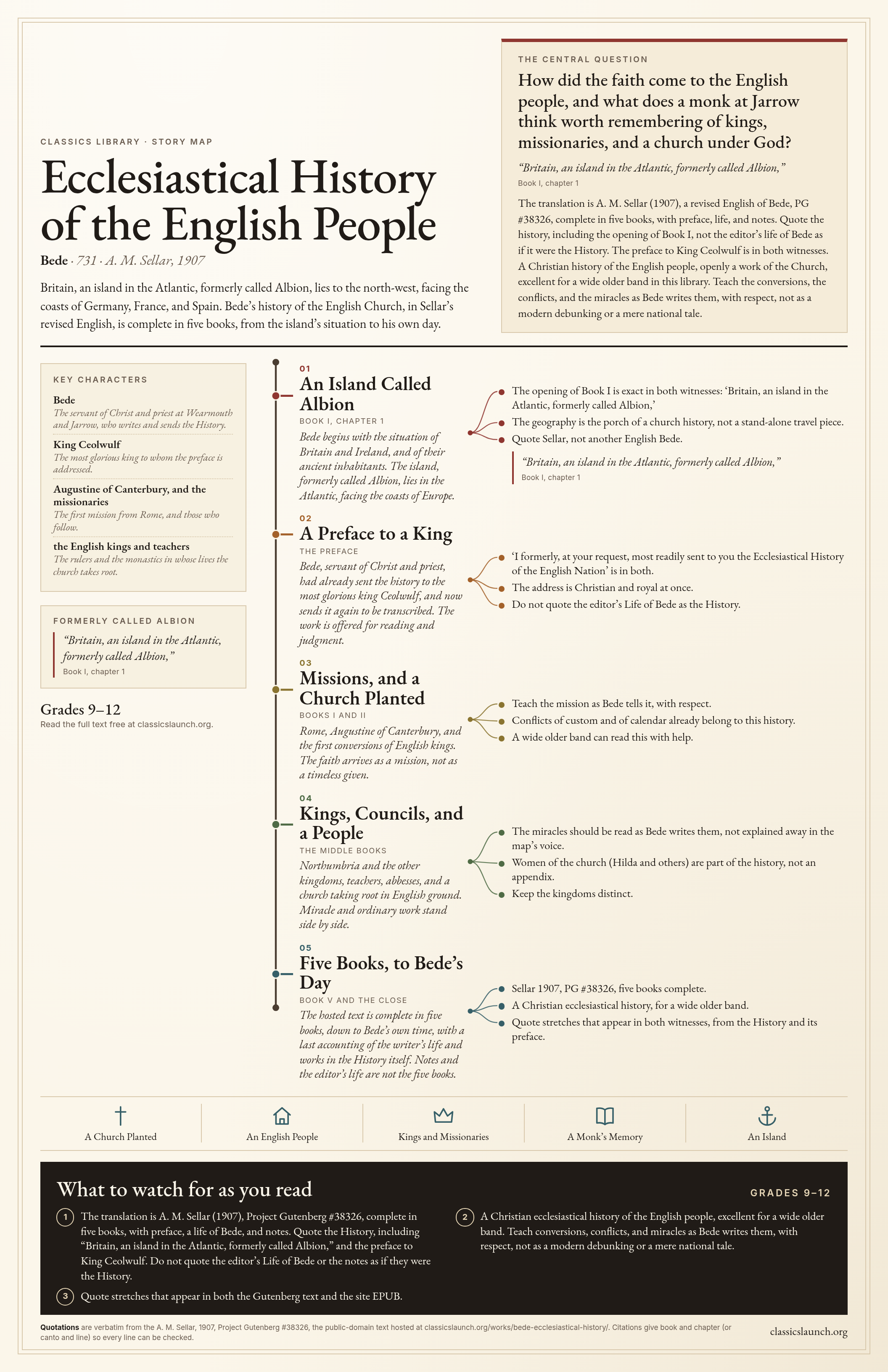
Ecclesiastical History of the English People: A Story Map
The PDF is one tabloid page (11 × 17 in). On letter paper, choose “Fit to page.”
Britain, an island in the Atlantic, formerly called Albion, lies to the north-west, facing the coasts of Germany, France, and Spain. Bede’s history of the English Church, in Sellar’s revised English, is complete in five books, from the island’s situation to his own day.
The central question
How did the faith come to the English people, and what does a monk at Jarrow think worth remembering of kings, missionaries, and a church under God?
“Britain, an island in the Atlantic, formerly called Albion,”
The translation is A. M. Sellar (1907), a revised English of Bede, PG #38326, complete in five books, with preface, life, and notes. Quote the history, including the opening of Book I, not the editor’s life of Bede as if it were the History. The preface to King Ceolwulf is in both witnesses. A Christian history of the English people, openly a work of the Church, excellent for a wide older band in this library. Teach the conversions, the conflicts, and the miracles as Bede writes them, with respect, not as a modern debunking or a mere national tale.
- 01
An Island Called Albion
Book I, chapter 1
Bede begins with the situation of Britain and Ireland, and of their ancient inhabitants. The island, formerly called Albion, lies in the Atlantic, facing the coasts of Europe.
- The opening of Book I is exact in both witnesses: ‘Britain, an island in the Atlantic, formerly called Albion,’
- The geography is the porch of a church history, not a stand-alone travel piece.
- Quote Sellar, not another English Bede.
“Britain, an island in the Atlantic, formerly called Albion,”
- 02
A Preface to a King
The preface
Bede, servant of Christ and priest, had already sent the history to the most glorious king Ceolwulf, and now sends it again to be transcribed. The work is offered for reading and judgment.
- ‘I formerly, at your request, most readily sent to you the Ecclesiastical History of the English Nation’ is in both.
- The address is Christian and royal at once.
- Do not quote the editor’s Life of Bede as the History.
- 03
Missions, and a Church Planted
Books I and II
Rome, Augustine of Canterbury, and the first conversions of English kings. The faith arrives as a mission, not as a timeless given.
- Teach the mission as Bede tells it, with respect.
- Conflicts of custom and of calendar already belong to this history.
- A wide older band can read this with help.
- 04
Kings, Councils, and a People
The middle books
Northumbria and the other kingdoms, teachers, abbesses, and a church taking root in English ground. Miracle and ordinary work stand side by side.
- The miracles should be read as Bede writes them, not explained away in the map’s voice.
- Women of the church (Hilda and others) are part of the history, not an appendix.
- Keep the kingdoms distinct.
- 05
Five Books, to Bede’s Day
Book V and the close
The hosted text is complete in five books, down to Bede’s own time, with a last accounting of the writer’s life and works in the History itself. Notes and the editor’s life are not the five books.
- Sellar 1907, PG #38326, five books complete.
- A Christian ecclesiastical history, for a wide older band.
- Quote stretches that appear in both witnesses, from the History and its preface.
- A Church Planted
- An English People
- Kings and Missionaries
- A Monk’s Memory
- An Island
What to watch for as you read
Grades 9–12- The translation is A. M. Sellar (1907), Project Gutenberg #38326, complete in five books, with preface, a life of Bede, and notes. Quote the History, including “Britain, an island in the Atlantic, formerly called Albion,” and the preface to King Ceolwulf. Do not quote the editor’s Life of Bede or the notes as if they were the History.
- A Christian ecclesiastical history of the English people, excellent for a wide older band. Teach conversions, conflicts, and miracles as Bede writes them, with respect, not as a modern debunking or a mere national tale.
- Quote stretches that appear in both the Gutenberg text and the site EPUB.
Every quotation is word for word from the A. M. Sellar, 1907 hosted in this library and is checked against that text each time the site is built. Citations give book and chapter (or canto and line).