Story maps · Grades 6–12
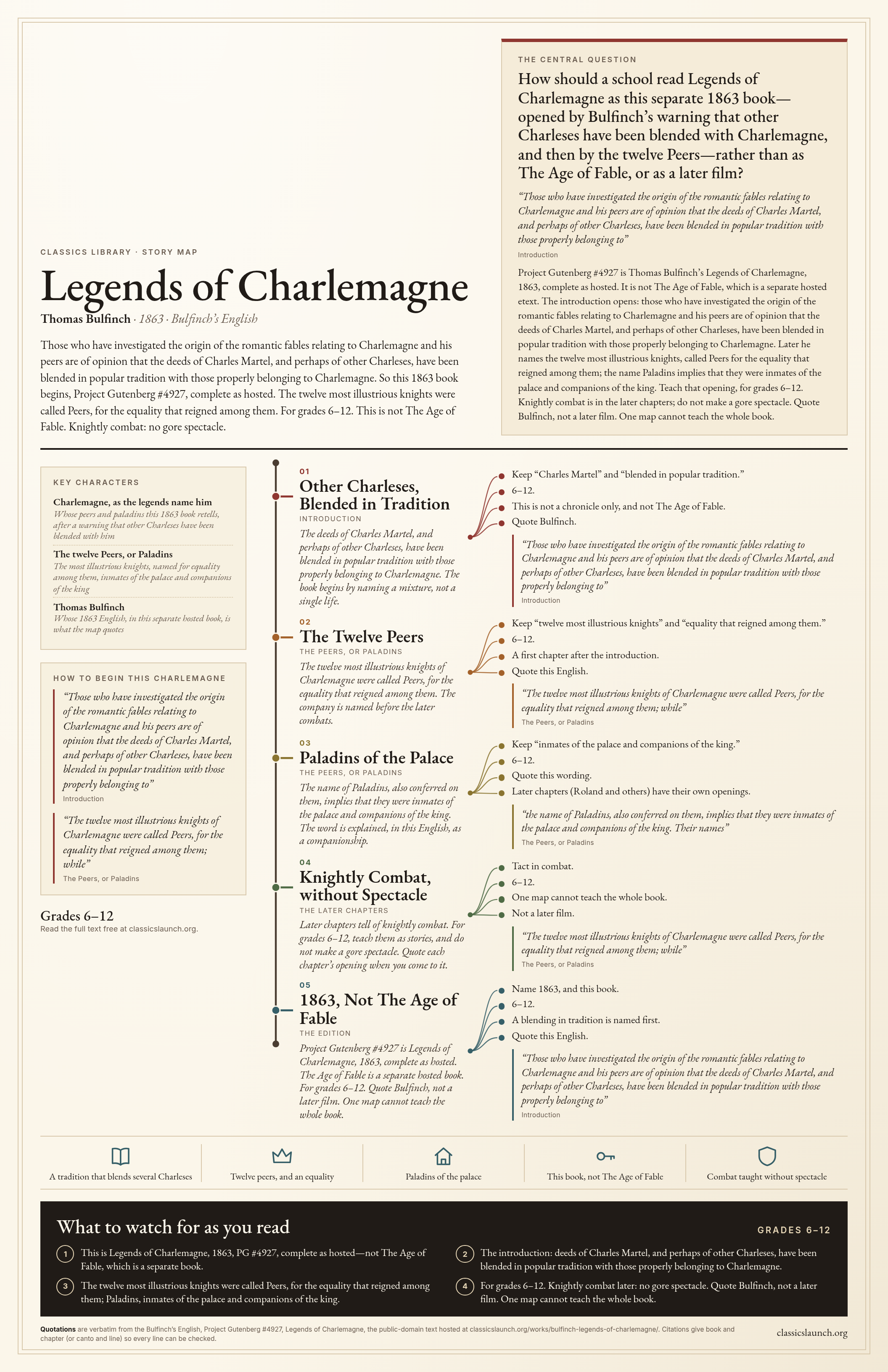
Legends of Charlemagne: A Story Map
The PDF is one tabloid page (11 × 17 in). On letter paper, choose “Fit to page.”
Those who have investigated the origin of the romantic fables relating to Charlemagne and his peers are of opinion that the deeds of Charles Martel, and perhaps of other Charleses, have been blended in popular tradition with those properly belonging to Charlemagne. So this 1863 book begins, Project Gutenberg #4927, complete as hosted. The twelve most illustrious knights were called Peers, for the equality that reigned among them. For grades 6–12. This is not The Age of Fable. Knightly combat: no gore spectacle.
The central question
How should a school read Legends of Charlemagne as this separate 1863 book—opened by Bulfinch’s warning that other Charleses have been blended with Charlemagne, and then by the twelve Peers—rather than as The Age of Fable, or as a later film?
“Those who have investigated the origin of the romantic fables relating to Charlemagne and his peers are of opinion that the deeds of Charles Martel, and perhaps of other Charleses, have been blended in popular tradition with those properly belonging to”
Project Gutenberg #4927 is Thomas Bulfinch’s Legends of Charlemagne, 1863, complete as hosted. It is not The Age of Fable, which is a separate hosted etext. The introduction opens: those who have investigated the origin of the romantic fables relating to Charlemagne and his peers are of opinion that the deeds of Charles Martel, and perhaps of other Charleses, have been blended in popular tradition with those properly belonging to Charlemagne. Later he names the twelve most illustrious knights, called Peers for the equality that reigned among them; the name Paladins implies that they were inmates of the palace and companions of the king. Teach that opening, for grades 6–12. Knightly combat is in the later chapters; do not make a gore spectacle. Quote Bulfinch, not a later film. One map cannot teach the whole book.
- 01
Other Charleses, Blended in Tradition
Introduction
The deeds of Charles Martel, and perhaps of other Charleses, have been blended in popular tradition with those properly belonging to Charlemagne. The book begins by naming a mixture, not a single life.
- Keep “Charles Martel” and “blended in popular tradition.”
- 6–12.
- This is not a chronicle only, and not The Age of Fable.
- Quote Bulfinch.
“Those who have investigated the origin of the romantic fables relating to Charlemagne and his peers are of opinion that the deeds of Charles Martel, and perhaps of other Charleses, have been blended in popular tradition with those properly belonging to”
- 02
The Twelve Peers
The Peers, or Paladins
The twelve most illustrious knights of Charlemagne were called Peers, for the equality that reigned among them. The company is named before the later combats.
- Keep “twelve most illustrious knights” and “equality that reigned among them.”
- 6–12.
- A first chapter after the introduction.
- Quote this English.
“The twelve most illustrious knights of Charlemagne were called Peers, for the equality that reigned among them; while”
- 03
Paladins of the Palace
The Peers, or Paladins
The name of Paladins, also conferred on them, implies that they were inmates of the palace and companions of the king. The word is explained, in this English, as a companionship.
- Keep “inmates of the palace and companions of the king.”
- 6–12.
- Quote this wording.
- Later chapters (Roland and others) have their own openings.
“the name of Paladins, also conferred on them, implies that they were inmates of the palace and companions of the king. Their names”
- 04
Knightly Combat, without Spectacle
The later chapters
Later chapters tell of knightly combat. For grades 6–12, teach them as stories, and do not make a gore spectacle. Quote each chapter’s opening when you come to it.
- Tact in combat.
- 6–12.
- One map cannot teach the whole book.
- Not a later film.
“The twelve most illustrious knights of Charlemagne were called Peers, for the equality that reigned among them; while”
- 05
1863, Not The Age of Fable
The edition
Project Gutenberg #4927 is Legends of Charlemagne, 1863, complete as hosted. The Age of Fable is a separate hosted book. For grades 6–12. Quote Bulfinch, not a later film. One map cannot teach the whole book.
- Name 1863, and this book.
- 6–12.
- A blending in tradition is named first.
- Quote this English.
“Those who have investigated the origin of the romantic fables relating to Charlemagne and his peers are of opinion that the deeds of Charles Martel, and perhaps of other Charleses, have been blended in popular tradition with those properly belonging to”
- A tradition that blends several Charleses
- Twelve peers, and an equality
- Paladins of the palace
- This book, not The Age of Fable
- Combat taught without spectacle
What to watch for as you read
Grades 6–12- This is Legends of Charlemagne, 1863, PG #4927, complete as hosted—not The Age of Fable, which is a separate book.
- The introduction: deeds of Charles Martel, and perhaps of other Charleses, have been blended in popular tradition with those properly belonging to Charlemagne.
- The twelve most illustrious knights were called Peers, for the equality that reigned among them; Paladins, inmates of the palace and companions of the king.
- For grades 6–12. Knightly combat later: no gore spectacle. Quote Bulfinch, not a later film. One map cannot teach the whole book.
Every quotation is word for word from the Bulfinch’s English hosted in this library and is checked against that text each time the site is built. Citations give book and chapter (or canto and line).