Story maps · Grades 6–8
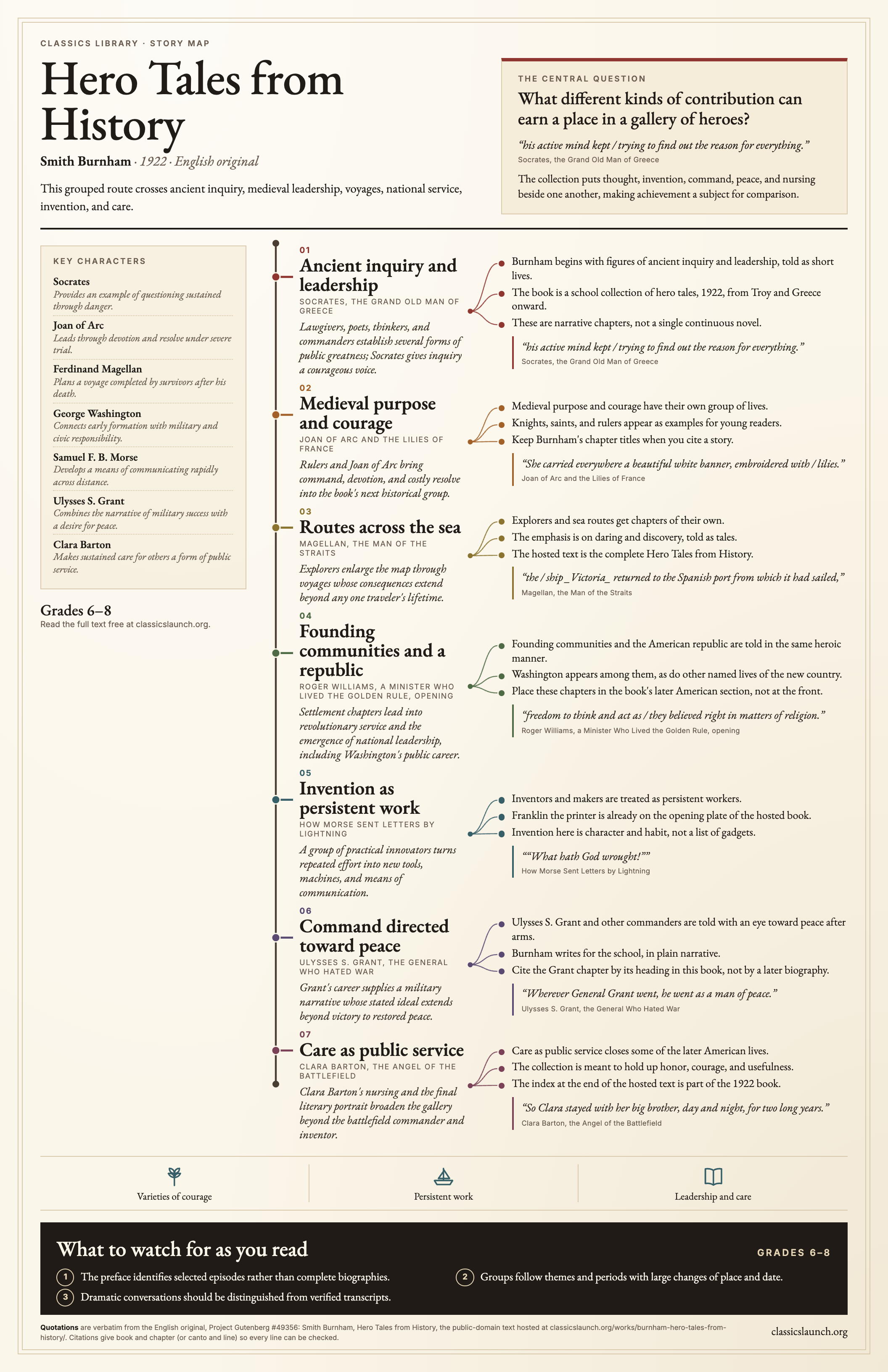
Hero Tales from History: A Story Map
The PDF is one tabloid page (11 × 17 in). On letter paper, choose “Fit to page.”
This grouped route crosses ancient inquiry, medieval leadership, voyages, national service, invention, and care.
The central question
What different kinds of contribution can earn a place in a gallery of heroes?
“his active mind kept / trying to find out the reason for everything.”
The collection puts thought, invention, command, peace, and nursing beside one another, making achievement a subject for comparison.
- 01
Ancient inquiry and leadership
Socrates, the Grand Old Man of Greece
Lawgivers, poets, thinkers, and commanders establish several forms of public greatness; Socrates gives inquiry a courageous voice.
- Burnham begins with figures of ancient inquiry and leadership, told as short lives.
- The book is a school collection of hero tales, 1922, from Troy and Greece onward.
- These are narrative chapters, not a single continuous novel.
“his active mind kept / trying to find out the reason for everything.”
- 02
Medieval purpose and courage
Joan of Arc and the Lilies of France
Rulers and Joan of Arc bring command, devotion, and costly resolve into the book's next historical group.
- Medieval purpose and courage have their own group of lives.
- Knights, saints, and rulers appear as examples for young readers.
- Keep Burnham's chapter titles when you cite a story.
“She carried everywhere a beautiful white banner, embroidered with / lilies.”
- 03
Routes across the sea
Magellan, the Man of the Straits
Explorers enlarge the map through voyages whose consequences extend beyond any one traveler's lifetime.
- Explorers and sea routes get chapters of their own.
- The emphasis is on daring and discovery, told as tales.
- The hosted text is the complete Hero Tales from History.
“the / ship _Victoria_ returned to the Spanish port from which it had sailed,”
- 04
Founding communities and a republic
Roger Williams, a Minister Who Lived the Golden Rule, opening
Settlement chapters lead into revolutionary service and the emergence of national leadership, including Washington's public career.
- Founding communities and the American republic are told in the same heroic manner.
- Washington appears among them, as do other named lives of the new country.
- Place these chapters in the book's later American section, not at the front.
“freedom to think and act as / they believed right in matters of religion.”
- 05
Invention as persistent work
How Morse Sent Letters by Lightning
A group of practical innovators turns repeated effort into new tools, machines, and means of communication.
- Inventors and makers are treated as persistent workers.
- Franklin the printer is already on the opening plate of the hosted book.
- Invention here is character and habit, not a list of gadgets.
““What hath God wrought!””
- 06
Command directed toward peace
Ulysses S. Grant, the General Who Hated War
Grant's career supplies a military narrative whose stated ideal extends beyond victory to restored peace.
- Ulysses S. Grant and other commanders are told with an eye toward peace after arms.
- Burnham writes for the school, in plain narrative.
- Cite the Grant chapter by its heading in this book, not by a later biography.
“Wherever General Grant went, he went as a man of peace.”
- 07
Care as public service
Clara Barton, the Angel of the Battlefield
Clara Barton's nursing and the final literary portrait broaden the gallery beyond the battlefield commander and inventor.
- Care as public service closes some of the later American lives.
- The collection is meant to hold up honor, courage, and usefulness.
- The index at the end of the hosted text is part of the 1922 book.
“So Clara stayed with her big brother, day and night, for two long years.”
- Varieties of courage
- Persistent work
- Leadership and care
What to watch for as you read
Grades 6–8- The preface identifies selected episodes rather than complete biographies.
- Groups follow themes and periods with large changes of place and date.
- Dramatic conversations should be distinguished from verified transcripts.
Every quotation is word for word from the English original hosted in this library and is checked against that text each time the site is built. Citations give book and chapter (or canto and line).