Work record
Hero Tales from History
Smith BurnhamHero Tales from History by Smith Burnham (1922)Hero Tales from History approaches the past through people placed in vivid situations.1922 · Early 20th Century · Collection · English
Read this when famous names need first scenes of learning, persistence, leadership, and practical service.
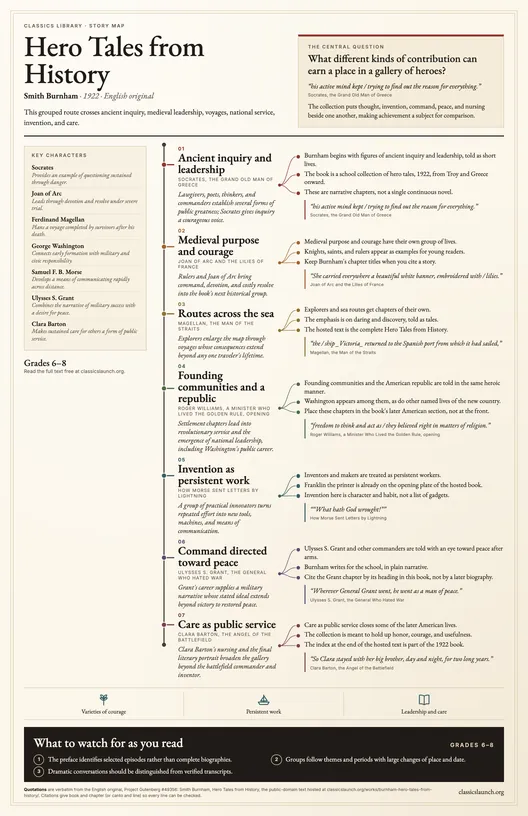 Story mapSee the story mapThe whole book on one page: the story in movements, the characters, and what to watch for. Free to print.
Abstract
Background. Burnham's 1922 collection presents historical lives through selected episodes meant for young readers. The preface clearly distinguishes these tales from full biographies and continuous history. Its arrangement reaches from ancient subjects to American public figures, with separate groups for medieval leaders, travelers, inventors, and others whose work shaped remembered events.
Content. Early chapters introduce lawgiving, poetry, questioning, and command through a varied ancient company. Medieval narratives lead toward ocean journeys and the founding of settlements. American independence and western travel supply further scenes of initiative, followed by practical inventions. The concluding range includes statesmanship, military leadership, nursing, and the literary contribution of Longfellow.
Themes. Character becomes visible through choices made under difficulty: persistent inquiry, patient labor, courage, restraint, and readiness to serve. Childhood or early apprenticeship often prepares the later achievement. The variety matters, since invention and bedside care place different demands on a person from those of battle or government, even within one gallery.
Significance. The book works best as an invitation to further historical reading. Its short scenes offer memorable points of entry, while primary accounts and complete biographies can enlarge their context and test particulars. A grouped approach to the collection preserves its broad movement without turning every chapter into an isolated item, and lets students compare forms of contribution across places and periods.
Key figures
- Socrates: Provides an example of questioning sustained through danger.
- Joan of Arc: Leads through devotion and resolve under severe trial.
- Ferdinand Magellan: Plans a voyage completed by survivors after his death.
- George Washington: Connects early formation with military and civic responsibility.
- Samuel F. B. Morse: Develops a means of communicating rapidly across distance.
- Ulysses S. Grant: Combines the narrative of military success with a desire for peace.
- Clara Barton: Makes sustained care for others a form of public service.
Summary
Hero Tales from History approaches the past through people placed in vivid situations. Burnham's preface explains that the chapters are neither complete biographies nor a connected historical narrative. Each is intended to make a name and an achievement memorable while presenting some quality of conduct in action. The book's groups move from ancient figures and medieval rulers to exploration, settlement, invention, and the public life of the United States. The opening range includes Moses, David, Homer, Socrates, Alexander, and Caesar. These selections bring religious tradition, poetry, philosophy, and military command into a common introduction to earlier lives. The Socrates chapter emphasizes questioning and the resolve to continue teaching despite danger. Later medieval subjects include Charlemagne, Alfred, William of Normandy, Richard and John, and Joan of Arc. Burnham favors scenes of early promise, decisive action, and the personal cost of remaining faithful to a purpose. Voyages and journeys then carry the reader across a larger map. Columbus and Magellan stand among a succession of explorers, while later chapters follow founders of settlements and travelers across North America. The structure makes geography part of the reading: seas, rivers, routes, and new communities connect otherwise independent lives. Revolutionary figures and western expeditions continue that movement into the formation and expansion of the United States. Inventors supply a different kind of adventure. Whitney, Fulton, Morse, McCormick, Howe, and Edison meet obstacles through experiment, practical work, and persistence. Morse's development of telegraphic communication gives discovery a public result: messages can travel across a distance with astonishing speed. The later group of American figures turns again toward leadership, war, and service. Grant's chapter places military success beside his desire for peace, while Clara Barton's care for the wounded gives courage a form that depends on tending rather than commanding. Longfellow's place near the close reminds readers that a poet can also belong in this gallery of public contribution. Taken together, the tales offer several kinds of achievement, not a single model of greatness. Their dramatic conversations and compressed careers invite a second step into fuller history. Reading them well means enjoying the narrative while remembering Burnham's stated choice to tell selected episodes rather than exhaustive lives.
Virtues in this work
- Industry: The inventor group repeatedly makes sustained practical effort a condition of achievement.
- Charity: Clara Barton's care provides a clear example of service directed toward others' needs.
- Fortitude: Several figures continue their chosen work through danger, rejection, or physical hardship.
- Magnanimity: The Grant chapter values peace and generous treatment after military victory.
Plot or Argument
- Ancient inquiry and leadership
Lawgivers, poets, thinkers, and commanders establish several forms of public greatness; Socrates gives inquiry a courageous voice.
- Medieval purpose and courage
Rulers and Joan of Arc bring command, devotion, and costly resolve into the book's next historical group.
- Routes across the sea
Explorers enlarge the map through voyages whose consequences extend beyond any one traveler's lifetime.
- Founding communities and a republic
Settlement chapters lead into revolutionary service and the emergence of national leadership, including Washington's public career.
- Invention as persistent work
A group of practical innovators turns repeated effort into new tools, machines, and means of communication.
- Command directed toward peace
Grant's career supplies a military narrative whose stated ideal extends beyond victory to restored peace.
- Care as public service
Clara Barton's nursing and the final literary portrait broaden the gallery beyond the battlefield commander and inventor.
Characters
- Socrates, Ancient philosopher
Provides an example of questioning sustained through danger.
- Joan of Arc, Medieval leader
Leads through devotion and resolve under severe trial.
- Ferdinand Magellan, Navigator
Plans a voyage completed by survivors after his death.
- George Washington, National leader
Connects early formation with military and civic responsibility.
- Samuel F. B. Morse, Inventor
Develops a means of communicating rapidly across distance.
- Ulysses S. Grant, General and president
Combines the narrative of military success with a desire for peace.
- Clara Barton, Nurse and organizer
Makes sustained care for others a form of public service.
Lessons
One life can begin a larger inquiry
Burnham chooses an episode rather than telling everything a person did. The result offers a starting point that can lead into fuller evidence.
- What does the preface say these tales are not?
- Which chapter would you follow with a complete biography?
Achievement has several forms
Inventors, nurses, poets, and commanders all appear in the gallery. Comparing their work makes the word courage more precise.
- What does Morse need that a general may not?
- How does Barton's service differ from command?
Early habits prepare later work
Several chapters connect childhood practice with an adult purpose. The pattern invites attention to learning, patience, and repeated effort.
- How does Barton's care for her brother prepare later work?
- Which other figure develops a habit before becoming famous?
Context
Burnham wrote from an American educational setting that used narrative lives to encourage historical interest and recognizable virtues. His preface explicitly favors concrete pictures, emotional engagement, and selected episodes over exhaustive biography.
Composition
Hero Tales from History was published in 1922. The hosted complete Gutenberg text includes its grouped contents, prefatory explanation, and Grant chapter.
Reception
The volume can serve as an introductory gallery for further reading, especially when its compressed dramatic scenes are paired with longer histories or the figures' own accounts.
Comparisons
- Personal Memoirs
Grant's own narrative provides a fuller first-person companion to Burnham's brief portrait of the general.
- Paul Revere's Ride
Both make earlier action vivid for younger audiences, but a grouped prose gallery organizes memory differently from one driving ballad.
- Julius Caesar
Compare the collection's short Caesar portrait with Shakespeare's extended drama of reputation and public speech.
Quotes
“his active mind kept trying to find out the reason for everything.”
“She carried everywhere a beautiful white banner, embroidered with lilies.”
“the ship _Victoria_ returned to the Spanish port from which it had sailed,”
“freedom to think and act as they believed right in matters of religion.”
““What hath God wrought!””
“Wherever General Grant went, he went as a man of peace.”
“So Clara stayed with her big brother, day and night, for two long years.”
For Students
A reading companion for classical Christian high school students. See the student guide.
Reading Guide
Watch for
- The preface identifies selected episodes rather than complete biographies.
- Groups follow themes and periods with large changes of place and date.
- Dramatic conversations should be distinguished from verified transcripts.
Key terms and names
- biographical episode
- A selected incident from a life rather than a complete life history.
- telegraph
- A system for transmitting coded messages over distance by electrical signals.
- circumnavigation
- A journey that goes all the way around the earth.
- primary source
- Evidence produced by a participant, witness, or institution of the period studied.
- public service
- Work directed toward the needs or benefit of a community.
Seminar Questions
- Comprehension How does Burnham distinguish his tales from biographies?
- Comprehension What larger journey is completed after Magellan's death?
- Interpretation Why include inventors and a poet in a book about heroes?
- Interpretation How does Grant's chapter connect victory with peace?
- Big Question What does a memorable episode reveal or leave unanswered about a life?
- Big Question Can patient care require courage comparable to command in danger?
Faith Connections
- Romans 12:6–8 (Scripture)
Paul's account of different gifts supports comparison among teaching, leadership, generosity, and service in the gallery.
- Matthew 25:35–40 (Scripture)
Practical care for those in need gives a close companion to the treatment of Barton's nursing.
- Plato, Apology (Great Conversation)
Plato's presentation of Socrates provides a primary-text conversation with Burnham's short account of inquiry and courage.
Logic and Rhetoric
Central argument: Selected lives can awaken historical curiosity by making different forms of courage and service visible through concrete episodes.
Rhetorical device: exemplum. The childhood nursing scene supplies a small-scale example that prepares the reader to understand a later public vocation.
Debate: Resolved: a gallery of heroes should include care, invention, and teaching alongside military leadership.
Memory Work
Wherever General Grant went, he went as a man of peace.
Writing Prompts
Essay: Compare two figures whose contributions require different kinds of courage, and explain how Burnham makes each memorable.
Comparison with Personal Memoirs: Compare the portrait of Grant in this collection with a passage from his Personal Memoirs, attending to voice and selection.
Medical Lens
Clara Barton's chapter explicitly treats family nursing and care for wounded soldiers. These episodes form one part of a broad historical gallery.
- Clara Barton, the Angel of the Battlefield
Burnham connects Barton's early nursing of her brother with her later work providing care during war.
Creative Prompts
- Classroom
Build a gallery of six figures grouped by kinds of service, with one concrete action under each portrait.
- Essay
Choose one compressed chapter and list the historical questions a fuller biography would need to answer.
- Dialogue
Imagine a conversation between an inventor and a nurse about patience, failure, and work that benefits strangers.
Further Reading
- Personal Memoirs of U. S. Grant, Ulysses S. Grant
- Apology, Plato
- The Story of My Life, Helen Keller
Verification notes
All quotations are exact body substrings from the hosted Project Gutenberg #49356 text. The 1922 book's own preface establishes its episode-based method. Dramatic dialogue, childhood anecdotes, and compressed technical histories are treated as Burnham's presentations rather than independently verified transcripts.
No verification flags recorded.