Story maps · Grades 10–12
The Turkish Letters: A Story Map
The PDF is one tabloid page (11 × 17 in). On letter paper, choose “Fit to page.”
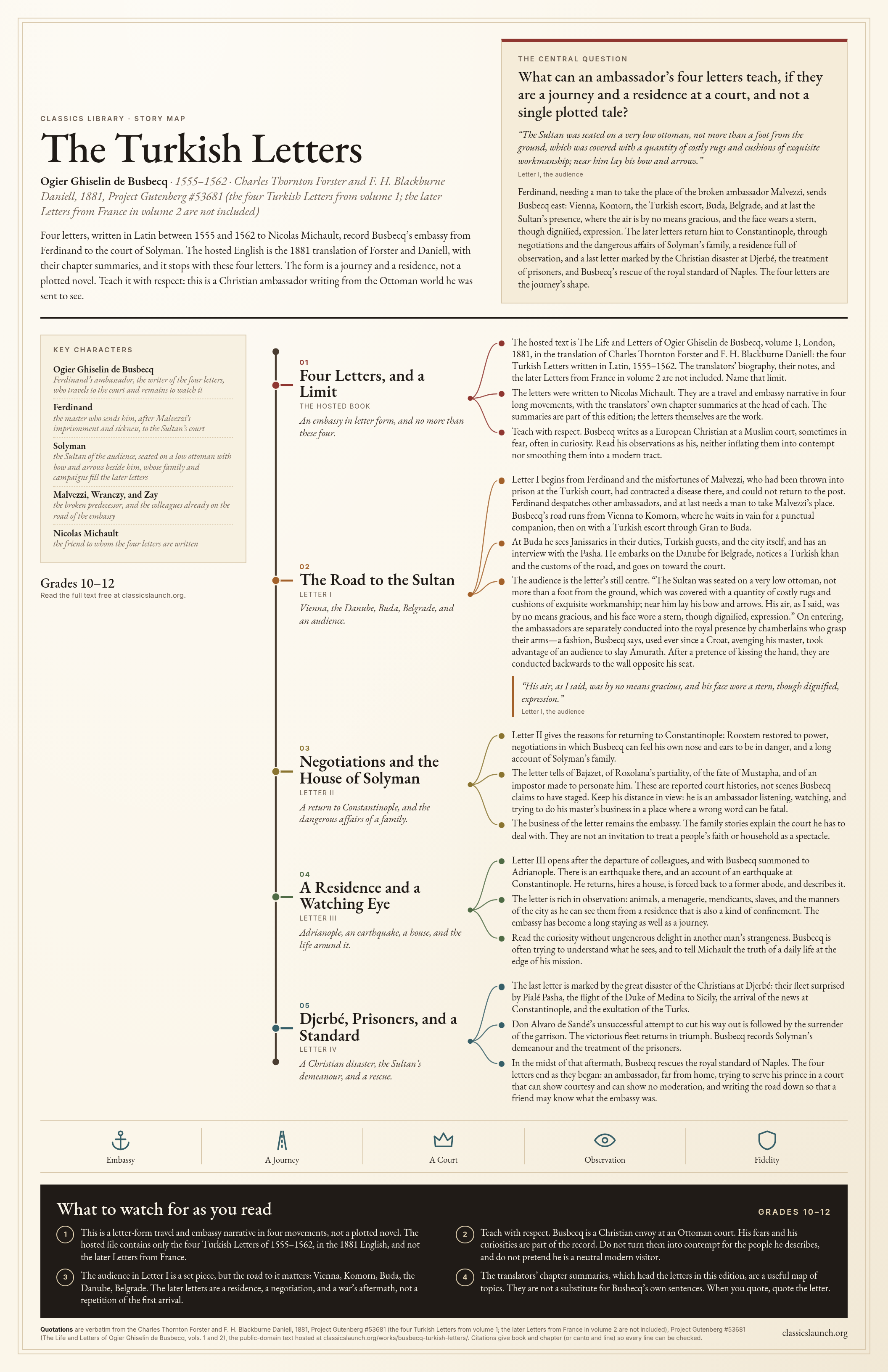
Four letters, written in Latin between 1555 and 1562 to Nicolas Michault, record Busbecq’s embassy from Ferdinand to the court of Solyman. The hosted English is the 1881 translation of Forster and Daniell, with their chapter summaries, and it stops with these four letters. The form is a journey and a residence, not a plotted novel. Teach it with respect: this is a Christian ambassador writing from the Ottoman world he was sent to see.
The central question
What can an ambassador’s four letters teach, if they are a journey and a residence at a court, and not a single plotted tale?
“The Sultan was seated on a very low ottoman, not more than a foot from the ground, which was covered with a quantity of costly rugs and cushions of exquisite workmanship; near him lay his bow and arrows.”
Ferdinand, needing a man to take the place of the broken ambassador Malvezzi, sends Busbecq east: Vienna, Komorn, the Turkish escort, Buda, Belgrade, and at last the Sultan’s presence, where the air is by no means gracious, and the face wears a stern, though dignified, expression. The later letters return him to Constantinople, through negotiations and the dangerous affairs of Solyman’s family, a residence full of observation, and a last letter marked by the Christian disaster at Djerbé, the treatment of prisoners, and Busbecq’s rescue of the royal standard of Naples. The four letters are the journey’s shape.
- 01
Four Letters, and a Limit
The hosted book
An embassy in letter form, and no more than these four.
- The hosted text is The Life and Letters of Ogier Ghiselin de Busbecq, volume 1, London, 1881, in the translation of Charles Thornton Forster and F. H. Blackburne Daniell: the four Turkish Letters written in Latin, 1555–1562. The translators’ biography, their notes, and the later Letters from France in volume 2 are not included. Name that limit.
- The letters were written to Nicolas Michault. They are a travel and embassy narrative in four long movements, with the translators’ own chapter summaries at the head of each. The summaries are part of this edition; the letters themselves are the work.
- Teach with respect. Busbecq writes as a European Christian at a Muslim court, sometimes in fear, often in curiosity. Read his observations as his, neither inflating them into contempt nor smoothing them into a modern tract.
- 02
The Road to the Sultan
Letter I
Vienna, the Danube, Buda, Belgrade, and an audience.
- Letter I begins from Ferdinand and the misfortunes of Malvezzi, who had been thrown into prison at the Turkish court, had contracted a disease there, and could not return to the post. Ferdinand despatches other ambassadors, and at last needs a man to take Malvezzi’s place. Busbecq’s road runs from Vienna to Komorn, where he waits in vain for a punctual companion, then on with a Turkish escort through Gran to Buda.
- At Buda he sees Janissaries in their duties, Turkish guests, and the city itself, and has an interview with the Pasha. He embarks on the Danube for Belgrade, notices a Turkish khan and the customs of the road, and goes on toward the court.
- The audience is the letter’s still centre. “The Sultan was seated on a very low ottoman, not more than a foot from the ground, which was covered with a quantity of costly rugs and cushions of exquisite workmanship; near him lay his bow and arrows. His air, as I said, was by no means gracious, and his face wore a stern, though dignified, expression.” On entering, the ambassadors are separately conducted into the royal presence by chamberlains who grasp their arms—a fashion, Busbecq says, used ever since a Croat, avenging his master, took advantage of an audience to slay Amurath. After a pretence of kissing the hand, they are conducted backwards to the wall opposite his seat.
“His air, as I said, was by no means gracious, and his face wore a stern, though dignified, expression.”
- 03
Negotiations and the House of Solyman
Letter II
A return to Constantinople, and the dangerous affairs of a family.
- Letter II gives the reasons for returning to Constantinople: Roostem restored to power, negotiations in which Busbecq can feel his own nose and ears to be in danger, and a long account of Solyman’s family.
- The letter tells of Bajazet, of Roxolana’s partiality, of the fate of Mustapha, and of an impostor made to personate him. These are reported court histories, not scenes Busbecq claims to have staged. Keep his distance in view: he is an ambassador listening, watching, and trying to do his master’s business in a place where a wrong word can be fatal.
- The business of the letter remains the embassy. The family stories explain the court he has to deal with. They are not an invitation to treat a people’s faith or household as a spectacle.
- 04
A Residence and a Watching Eye
Letter III
Adrianople, an earthquake, a house, and the life around it.
- Letter III opens after the departure of colleagues, and with Busbecq summoned to Adrianople. There is an earthquake there, and an account of an earthquake at Constantinople. He returns, hires a house, is forced back to a former abode, and describes it.
- The letter is rich in observation: animals, a menagerie, mendicants, slaves, and the manners of the city as he can see them from a residence that is also a kind of confinement. The embassy has become a long staying as well as a journey.
- Read the curiosity without ungenerous delight in another man’s strangeness. Busbecq is often trying to understand what he sees, and to tell Michault the truth of a daily life at the edge of his mission.
- 05
Djerbé, Prisoners, and a Standard
Letter IV
A Christian disaster, the Sultan’s demeanour, and a rescue.
- The last letter is marked by the great disaster of the Christians at Djerbé: their fleet surprised by Pialé Pasha, the flight of the Duke of Medina to Sicily, the arrival of the news at Constantinople, and the exultation of the Turks.
- Don Alvaro de Sandé’s unsuccessful attempt to cut his way out is followed by the surrender of the garrison. The victorious fleet returns in triumph. Busbecq records Solyman’s demeanour and the treatment of the prisoners.
- In the midst of that aftermath, Busbecq rescues the royal standard of Naples. The four letters end as they began: an ambassador, far from home, trying to serve his prince in a court that can show courtesy and can show no moderation, and writing the road down so that a friend may know what the embassy was.
- Embassy
- A Journey
- A Court
- Observation
- Fidelity
What to watch for as you read
Grades 10–12- This is a letter-form travel and embassy narrative in four movements, not a plotted novel. The hosted file contains only the four Turkish Letters of 1555–1562, in the 1881 English, and not the later Letters from France.
- Teach with respect. Busbecq is a Christian envoy at an Ottoman court. His fears and his curiosities are part of the record. Do not turn them into contempt for the people he describes, and do not pretend he is a neutral modern visitor.
- The audience in Letter I is a set piece, but the road to it matters: Vienna, Komorn, Buda, the Danube, Belgrade. The later letters are a residence, a negotiation, and a war’s aftermath, not a repetition of the first arrival.
- The translators’ chapter summaries, which head the letters in this edition, are a useful map of topics. They are not a substitute for Busbecq’s own sentences. When you quote, quote the letter.
Every quotation is word for word from the Charles Thornton Forster and F. H. Blackburne Daniell, 1881, Project Gutenberg #53681 (the four Turkish Letters from volume 1; the later Letters from France in volume 2 are not included) hosted in this library and is checked against that text each time the site is built. Citations give book and chapter (or canto and line).