Story maps · Grades 10–12
The Schoolmistress and Other Stories: A Story Map
The PDF is one tabloid page (11 × 17 in). On letter paper, choose “Fit to page.”
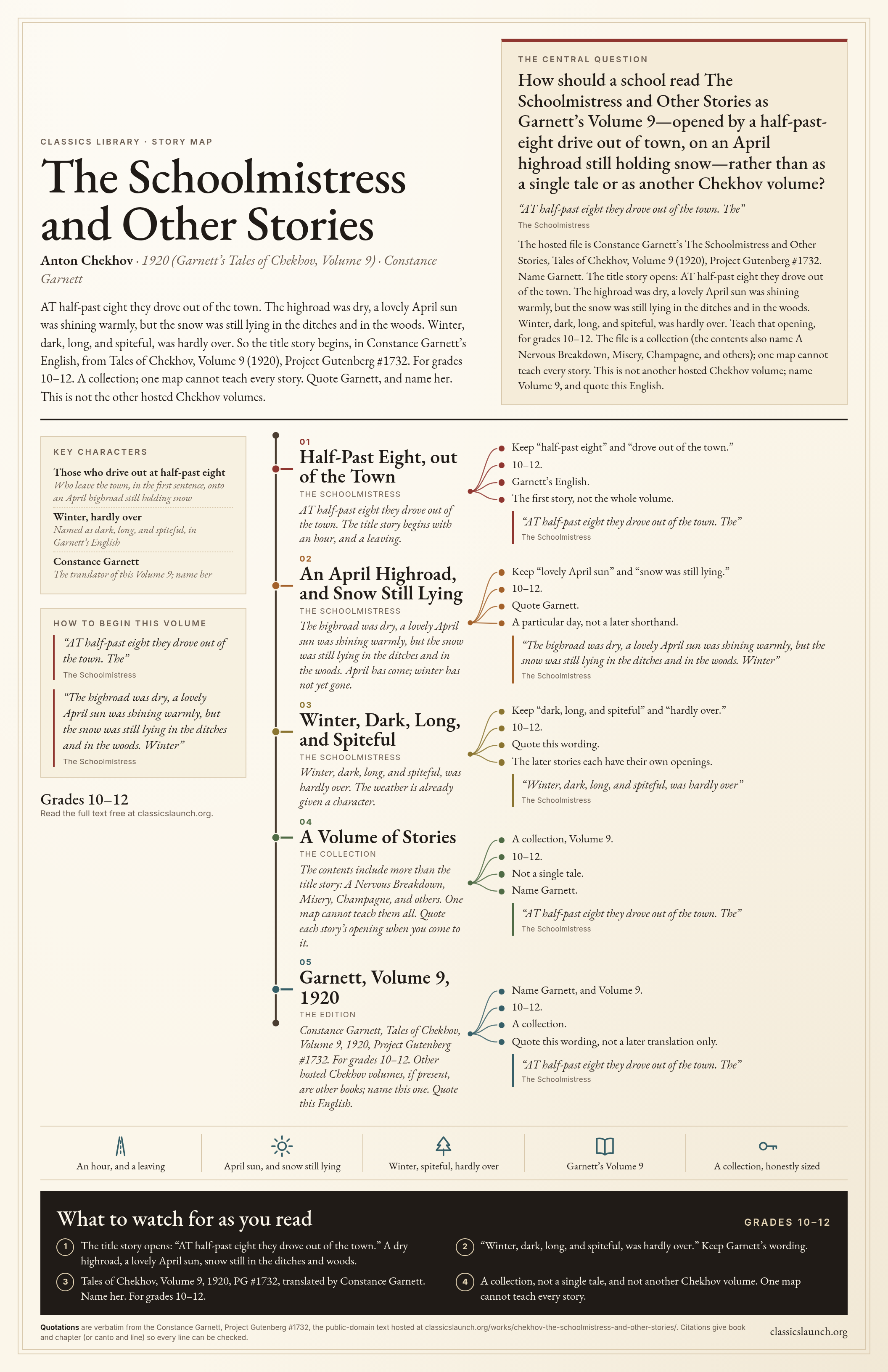
AT half-past eight they drove out of the town. The highroad was dry, a lovely April sun was shining warmly, but the snow was still lying in the ditches and in the woods. Winter, dark, long, and spiteful, was hardly over. So the title story begins, in Constance Garnett’s English, from Tales of Chekhov, Volume 9 (1920), Project Gutenberg #1732. For grades 10–12. A collection; one map cannot teach every story. Quote Garnett, and name her. This is not the other hosted Chekhov volumes.
The central question
How should a school read The Schoolmistress and Other Stories as Garnett’s Volume 9—opened by a half-past-eight drive out of town, on an April highroad still holding snow—rather than as a single tale or as another Chekhov volume?
“AT half-past eight they drove out of the town. The”
The hosted file is Constance Garnett’s The Schoolmistress and Other Stories, Tales of Chekhov, Volume 9 (1920), Project Gutenberg #1732. Name Garnett. The title story opens: AT half-past eight they drove out of the town. The highroad was dry, a lovely April sun was shining warmly, but the snow was still lying in the ditches and in the woods. Winter, dark, long, and spiteful, was hardly over. Teach that opening, for grades 10–12. The file is a collection (the contents also name A Nervous Breakdown, Misery, Champagne, and others); one map cannot teach every story. This is not another hosted Chekhov volume; name Volume 9, and quote this English.
- 01
Half-Past Eight, out of the Town
The Schoolmistress
AT half-past eight they drove out of the town. The title story begins with an hour, and a leaving.
- Keep “half-past eight” and “drove out of the town.”
- 10–12.
- Garnett’s English.
- The first story, not the whole volume.
“AT half-past eight they drove out of the town. The”
- 02
An April Highroad, and Snow Still Lying
The Schoolmistress
The highroad was dry, a lovely April sun was shining warmly, but the snow was still lying in the ditches and in the woods. April has come; winter has not yet gone.
- Keep “lovely April sun” and “snow was still lying.”
- 10–12.
- Quote Garnett.
- A particular day, not a later shorthand.
“The highroad was dry, a lovely April sun was shining warmly, but the snow was still lying in the ditches and in the woods. Winter”
- 03
Winter, Dark, Long, and Spiteful
The Schoolmistress
Winter, dark, long, and spiteful, was hardly over. The weather is already given a character.
- Keep “dark, long, and spiteful” and “hardly over.”
- 10–12.
- Quote this wording.
- The later stories each have their own openings.
“Winter, dark, long, and spiteful, was hardly over”
- 04
A Volume of Stories
The collection
The contents include more than the title story: A Nervous Breakdown, Misery, Champagne, and others. One map cannot teach them all. Quote each story’s opening when you come to it.
- A collection, Volume 9.
- 10–12.
- Not a single tale.
- Name Garnett.
“AT half-past eight they drove out of the town. The”
- 05
Garnett, Volume 9, 1920
The edition
Constance Garnett, Tales of Chekhov, Volume 9, 1920, Project Gutenberg #1732. For grades 10–12. Other hosted Chekhov volumes, if present, are other books; name this one. Quote this English.
- Name Garnett, and Volume 9.
- 10–12.
- A collection.
- Quote this wording, not a later translation only.
“AT half-past eight they drove out of the town. The”
- An hour, and a leaving
- April sun, and snow still lying
- Winter, spiteful, hardly over
- Garnett’s Volume 9
- A collection, honestly sized
What to watch for as you read
Grades 10–12- The title story opens: “AT half-past eight they drove out of the town.” A dry highroad, a lovely April sun, snow still in the ditches and woods.
- “Winter, dark, long, and spiteful, was hardly over.” Keep Garnett’s wording.
- Tales of Chekhov, Volume 9, 1920, PG #1732, translated by Constance Garnett. Name her. For grades 10–12.
- A collection, not a single tale, and not another Chekhov volume. One map cannot teach every story.
Every quotation is word for word from the Constance Garnett hosted in this library and is checked against that text each time the site is built. Citations give book and chapter (or canto and line).