Story maps · Grades 9–12
The Steppe: A Story Map
The PDF is one tabloid page (11 × 17 in). On letter paper, choose “Fit to page.”
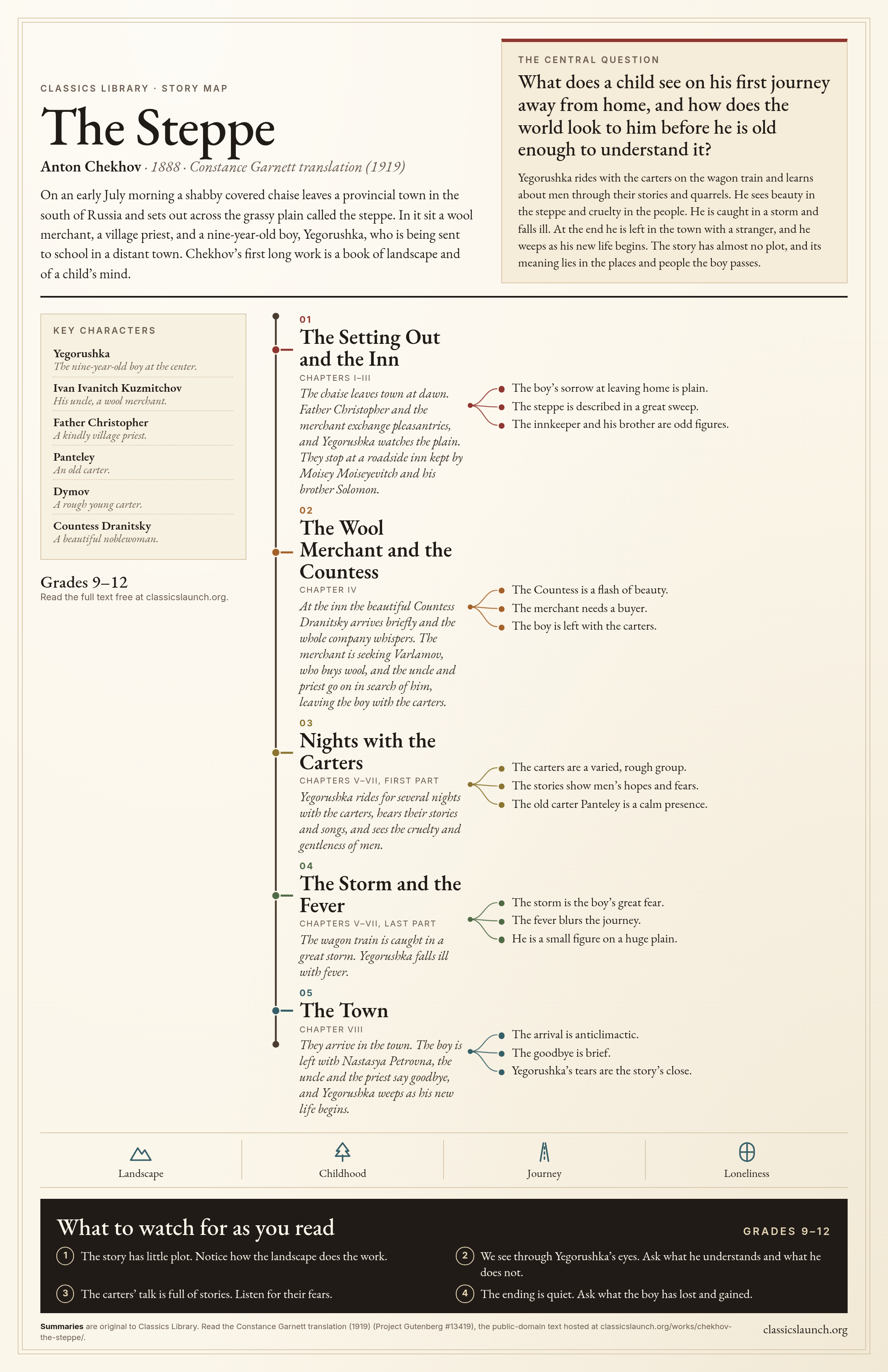
On an early July morning a shabby covered chaise leaves a provincial town in the south of Russia and sets out across the grassy plain called the steppe. In it sit a wool merchant, a village priest, and a nine-year-old boy, Yegorushka, who is being sent to school in a distant town. Chekhov’s first long work is a book of landscape and of a child’s mind.
The central question
What does a child see on his first journey away from home, and how does the world look to him before he is old enough to understand it?
Yegorushka rides with the carters on the wagon train and learns about men through their stories and quarrels. He sees beauty in the steppe and cruelty in the people. He is caught in a storm and falls ill. At the end he is left in the town with a stranger, and he weeps as his new life begins. The story has almost no plot, and its meaning lies in the places and people the boy passes.
- 01
The Setting Out and the Inn
Chapters I–III
The chaise leaves town at dawn. Father Christopher and the merchant exchange pleasantries, and Yegorushka watches the plain. They stop at a roadside inn kept by Moisey Moiseyevitch and his brother Solomon.
- The boy’s sorrow at leaving home is plain.
- The steppe is described in a great sweep.
- The innkeeper and his brother are odd figures.
- 02
The Wool Merchant and the Countess
Chapter IV
At the inn the beautiful Countess Dranitsky arrives briefly and the whole company whispers. The merchant is seeking Varlamov, who buys wool, and the uncle and priest go on in search of him, leaving the boy with the carters.
- The Countess is a flash of beauty.
- The merchant needs a buyer.
- The boy is left with the carters.
- 03
Nights with the Carters
Chapters V–VII, first part
Yegorushka rides for several nights with the carters, hears their stories and songs, and sees the cruelty and gentleness of men.
- The carters are a varied, rough group.
- The stories show men’s hopes and fears.
- The old carter Panteley is a calm presence.
- 04
The Storm and the Fever
Chapters V–VII, last part
The wagon train is caught in a great storm. Yegorushka falls ill with fever.
- The storm is the boy’s great fear.
- The fever blurs the journey.
- He is a small figure on a huge plain.
- 05
The Town
Chapter VIII
They arrive in the town. The boy is left with Nastasya Petrovna, the uncle and the priest say goodbye, and Yegorushka weeps as his new life begins.
- The arrival is anticlimactic.
- The goodbye is brief.
- Yegorushka’s tears are the story’s close.
- Landscape
- Childhood
- Journey
- Loneliness
What to watch for as you read
Grades 9–12- The story has little plot. Notice how the landscape does the work.
- We see through Yegorushka’s eyes. Ask what he understands and what he does not.
- The carters’ talk is full of stories. Listen for their fears.
- The ending is quiet. Ask what the boy has lost and gained.
Every quotation is word for word from the Constance Garnett translation (1919) hosted in this library and is checked against that text each time the site is built. Citations give book and chapter (or canto and line).