Work record
The Steppe
Anton ChekhovThe Steppe: The Story of a Journey; The Steppe (Chekhov)The Steppe by Anton Chekhov (1888)The Steppe is Chekhov's first long work, a book of landscape and of a child's mind.Also known as: The Steppe: The Story of a Journey · The Steppe (Chekhov)
1888 · 19th Century · Novella · Russian
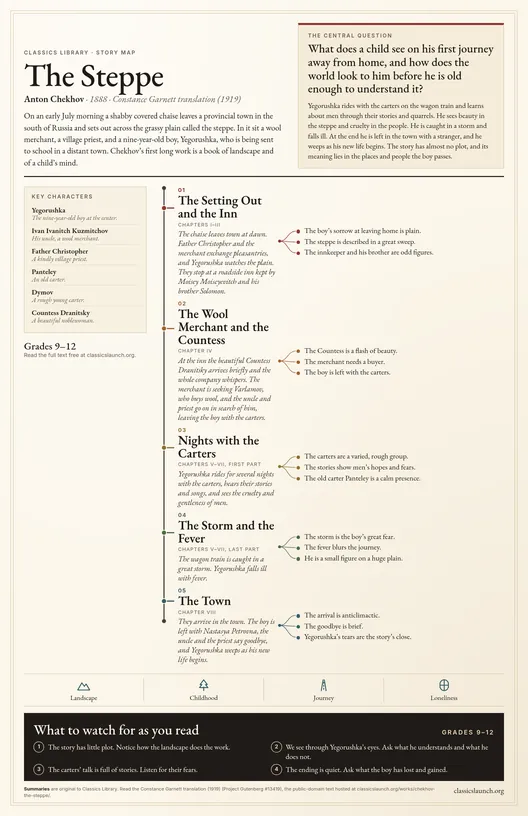 Story mapSee the story mapThe whole book on one page: the story in movements, the characters, and what to watch for. Free to print.
Abstract
Background. Chekhov wrote this story in 1888 for the Northern Herald, a serious literary magazine, and it brought him to the notice of the literary world. He called it a picture of the steppe and its people.
Plot. A boy is taken across the plain by his uncle and a priest to be sent to school. On the way he spends nights among carters, hears their tales, endures a storm and a fever, and is left among strangers in the town. The story ends on a question.
Ideas. The story shows the beauty and loneliness of a vast landscape and the way a child feels it. It balances kindness and cruelty, and honors a priest's blessing in a world that gives the boy no promise.
Text. The Garnett translation is smooth and gentle, with long descriptive sentences and brief dialogue. The story has no plot to speak of, and is best read slowly, a chapter at a time. Teachers can pair this work with the library's study guide, seminar questions and memory-work selection to prepare a discussion, a short essay or a recitation. The full text is hosted on this site, and each quotation in the guide has been checked against the hosted translation.
Main characters
- Yegorushka: A nine-year-old boy sent to school
- Kuzmitchov: His merchant uncle
- Father Christopher: A kind old priest
- Panteley: An old carter

Summary
The Steppe is Chekhov's first long work, a book of landscape and of a child's mind. On an early morning in July a shabby covered chaise leaves a provincial town in the south of Russia and sets out across the grassy plain called the steppe. In it sit three men: a merchant, Ivan Ivanitch Kuzmitchov, who is going to sell wool; a village priest, Father Christopher, who goes with him for company; and the boy Yegorushka, nine years old, Kuzmitchov's nephew, who has been sent to town to begin school. His mother, a widow, is fond of educated people and wishes him to rise. Yegorushka is not glad. He leaves behind his home and his mother, and he has to ride for days with two old men who do not speak to him. There is no plot in the usual sense. The journey is a chain of encounters and impressions. The travellers rest at noon in the heat, stop at an inn kept by a Jewish family, see the beautiful Countess Dranitsky arrive and leave, and join a train of wagons carrying wool, where Yegorushka lives for several nights among the carters. The steppe grows alive and enormous around them: the poplar by the road that seems to be alone for life, the grass and the larks, the mournful songs of the women, the storm at night, the stars. The carters tell stories of robbers, of a merchant killed by brigands, of old Panteley's ruined life. Yegorushka sees a cruel man kill a snake, a young man fight and be beaten, and an old man pray in terror at the thunder. The long-awaited storm breaks one night and drenches Yegorushka. He falls ill with a fever and is carried into the house of a family friend, Nastasya Petrovna, in the town. The final scene is quiet and sad. The uncle and the priest say good-bye. Father Christopher blesses the boy and tells him to study and to remember him in his prayers. Yegorushka cries and feels that with these people everything he has known has vanished for ever, and the story ends on the question what the new life will be like. Chekhov himself called the work an encyclopedia of the steppe. It is a story of a child's first sorrow and his first sight of the world's size and loneliness, written with a lightness of touch that shows his debt to Gogol and Turgenev. Christian readers will find in it the quiet beauty of creation, the plain faith of the old priest, and the sorrow of a child who is sent away from home.
Virtues in this work
- Faith: Father Christopher's prayer and blessing are the story's modest picture of faith.
- Charity: The carters' care for the boy at night is a small sign of charity among rough men.
- Humility: The story treats a child's smallness before the plain with respect and gentle awe.
- Hope: The final question leaves the boy's future open, which the story treats as a form of hope.
Plot or Argument
- Chapters I–III: The setting out and the inn
The chaise leaves town at dawn. Father Christopher and the merchant exchange pleasantries, and Yegorushka watches the plain. They stop at a roadside inn kept by Moisey Moiseyevitch and his brother Solomon.
- Chapter IV: The wool merchant and the countess
At the inn the beautiful Countess Dranitsky arrives briefly and the whole company whispers. The merchant is seeking Varlamov, who buys wool, and the uncle and priest go on in search of him, leaving the boy with the carters.
- Chapters V–VII: The wagon train
Yegorushka rides for several nights with the carters, hears their stories and songs, sees the cruelty and gentleness of men, and is caught in a great storm. He falls ill with fever.
- Chapter VIII: The town
They arrive in the town. The boy is left with Nastasya Petrovna, the uncle and the priest say goodbye, and Yegorushka weeps as his new life begins.
Characters
- Yegorushka, protagonist
A nine-year-old boy sent to school, who watches the steppe, the carters and the storm with a child's open attention.
- Ivan Ivanitch Kuzmitchov, the uncle
A busy, cold merchant who is selling wool and does not understand his nephew.
- Father Christopher, the priest
A kindly, talkative old priest who takes the boy under his protection and blesses him at parting.
- Panteley, the old carter
An old waggoner who tells of the brigands and is a figure of patient suffering.
- Dymov, the carter
A strong, bored young man who kills a snake for no reason, and who is also a fighter.
- Countess Dranitsky, the beauty
A young woman of great wealth, seen briefly at the inn, who stands for what is beautiful and out of reach.
Lessons
A child sees the world's loneliness
Yegorushka does not know what he feels, but the steppe, the song and the storm fill him with a sense of being alone in something huge. Chekhov shows that a child's attention is a form of moral education.
- What does Yegorushka notice that the adults do not?
- Why does Chekhov call the plain lonely?
Gentleness and cruelty live side by side
The carters tell stories of violence, kill a snake without cause, and yet sit up at night to feed and comfort a boy. A good reader will note how neither side of their character cancels the other.
- Where do the carters show kindness to Yegorushka?
- What does the killing of the snake say about Dymov?
A blessing sends a child out
Father Christopher's parting words, to study, to work hard and to remember him in prayer, are plain and sincere. The story honors the old man's faith as the small, steady light in a dark landscape.
- What does the priest give Yegorushka at the end?
- Why does Chekhov end with a question?
Context
The story is set in the steppe of southern Russia, in the Ukraine and Don region, in the 1870s, a country of wide plains, wool merchants and carters, on the edge of the world of gentlemen and universities. Chekhov was born in Taganrog, at the edge of this country, and knew it from his childhood.
Composition
Chekhov wrote the story in 1888 and printed it in the Northern Herald, a serious literary magazine, which was his first appearance in a major monthly. He called it a study of the steppe. The Garnett translation hosted here is from 1919.
Reception
The story won him the attention of the literary world and the Pushkin Prize in the same year, and established him as a serious writer after years of comic sketches.
Comparisons
- A Sportsman's Sketches
Turgenev's sketches of the Russian countryside and its people are the model for Chekhov's love of a particular place, and its peasants and storms.
- Childhood, Boyhood, Youth
Tolstoy's picture of a boy's early life in Russia is a counterpart to Chekhov's journey, with more reflection and less landscape.
- Ward No. 6
Chekhov's later, darker story of the provincial world, written four years afterward.
- Dead Souls
Gogol's picaresque novel travels the same Russian roads in the comic mode, with a rogue where Chekhov has a child.
- Adventures of Huckleberry Finn
Another boy's journey across a great landscape in a book that mixes humor, cruelty and wonder.
Quotes
Frequently cited
“Was that lovely creature happy? Sultry heat in summer, in winter frost and snowstorms, terrible nights in autumn when nothing is to be seen but darkness and nothing is to be heard but the senseless angry howling wind, and, worst of all, alone, alone for the whole of life”
Frequently cited
“Father Christopher, without haste, blessed Yegorushka. "In the name of the Father, the Son, and the Holy Ghost. . . . Study," he said. "Work hard, my lad. If I die, remember me in your prayers.”
Frequently cited
“Yegorushka felt that with these people all that he had known till then had vanished from him for ever. He sank helplessly on to the little bench, and with bitter tears greeted the new unknown life that was beginning for him now. . . . What would that life be like?”
“it was guiltless, but yet it prayed forgiveness and protested that it was in anguish, sad and sorry for itself.”
“It is terribly lonely and caressing; it looks down languid and alluring, and its caressing sweetness makes one giddy.”
For Students
A reading companion for classical Christian high school students. See the student guide.
Reading Guide
Watch for
- How each chapter begins with a scene in the landscape before it shows people.
- The stories the carters tell at night, and how Yegorushka listens.
- Every time Father Christopher speaks of God, school or prayer.
Key terms and names
- Steppe
- A vast treeless grassy plain, as in southern Russia and Ukraine.
- Chaise
- A light open carriage, here a covered chaise without springs.
- Waggoner
- A carter who drives a wagon train, here transporting wool.
- Collegiate secretary
- A civil-service rank in imperial Russia, the late father's rank.
Seminar Questions
- Comprehension Who is Yegorushka, and where is he going?
- Comprehension Who are the three travelers in the chaise, and what are they after?
- Interpretation Why does Chekhov devote so much space to landscape?
- Interpretation What do the stories of the carters tell about the steppe?
- Interpretation Why does the story end with a question?
- Big Question Is a boy's loneliness a loss or a gift? Argue from the story.
- Big Question What kind of faith does Father Christopher represent, and is it enough?
Faith Connections
- Psalm 19:1–4 (Scripture)
'The heavens declare the glory of God.' The steppe sky, the stars and the storm in the story are praised without a name for their maker, and the psalm supplies it.
- Proverbs 22:6 (Scripture)
'Train up a child in the way he should go.' The uncle and the priest and the mother each attempt it in a different way.
- Psalm 139:7–10 (Scripture)
'Where shall I flee from your presence?' A child alone on a great plain at night is a good picture of the psalm's question.
Logic and Rhetoric
Central argument: A child's first experience of the world's size and loneliness is also a moral education, in which beauty, cruelty and kindness meet. The story argues by accumulation of scenes, not by statement.
Rhetorical device: personification. Chekhov gives the poplar, the grass and the song a life of their own, as when the song prays forgiveness and is sad and sorry for itself.
Debate: Resolved: That The Steppe is a story about a child more than about a place.
Memory Work
Father Christopher, without haste, blessed Yegorushka. "In the name of the Father, the Son, and the Holy Ghost. . . . Study," he said. "Work hard, my lad. If I die, remember me in your prayers.
Yegorushka felt that with these people all that he had known till then had vanished from him for ever. He sank helplessly on to the little bench, and with bitter tears greeted the new unknown life that was beginning for him now. . . . What would that life be like?
Writing Prompts
Essay: Choose three moments in the journey and show how each changes Yegorushka. What has he learned by the end?
Comparison with Childhood, Boyhood, Youth: Compare the way Tolstoy and Chekhov treat a child's first loss. What does each choose to describe?
Medical Lens
Yegorushka catches a chill and fever after the great storm and is nursed by a stranger. The story also contains accounts of killing by brigands and of old age and fatigue, but no clinical detail.
- Chapter VII, after the storm
The boy is drenched, shivers and falls ill with a fever.
Creative Prompts
- Essay
Choose one passage describing the steppe and show how Chekhov creates a mood through a few images.
- Fiction
Write a short scene of a journey seen through a child's eyes, with one clear event and many plain details.
- Classroom
Read the last page of The Steppe aloud. What does the question at the end leave with the reader?
- Dialogue
Write a conversation between Yegorushka and Father Christopher on the last night.
Further Reading
- A Sportsman's Sketches, Ivan Turgenev
A great earlier book of the Russian countryside; hosted in this library.
- Childhood, Boyhood, Youth, Leo Tolstoy
Tolstoy's account of a boyhood; hosted in this library.
- Ward No. 6, Anton Chekhov
Chekhov's later story; hosted in this library.
- Chekhov: A Life, Donald Rayfield
A full account of the writer's early years.
Verification notes
Full text from Project Gutenberg, the Constance Garnett translation (dated 1919 in the hosted source), in public domain. Quotes were checked against the hosted text. The journalistic details of 1888 publication and the prize follow standard accounts.
- The magazine in which the story first appeared and the exact month.
- The year of Garnett's translation (1919 as hosted) against the first printed volume.