Story maps · Grades 9–12
The History of Alexander the Great: A Story Map
The PDF is one tabloid page (11 × 17 in). On letter paper, choose “Fit to page.”
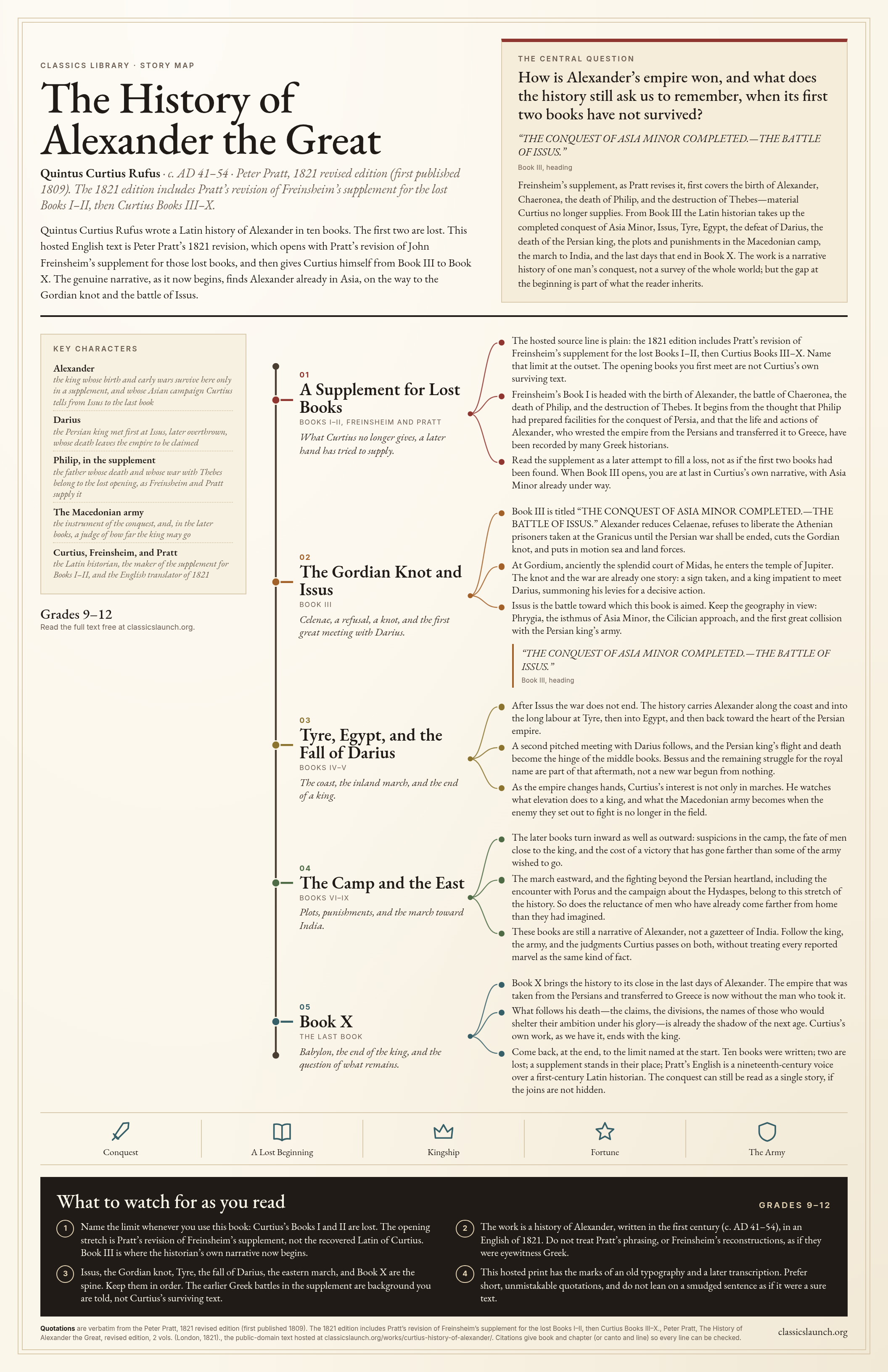
Quintus Curtius Rufus wrote a Latin history of Alexander in ten books. The first two are lost. This hosted English text is Peter Pratt’s 1821 revision, which opens with Pratt’s revision of John Freinsheim’s supplement for those lost books, and then gives Curtius himself from Book III to Book X. The genuine narrative, as it now begins, finds Alexander already in Asia, on the way to the Gordian knot and the battle of Issus.
The central question
How is Alexander’s empire won, and what does the history still ask us to remember, when its first two books have not survived?
“THE CONQUEST OF ASIA MINOR COMPLETED.—THE BATTLE OF ISSUS.”
Freinsheim’s supplement, as Pratt revises it, first covers the birth of Alexander, Chaeronea, the death of Philip, and the destruction of Thebes—material Curtius no longer supplies. From Book III the Latin historian takes up the completed conquest of Asia Minor, Issus, Tyre, Egypt, the defeat of Darius, the death of the Persian king, the plots and punishments in the Macedonian camp, the march to India, and the last days that end in Book X. The work is a narrative history of one man’s conquest, not a survey of the whole world; but the gap at the beginning is part of what the reader inherits.
- 01
A Supplement for Lost Books
Books I–II, Freinsheim and Pratt
What Curtius no longer gives, a later hand has tried to supply.
- The hosted source line is plain: the 1821 edition includes Pratt’s revision of Freinsheim’s supplement for the lost Books I–II, then Curtius Books III–X. Name that limit at the outset. The opening books you first meet are not Curtius’s own surviving text.
- Freinsheim’s Book I is headed with the birth of Alexander, the battle of Chaeronea, the death of Philip, and the destruction of Thebes. It begins from the thought that Philip had prepared facilities for the conquest of Persia, and that the life and actions of Alexander, who wrested the empire from the Persians and transferred it to Greece, have been recorded by many Greek historians.
- Read the supplement as a later attempt to fill a loss, not as if the first two books had been found. When Book III opens, you are at last in Curtius’s own narrative, with Asia Minor already under way.
- 02
The Gordian Knot and Issus
Book III
Celenae, a refusal, a knot, and the first great meeting with Darius.
- Book III is titled “THE CONQUEST OF ASIA MINOR COMPLETED.—THE BATTLE OF ISSUS.” Alexander reduces Celaenae, refuses to liberate the Athenian prisoners taken at the Granicus until the Persian war shall be ended, cuts the Gordian knot, and puts in motion sea and land forces.
- At Gordium, anciently the splendid court of Midas, he enters the temple of Jupiter. The knot and the war are already one story: a sign taken, and a king impatient to meet Darius, summoning his levies for a decisive action.
- Issus is the battle toward which this book is aimed. Keep the geography in view: Phrygia, the isthmus of Asia Minor, the Cilician approach, and the first great collision with the Persian king’s army.
“THE CONQUEST OF ASIA MINOR COMPLETED.—THE BATTLE OF ISSUS.”
- 03
Tyre, Egypt, and the Fall of Darius
Books IV–V
The coast, the inland march, and the end of a king.
- After Issus the war does not end. The history carries Alexander along the coast and into the long labour at Tyre, then into Egypt, and then back toward the heart of the Persian empire.
- A second pitched meeting with Darius follows, and the Persian king’s flight and death become the hinge of the middle books. Bessus and the remaining struggle for the royal name are part of that aftermath, not a new war begun from nothing.
- As the empire changes hands, Curtius’s interest is not only in marches. He watches what elevation does to a king, and what the Macedonian army becomes when the enemy they set out to fight is no longer in the field.
- 04
The Camp and the East
Books VI–IX
Plots, punishments, and the march toward India.
- The later books turn inward as well as outward: suspicions in the camp, the fate of men close to the king, and the cost of a victory that has gone farther than some of the army wished to go.
- The march eastward, and the fighting beyond the Persian heartland, including the encounter with Porus and the campaign about the Hydaspes, belong to this stretch of the history. So does the reluctance of men who have already come farther from home than they had imagined.
- These books are still a narrative of Alexander, not a gazetteer of India. Follow the king, the army, and the judgments Curtius passes on both, without treating every reported marvel as the same kind of fact.
- 05
Book X
The last book
Babylon, the end of the king, and the question of what remains.
- Book X brings the history to its close in the last days of Alexander. The empire that was taken from the Persians and transferred to Greece is now without the man who took it.
- What follows his death—the claims, the divisions, the names of those who would shelter their ambition under his glory—is already the shadow of the next age. Curtius’s own work, as we have it, ends with the king.
- Come back, at the end, to the limit named at the start. Ten books were written; two are lost; a supplement stands in their place; Pratt’s English is a nineteenth-century voice over a first-century Latin historian. The conquest can still be read as a single story, if the joins are not hidden.
- Conquest
- A Lost Beginning
- Kingship
- Fortune
- The Army
What to watch for as you read
Grades 9–12- Name the limit whenever you use this book: Curtius’s Books I and II are lost. The opening stretch is Pratt’s revision of Freinsheim’s supplement, not the recovered Latin of Curtius. Book III is where the historian’s own narrative now begins.
- The work is a history of Alexander, written in the first century (c. AD 41–54), in an English of 1821. Do not treat Pratt’s phrasing, or Freinsheim’s reconstructions, as if they were eyewitness Greek.
- Issus, the Gordian knot, Tyre, the fall of Darius, the eastern march, and Book X are the spine. Keep them in order. The earlier Greek battles in the supplement are background you are told, not Curtius’s surviving text.
- This hosted print has the marks of an old typography and a later transcription. Prefer short, unmistakable quotations, and do not lean on a smudged sentence as if it were a sure text.
Every quotation is word for word from the Peter Pratt, 1821 revised edition (first published 1809). The 1821 edition includes Pratt’s revision of Freinsheim’s supplement for the lost Books I–II, then Curtius Books III–X. hosted in this library and is checked against that text each time the site is built. Citations give book and chapter (or canto and line).