Work record
The History of Alexander the Great
Quintus Curtius RufusThe History of Alexander the Great by Quintus Curtius Rufus (c. AD 41–54)The History of Alexander the Great is the only surviving Latin history devoted wholly to Alexander, written by Quintus Curtius Rufus, most likely in the first century AD.c. AD 41–54 · Ancient · History · Latin
Read this when you want Alexander judged as a character, not only as a conqueror.
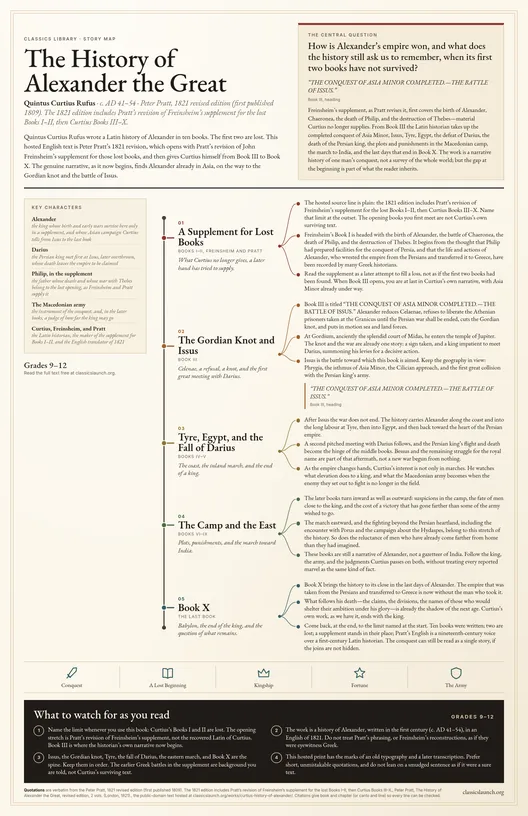 Story mapSee the story mapThe whole book on one page: the story in movements, the characters, and what to watch for. Free to print.
Abstract
Background. A Roman writer of the early imperial age devoted ten books to the Macedonian conqueror. Because the opening books of that Latin history did not survive, the English edition used here prefixes a reconstructed youth and first wars before the genuine text resumes.
Scope. From the approach to the first great meeting with Darius, the story moves through the siege of Tyre, the collapse of the Persian royal cause, the long advance into the east, and the final days at Babylon, after which the leading officers begin to seize what they can.
Method. The historian's taste is oratorical: speeches, counsel scenes, and contrasts of mercy and anger do as much work as the order of marches, and the question throughout is what almost unlimited success does to a king's self-command.
Significance. For many centuries this Latin Alexander was a familiar school history, and in 1785 it was included in the first historical stage of a plan of study drawn up in Paris for a young American, just after the Greek historians. Readers who already know a Greek campaign account of the same life will notice how much more this Roman writer cares for the trial of a soul than for the technical movement of a phalanx.
Key figures
- Alexander: King of Macedon and subject of the history
- Darius: The Persian king defeated and pursued to his death
- Clitus: The companion killed in the later books
Summary
The History of Alexander the Great is the only surviving Latin history devoted wholly to Alexander, written by Quintus Curtius Rufus, most likely in the first century AD. The first two books of Curtius himself are lost; the 1821 English edition hosted here opens with a supplement, revised by the translator Peter Pratt from the earlier reconstruction by Johann Freinsheim, covering Alexander's birth, the death of Philip, and the destruction of Thebes. With Book III the genuine Curtius begins, and the narrative runs through the cutting of the knot at Gordium, the battle of Issus, the long siege of Tyre, Egypt, the victory near Gaugamela, the death of Darius, the march into Bactria and India, the killing of Clitus, the marriage with Roxana, the campaign against Porus, the return, and Alexander's death, after which the leading captains divide the empire. Curtius is as much a moralist as a campaign historian. He attends to counsel given and refused, to the flattery that surrounds a successful king, and to the slow change in Alexander as victory follows victory. Fortune, luxury, anger, and the difference between greatness and self-command are constant themes. The style is rhetorical, and Pratt's English, first published in 1809 and revised in 1821, keeps that elevated manner. Jefferson named Quintus Curtius in the first stage of ancient history he laid out for Peter Carr in 1785, after Herodotus, Thucydides, and Xenophon, and he ordered a copy sent from Paris. A student who has already read Arrian or Plutarch will find here a Roman historian less interested in military technicality than in the trial of a character under almost unbounded success. The hosted text is Pratt's public-domain translation of the 1821 revised edition, not a later copyrighted version. Readers should notice the seam between the reconstructed opening and Book III, and they should read the later books as a study of how power tests a soul, not only as a record of marches and sieges.
Virtues in this work
- Temperance: The later books treat Alexander's anger and luxury as the moral danger that follows unchecked success.
- Prudence: Scenes of counsel, accepted or refused, are how Curtius measures a king's fitness as much as any battle does.
- Magnanimity: At moments such as the treatment of Darius's family or of Porus, Curtius still records a greatness of mind in victory.
Plot or Argument
- Supplement, Books I–II: Youth and the first wars
Because Curtius's own first books are lost, this edition supplies a reconstructed opening: Alexander's birth and education, the death of Philip, the destruction of Thebes, and the first movements into Asia, down to the threshold of Issus.
- Books III–V: Issus, Tyre, and the fall of Darius
The genuine Curtius begins at Book III. Alexander cuts the knot at Gordium, defeats Darius at Issus, takes Tyre after a long siege, enters Egypt, wins the great battle in Assyria, and pursues Darius to his death.
- Books VI–X: The farther east, the king's temper, and the aftermath
The later books follow the burning of Persepolis, the death of Clitus, the pages' conspiracy, the Indian campaign and the battle with Porus, the return, Alexander's death at Babylon, and the first division of the empire among his captains.
Characters
- Alexander, King of Macedon
The central figure, followed from the recovered early years through conquest, rising pride, and death.
- Darius, King of Persia
Alexander's rival, defeated at Issus and in Assyria, and finally killed in flight by his own people.
- Parmenio, Macedonian general
The veteran commander whose counsel and later fate mark the changing temper of the court.
- Clitus, Companion
The friend Alexander kills in a quarrel over wine, a turning point in the later books.
- Porus, Indian king
The opponent in the river battle of the later campaign, treated by Alexander with marked honor after defeat.
Lessons
Fortune is not the same as virtue
Curtius never lets the reader forget that Alexander's success is immense and still not a complete moral measure. The later books ask what happens to a soul when almost no earthly check remains.
- At what point in the narrative does success begin to change Alexander's counsel and temper?
- How does Curtius keep admiration and warning together in the same portrait?
Counsel refused
Again and again advisers speak and are not heard, or are heard too late. The history is a school of how a court talks to a powerful man, and of what is lost when frank speech becomes dangerous.
- Choose one scene of counsel before a battle or a punishment. What is at stake in whether Alexander listens?
- Why is the death of Clitus more than a private quarrel?
A Roman historian of a Greek king
Curtius writes in Latin for Roman readers, with a taste for set speeches and moral contrast. Students should notice what a Roman writer wants from the Alexander story, and how that differs from a Greek campaign narrative.
- What kinds of scenes does Curtius expand that a stricter military historian might shorten?
- How does the lost beginning, and the later supplement, change the way the story is first met?
Context
Curtius wrote a ten-book history of Alexander, of which Books III–X survive. The work is usually dated to the first century AD. It became one of the chief Latin sources for Alexander in the Middle Ages and in early modern schools.
Composition
The 1821 Pratt edition used here is a revised form of his 1809 translation, with a supplement for the lost opening books based on Freinsheim. Pratt added geographical and critical notes; the history itself remains a public-domain English rendering of Curtius.
Reception
Jefferson placed Curtius in the first historical course after the Greek historians, and he had a copy sent from Paris for Peter Carr in 1785. English-speaking students long met Alexander through this tradition of school Latin and its translations.
Comparisons
- The Campaigns of Alexander
Arrian's campaign narrative is the other full ancient account commonly read with Curtius; it is cooler and more military, Curtius more rhetorical and moral.
- The Age of Alexander: Nine Greek Lives
Plutarch's life of Alexander, in this library's Age of Alexander grouping, offers a Greek character-study of the same career Curtius tells in Latin.
- The Persian Expedition
Xenophon's march had already shown how a disciplined Greek force could move through the Persian lands Alexander later took; Jefferson set both authors in the same historical course.
Quotes
“Few were the attendants of the king; for the flying army did not take one road;”
“DARIUS —recently at the head of so powerful an army, riding in his car, more in the manner of a victor in a triumphant procession, than of a general advancing to battle—”
For Students
A reading companion for classical Christian high school students. See the student guide.
Reading Guide
Watch for
- The seam between the supplement and Book III, so that you can tell recovered early narrative from Curtius himself.
- The sequence from Gordium and Issus through the siege of Tyre, where counsel, endurance, and severity are all on display.
- The death of Clitus and other court scenes in which anger and flattery start to govern the camp.
- The last book, in which the king's death is followed at once by the question of who will hold what he had taken.
Key terms and names
- Supplement
- The reconstructed Books I–II supplied in this edition to cover the years before the surviving text of Curtius begins at Book III.
- Issus
- The 333 BC battle in which Alexander first defeated Darius in person and captured the Persian royal family.
- Gaugamela
- The later, decisive defeat of Darius in Assyria, often called Arbela in older English, after which the Persian royal cause collapses.
- Fortune
- Curtius's repeated name for the unstable success that lifts a king and can as quickly expose him; not a Christian providence, but a moral test.
Seminar Questions
- Comprehension Why does this edition begin with a supplement, and at what book does the surviving text of Curtius himself begin?
- Comprehension Name three major stages of the campaign between Issus and Alexander's death.
- Interpretation How does Curtius use the death of Clitus to mark a change in Alexander?
- Interpretation In the siege of Tyre or the treatment of Darius's family, where does Curtius ask the reader to admire Alexander, and where to judge him?
- Big Question Can great military success be a moral danger to the person who wins it?
- Big Question What does a historian owe a famous conqueror: praise of his gifts, or a record of what those gifts cost him and others?
Faith Connections
- Proverbs 16:18 (Scripture)
The warning that pride goes before destruction is a just frame for the later books, in which almost unbounded success tests Alexander's self-command.
- Daniel 4:28-32 (Scripture)
Nebuchadnezzar's humiliation in Daniel is a scriptural picture of a great king taught the limits of his power. Students can set that chapter beside Curtius's interest in fortune without treating Alexander's story as the same revelation.
Logic and Rhetoric
Central argument: Curtius tells the life of Alexander in order to show a character under the pressure of almost complete success. The battles matter, but so do the moments of counsel, anger, mercy, and luxury by which a reader can judge whether the king's soul kept pace with his fortune.
Rhetorical device: moral contrast. Set speeches and paired scenes place counsel against impulse, or mercy against a later cruelty, so that the reader's judgment is formed by comparison rather than by a single verdict.
Debate: Resolved: Alexander's later cruelty outweighs the greatness of his earlier campaigns.
Writing Prompts
Essay: Follow one virtue or one vice—self-command, mercy, anger, or love of glory—from Issus to the last book, and show how Curtius traces its change.
Comparison with The Campaigns of Alexander: Arrian writes a campaign history in the Greek tradition; Curtius writes a Latin moral history of the same man. Compare their treatment of one episode you can follow in both, and say what each historian wants the reader to learn.
Creative Prompts
- Essay
Write a judgment of Alexander at the end of Book V and again at the end of Book X, showing what Curtius thinks has changed.
- Dialogue
Write a council scene in Curtius's manner, in which a frank adviser and a flatterer speak to Alexander after a victory.
- Classroom
Give students a map and have them mark Issus, Tyre, Gaugamela, and the Hydaspes, then annotate each site with a question of character rather than of tactics only.
Further Reading
Verification notes
Primary text checked against the edition identified in fullText. No unverified quotations or page numbers supplied. Recommended grades concern teaching suitability, not a mechanical reading score.
No verification flags recorded.