Story maps · Grades 9–12
Cyrano de Bergerac: A Story Map
The PDF is one tabloid page (11 × 17 in). On letter paper, choose “Fit to page.”
A Gascon poet-swordsman with a famously large nose writes another man’s love and keeps his own secret under Roxane’s balcony. Edmond Rostand’s verse play is panache—courage with style—to the last word. This site hosts the 1898 English of Gladys Thomas and Mary F. Guillemard, which ends not on a ‘white plume’ but on ‘My panache.’
The central question
What is panache worth if it will not speak its own love until too late, and can a borrowed voice still be a loyal one?
“My panache.”
Cyrano will fight a hundred men, mock his own nose, and feed his friend poetry, but he will not, until he is dying, claim Roxane’s love in his own name. Christian has the face; Cyrano has the soul of the letters; Roxane loves, first, the words. The generosity is real, and so is the pride that hides. At the convent, years later, the truth comes as he is struck down by a hidden blow. He falls fighting still, and what he will not let them take is his panache. Quote this translation, not a later English ‘white plume.’
- 01
The Hotel de Bourgogne
Act I
A theatre, a crowded pit, and Cyrano stopping the play to fight a duel in verse. Roxane is in her box; Christian, new to the Guards, sees her. The nose is already a legend and a wound.
- The duel-ballade is panache as public craft.
- The descriptive catalogue of the nose—‘’Tis a rock!. . .a peak!. . .a cape!’—is this translation’s wording.
- Le Bret already knows the hidden love.
- 02
The Bakery of the Poets
Act II
Roxane, in Ragueneau’s shop, asks Cyrano to befriend the handsome Christian. Cyrano, who had hoped for himself, promises—and then offers Christian his wit.
- The sacrifice is immediate and almost unspoken.
- The compact of face and soul is the plot’s engine and its cost.
- The cadets and de Guiche set the war and the danger coming.
- 03
Under a Balcony
Act III
Christian cannot speak well enough. Cyrano, in the dark, becomes the voice. The kiss is Christian’s; the words are not. De Guiche is delayed by a pretended fall from the moon, and a sudden marriage is snatched before the regiment leaves for Arras.
- The balcony is the play’s most famous kindness and its most famous deceit.
- Roxane weds the man she thinks has both gifts.
- Cyrano’s self-erasure is complete for the moment.
- 04
The Cadets at Arras
Act IV
Besieged, the Gascons starve. Cyrano crosses the lines daily to send a letter. Roxane comes to the camp. Christian, learning the truth of the letters, would have it told—and is shot before it can be.
- The daily letters are love as duty under fire.
- Christian’s last impulse is more honest than the pact.
- Cyrano, at Roxane’s request, keeps the secret over a dead friend.
- 05
A Convent Garden
Act V
Fourteen years later, Cyrano visits Roxane as he is dying of a hidden blow. He asks to read Christian’s last letter, which he knows by heart. The voice is recognized. He rises to fight shadow-enemies, and his last word is his panache.
- ‘You strip from me the laurel and the rose!’—but one thing is left unstained.
- He would enter ‘Christ’s fair courts’ with that one thing still his.
- The translation’s last word is “My panache.” Do not replace it with a later English line.
“’Tis a rock!. . .a peak!. . .a cape!”
- Panache
- A Hidden Love
- Pride
- Loyalty
- Words and Faces
What to watch for as you read
Grades 9–12- The hosted text is the 1898 English verse translation by Gladys Thomas and Mary F. Guillemard (Project Gutenberg #1254), not a later stage version. The last word in this text is “My panache.”—not the later popular English “my white plume.” Quote this translation only.
- The nose speech’s ‘descriptive’ line is “’Tis a rock!. . .a peak!. . .a cape!” (spaced ellipses in this text).
- Near the close Cyrano says he will enter “Christ’s fair courts,” and that, void of stain, he bears one thing away. Then, to Roxane: “My panache.”
- The play is five acts, in verse in this English. It includes duels, a siege, and a hidden, fatal blow. It is a romance of honor, and also a story of a long unspoken love.
- Do not lean on another edition’s wording when a classroom quotation is needed; this map’s lines are from Thomas and Guillemard only.
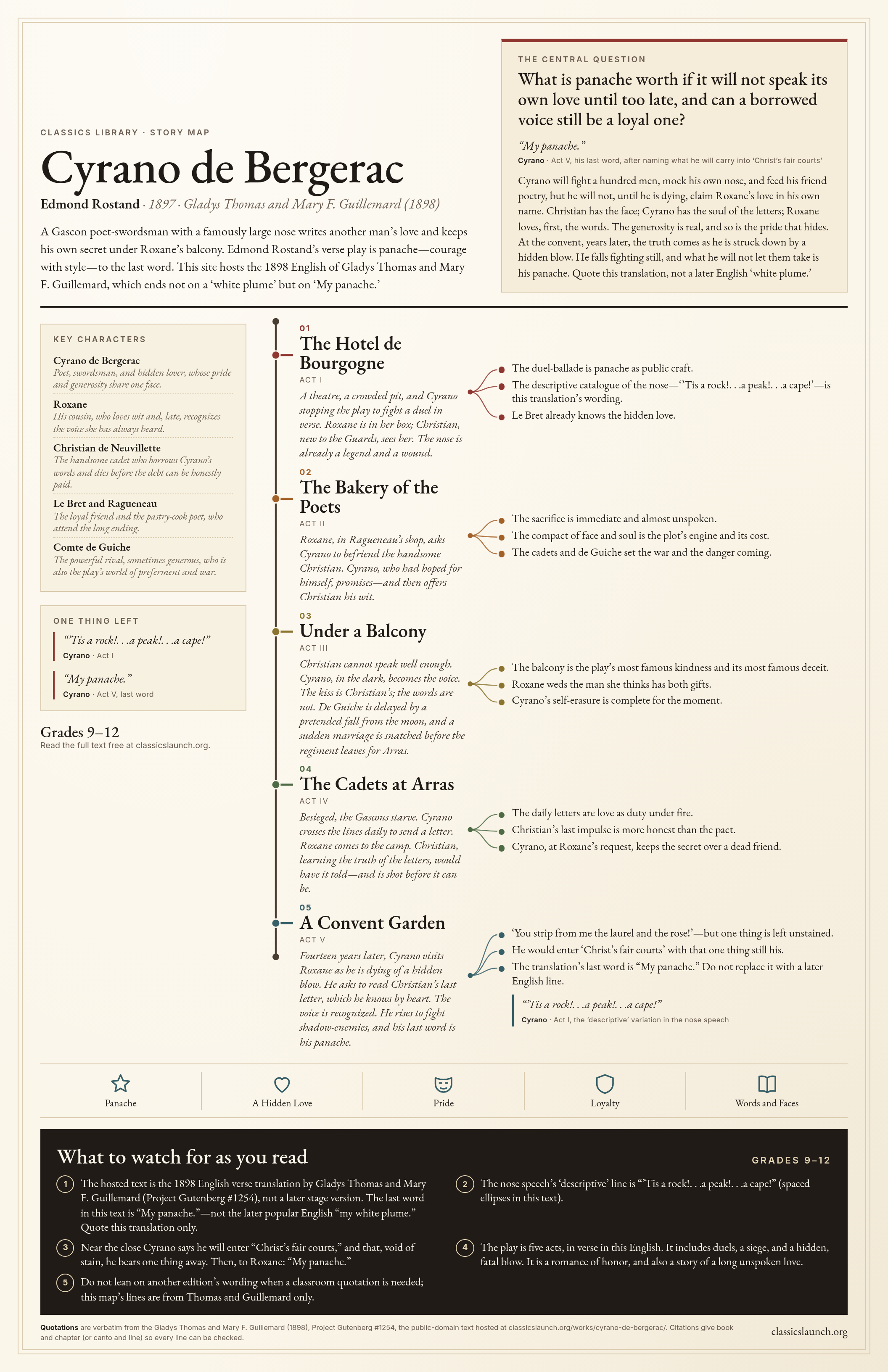
Every quotation is word for word from the Gladys Thomas and Mary F. Guillemard (1898) hosted in this library and is checked against that text each time the site is built. Citations give book and chapter (or canto and line).