Story maps · Grades 4–8
Cuore (Heart): An Italian Schoolboy’s Journal: A Story Map
The PDF is one tabloid page (11 × 17 in). On letter paper, choose “Fit to page.”
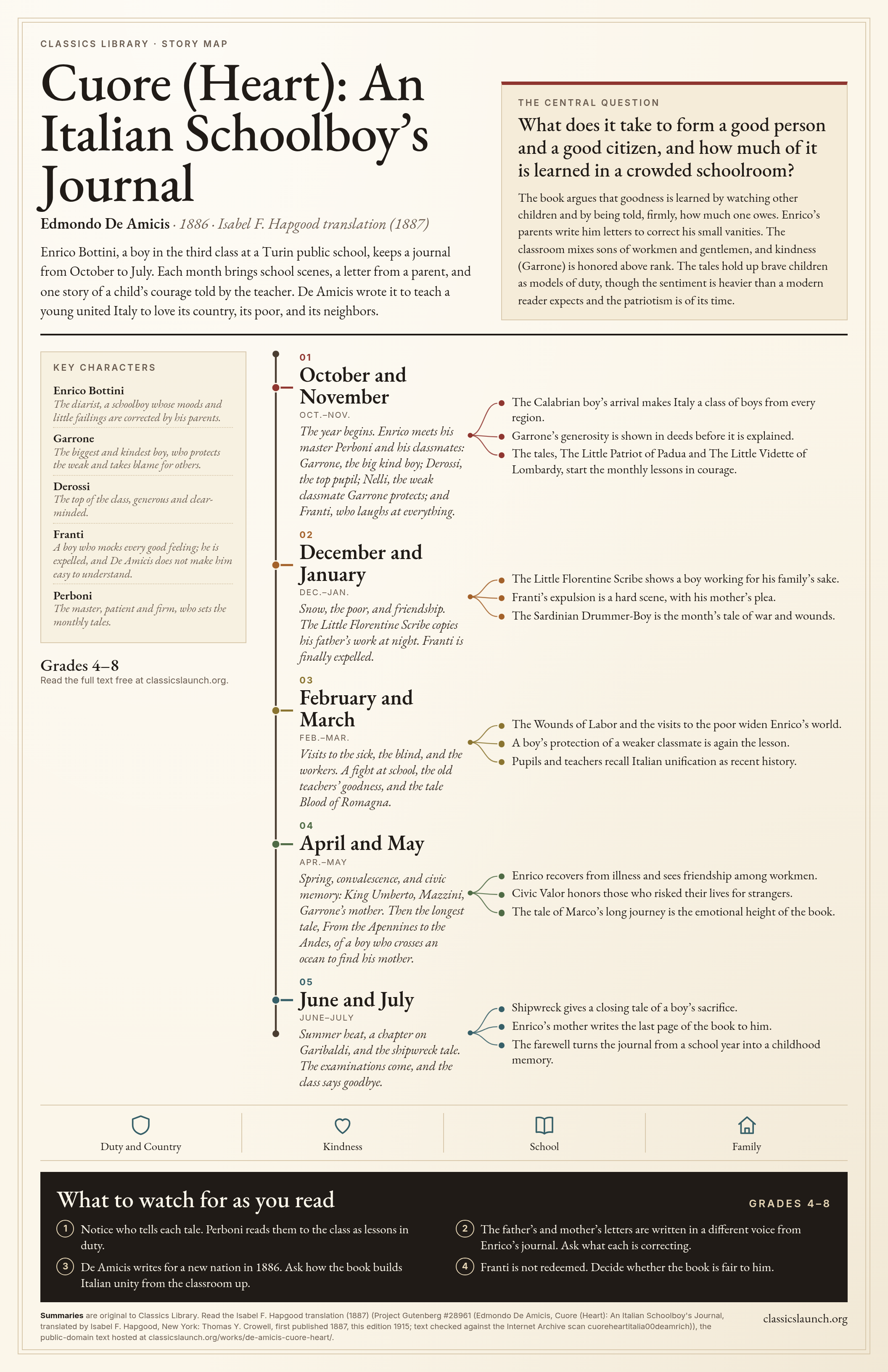
Enrico Bottini, a boy in the third class at a Turin public school, keeps a journal from October to July. Each month brings school scenes, a letter from a parent, and one story of a child’s courage told by the teacher. De Amicis wrote it to teach a young united Italy to love its country, its poor, and its neighbors.
The central question
What does it take to form a good person and a good citizen, and how much of it is learned in a crowded schoolroom?
The book argues that goodness is learned by watching other children and by being told, firmly, how much one owes. Enrico’s parents write him letters to correct his small vanities. The classroom mixes sons of workmen and gentlemen, and kindness (Garrone) is honored above rank. The tales hold up brave children as models of duty, though the sentiment is heavier than a modern reader expects and the patriotism is of its time.
- 01
October and November
Oct.–Nov.
The year begins. Enrico meets his master Perboni and his classmates: Garrone, the big kind boy; Derossi, the top pupil; Nelli, the weak classmate Garrone protects; and Franti, who laughs at everything.
- The Calabrian boy’s arrival makes Italy a class of boys from every region.
- Garrone’s generosity is shown in deeds before it is explained.
- The tales, The Little Patriot of Padua and The Little Vidette of Lombardy, start the monthly lessons in courage.
- 02
December and January
Dec.–Jan.
Snow, the poor, and friendship. The Little Florentine Scribe copies his father’s work at night. Franti is finally expelled.
- The Little Florentine Scribe shows a boy working for his family’s sake.
- Franti’s expulsion is a hard scene, with his mother’s plea.
- The Sardinian Drummer-Boy is the month’s tale of war and wounds.
- 03
February and March
Feb.–Mar.
Visits to the sick, the blind, and the workers. A fight at school, the old teachers’ goodness, and the tale Blood of Romagna.
- The Wounds of Labor and the visits to the poor widen Enrico’s world.
- A boy’s protection of a weaker classmate is again the lesson.
- Pupils and teachers recall Italian unification as recent history.
- 04
April and May
Apr.–May
Spring, convalescence, and civic memory: King Umberto, Mazzini, Garrone’s mother. Then the longest tale, From the Apennines to the Andes, of a boy who crosses an ocean to find his mother.
- Enrico recovers from illness and sees friendship among workmen.
- Civic Valor honors those who risked their lives for strangers.
- The tale of Marco’s long journey is the emotional height of the book.
- 05
June and July
June–July
Summer heat, a chapter on Garibaldi, and the shipwreck tale. The examinations come, and the class says goodbye.
- Shipwreck gives a closing tale of a boy’s sacrifice.
- Enrico’s mother writes the last page of the book to him.
- The farewell turns the journal from a school year into a childhood memory.
- Duty and Country
- Kindness
- School
- Family
What to watch for as you read
Grades 4–8- Notice who tells each tale. Perboni reads them to the class as lessons in duty.
- The father’s and mother’s letters are written in a different voice from Enrico’s journal. Ask what each is correcting.
- De Amicis writes for a new nation in 1886. Ask how the book builds Italian unity from the classroom up.
- Franti is not redeemed. Decide whether the book is fair to him.
Every quotation is word for word from the Isabel F. Hapgood translation (1887) hosted in this library and is checked against that text each time the site is built. Citations give book and chapter (or canto and line).