Work record
Heart (Cuore): An Italian Schoolboy's Journal
Edmondo De AmicisCuore; Heart (Cuore); An Italian Schoolboy's Journal; Heart: A Schoolboy's Journal; De Amicis's Heart; The Story of a Scholastic YearHeart (Cuore): An Italian Schoolboy's Journal by Edmondo De Amicis (1886)Cuore, which means Heart, is the diary of a school year, told by Enrico Bottini, a schoolboy who enters the third class of a municipal school in Turin in October and leaves it in July.Also known as: Cuore · Heart (Cuore) · An Italian Schoolboy's Journal · Heart: A Schoolboy's Journal · De Amicis's Heart · The Story of a Scholastic Year
1886 · 19th Century · Novel · Italian
Read this when a child needs plain stories of kindness, courage and gratitude to parents and teachers.
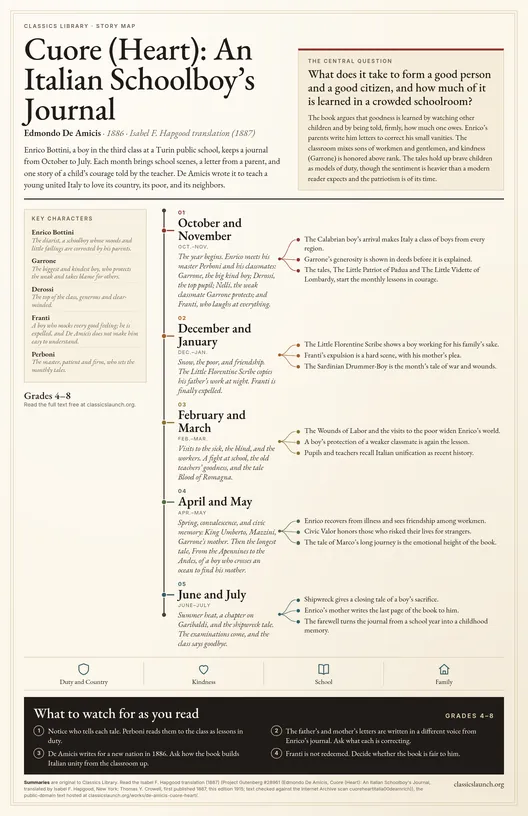 Story mapSee the story mapThe whole book on one page: the story in movements, the characters, and what to watch for. Free to print.
Abstract
Background. De Amicis wrote this book in 1886 for boys between nine and thirteen, in the years when the new kingdom of Italy was building its schools. He says in the preface that the diary is a boy's own and that the father added the finishing touches.
Plot. Enrico enters the third class of a Turin school in October and describes his comrades and his master. Through the year he is corrected in letters by his father and mother, and each month the master reads a story of a young hero. Boys fall ill, are hurt or die, and the class learns from them. In July he parts from his friends.
Method. Short diary entries, parents' letters and tales are mixed in sequence, so that each day's small event is followed by a lesson from the letter that comes after it.
Why it matters. The book was read by millions of children and gave Italians a common picture of the school and of boyhood virtue. It is also a gentle lesson in gratitude, charity and courage, for readers who wish to see these virtues in a child's life.
Main characters
- Enrico Bottini: The schoolboy who writes the diary
- Enrico's father: The writer of letters of advice
- Garrone: The biggest and kindest boy in the class
- Derossi: The head of the class
- Franti: The boy who mocks and is expelled
Summary
Cuore, which means Heart, is the diary of a school year, told by Enrico Bottini, a schoolboy who enters the third class of a municipal school in Turin in October and leaves it in July. De Amicis wrote it in 1886 as a book for boys between nine and thirteen, and he says in the preface that Enrico's father later wrote out the diary and added to it. Through the year Enrico notes the boys of his class. Garrone, the biggest and kindest, takes the blame for a prank to save a weaker boy, and he guards the hunchback Nelli from bullies. Derossi is the head of the class, Stardi works with grim patience, Coretti is jolly, Precossi is the son of a blacksmith and is beaten at home, and Franti is the one who mocks others and is at last driven from the school. The master, Perboni, welcomes a boy newly come from Calabria and tells the class to love him as a brother. Between the diary entries come letters from Enrico's father, his mother and his sister in which they correct him: he must honour his mother, give to the poor, thank his master and be brave, and he must remember that the greatest thing is to give up his own will for others. Each month the master gives the class a story of a boy's noble deed. A boy from Padua, sold by his parents to mountebanks, throws back the coins of rich passengers who insult Italy; a young Lombard scout is shot dead in a tree while spying out the Austrians; a Florentine boy copies addresses at night in secret to spare his father; a Sardinian drummer-boy keeps on at his post in battle although he is wounded; a boy from Naples walks to a hospital to nurse his sick father; a boy of Romagna, once wayward, is stabbed in defending his grandmother against thieves; a boy is given a medal for saving a comrade from the river; a boy from Genoa crosses the ocean in search of his mother; and last, a Sicilian lad named Mario gives his place in the lifeboat to a girl and goes down with the ship. Throughout the year Enrico grows in affection and in conscience, and the readings also set before him the heroes of Italian unity, including Cavour, Mazzini and Garibaldi. By July he parts from his friends with a full heart, and his father tells him to ask pardon of any boy he has wronged. The book is open about its purpose, which is to teach children a love of country, of family and of the poor, and to show them that kindness and courage are within their reach at school.
Virtues in this work
- Piety: Enrico's father teaches the duty to honour a mother and a father and the gratitude owed to a teacher.
- Charity: The book teaches the gift to the poor and the care of the weak, and Garrone shows it in the class.
- Fortitude: Garrone takes blame for others, and the monthly heroes face danger for their families and their country.
- Industry: The father tells Enrico that his books are his arms, and Stardi and Derossi are shown at steady work.
- Honor: The boys ask pardon of each other at the end of the year and are taught to keep an honest name.
Plot or Argument
- October: The new class
Enrico enters the third class under Master Perboni, and the boys are introduced: Garrone, Derossi, Stardi, Votini, Nelli, Coretti, Precossi, Crossi and Franti. Garrone takes the blame for Crossi, a boy from Calabria is welcomed as a brother, and Robetti is hurt in saving a child. The monthly story is The Little Patriot of Padua.
- November: Mothers and the poor
Enrico speaks rudely to his mother and is reproved in a letter; a charcoal-man's son is made to beg pardon of a gentleman's son, Garrone protects Nelli, and the father teaches him to give to the poor. The monthly story is The Little Vidette of Lombardy.
- December: Snow and gratitude
A snow-storm, a visit to a wounded man's house, Stardi's hard work and the letter on gratitude to teachers. The monthly story is The Little Florentine Scribe.
- January: The king's funeral
The class sees the funeral of King Victor Emmanuel, Franti is expelled for jeering at others, and Franti's mother pleads for him. The monthly story is The Sardinian Drummer-Boy.
- February: Work and the blind
Good resolutions, the wounds of labour, the story of a carved inkstand told by a teacher who was once a prisoner, a visit to the blind boys, and the sick master. The monthly story is Daddy's Nurse.
- March: Strife and death
A fight in the school, the death of a little boy, the distribution of prizes, Enrico's sister Silvia, and Count Cavour. The monthly story is Blood of Romagna.
- April: The nation's heroes
King Umberto, the infant asylum, friends among the workingmen, Giuseppe Mazzini and the medal for civic valour. The monthly story is Civic Valor.
- May–June: Fire, journeys and a farewell
A fire, the story of a Genoese boy who goes to South America in search of his mother, Garibaldi, and the love of Italy; Enrico's dead schoolmistress is mourned. The May story is From the Apennines to the Andes, and the last monthly story, Shipwreck, tells of Mario's sacrifice.
- July: The last examination and farewell
Enrico's mother writes the last page of the year, the class sits the last examination, and the boys part with embraces; Enrico's father asks whether he has wronged anyone.
Characters
- Enrico Bottini, narrator
The narrator, a schoolboy in the third class of a Turin school, who learns to take correction.
- Enrico's father, writer of letters in the diary
The writer of letters in the diary, who teaches his son about duty, mercy and gratitude.
- Enrico's mother, loving and patient woman
A loving and patient woman, to whom the book gives a great honour.
- Master Perboni, class teacher
The class teacher, a firm and kind man who stays with the same boys for four years.
- Garrone, biggest boy in the class
The biggest boy in the class, good-hearted and brave, who protects the weak.
- Derossi, head of the class
The head of the class, clever, generous and handsome, whom the whole school admires.
- Stardi, short
A short, stubborn boy who studies hard and says little.
- Franti, mocking boy
The mocking boy who laughs at kindness and is expelled from the school.
- Nelli, poor hunchback boy
A poor hunchback boy who is helped by Garrone.
- The Calabrian boy, newcomer from the far south of Italy
A newcomer from the far south of Italy, welcomed by the whole class.
Lessons
Honouring parents and teachers
The letters of Enrico's father teach that a son owes reverence to his mother and gratitude to his master. A Christian reader can set them beside the commandment to honour father and mother, and ask why gratitude is so hard to practise.
- What does Enrico do to offend his mother, and how does his father answer?
- Why does his father ask him to love the master who is sometimes impatient?
Charity to the poor
The father reproves Enrico for passing a beggar and teaches that mercy must be a habit and not a sudden feeling. The book gives many pictures of working people and poor children and calls the reader to give them respect as well as alms.
- What does Enrico's father say that he gains from giving a coin to a beggar?
- How does the class treat the poor boys among them, such as Crossi and Nelli?
Courage in small things
The great deeds of the monthly stories are balanced by the small acts of Garrone, who takes the blame for another boy. The book teaches that courage begins in the schoolroom, in refusing to join the bullies and in speaking the truth.
- Why does Garrone say that he did the deed?
- What is the difference between the courage of the Lombard scout and the courage of Garrone?
Love of country and its limits
De Amicis wrote for the young kingdom of Italy, and the book teaches loyalty to country and gratitude to those who died for it. A Christian reader can ask how a love of country is rightly ordered beside the love of neighbour and the love of God.
- What does the master mean when he says the Calabrian boy is a brother?
- Does the book ever put love of country above love of neighbour?
Context
Italy had been united under the king of Piedmont in 1861, and Rome became its capital in 1870, so that when De Amicis wrote, the new nation needed a common school, a common language and a common story. Many Italians were poor and unable to read, and the elementary school law of 1877 made school compulsory for the first years. Cuore speaks to that situation, and so it gives many pictures of boys of different regions and of the working classes meeting in one class.
Composition
De Amicis wrote Cuore in 1886, in the form of the diary of a boy in the third class of a Turin school, and published it that October with the Milan firm of Treves. It had a very quick success in Italy and was translated into dozens of languages. Isabel F. Hapgood's English translation appeared in New York in 1887, and it was reissued by Thomas Y. Crowell in 1915.
Reception
The book was a bestseller and was used in Italian schools for generations; its sentiment was parodied by later writers, but its stories were loved by children. It has been made into films and television series. Readers today may find it sentimental, but the courage and kindness of Garrone are still easy to feel.
Comparisons
- The Adventures of Pinocchio
Collodi's tale, also written for the schools of the new Italy, shows a disobedient puppet and the cost of idleness; Cuore shows the obedient boy and a world of good teachers.
- Little Women
Alcott's novel also grows out of a family in which a father and mother teach by letters, and it shares Cuore's belief that character is built by small daily duties.
- The Vicar of Wakefield
Goldsmith's vicar is a father who teaches his children by example and by speeches, like the father of Enrico, though Goldsmith adds humour.
- Silas Marner
Eliot's tale of a lonely man made human by a child also teaches the power of small kindnesses.
- Little Lord Fauntleroy
Burnett's novel of a good-hearted child who wins others by his goodness shares Cuore's belief in the power of a generous child.
- A Little Princess
Burnett's tale of a girl at a boarding school who keeps her kindness through hardship, a companion to Cuore's picture of children formed by school and by suffering.
- Heidi
Spyri's tale of a Swiss child who brings joy to those around her has the same trust in the child's affection and in the simple virtues.
Quotes
Frequently cited
“Love your brother who has come from so far away.”
Frequently cited
“Then Garrone, moved to pity for poor Crossi, rose abruptly and said, resolutely, "It was I."”
Frequently cited
“Your books are your arms, your class is your squadron, the field of battle is the whole earth, and the victory is human civilization.”
“Now read this book, boys; I hope that you will be pleased with it, and that it may do you good.”
“Oh, Enrico, beware; this is the most sacred of human affections; unhappy he who tramples it under foot.”
“Do not accustom yourself to pass indifferently before misery which stretches out its hand to you”
“To give one's life for one's country as the Lombard boy did, is a great virtue; but you must not neglect the lesser virtues, my son.”
“Respect, love, your master, my son.”
For Students
A reading companion for classical Christian high school students. See the student guide.
Reading Guide
Watch for
- How Enrico's father and mother correct him in letters, and how he answers.
- How each boy in the class is introduced and what he does later.
- How the monthly stories connect with the daily life of the class.
- What happens to Franti, and what the book says about him.
Key terms and names
- Third class
- The third year of the Italian municipal elementary school, in which Enrico is nine or ten years old.
- Monthly story
- The tale that the master reads to the class each month, about a young hero of the Italian nation.
- Risorgimento
- The movement that united Italy in the nineteenth century; its heroes are named and praised in the book.
- Soldo
- A small Italian coin, worth five centesimi, such as Enrico's father gives to a beggar.
- Vidette
- A mounted sentinel posted ahead of an army; the Lombard boy of the November story is one.
- Scrivano
- A copyist; the Florentine boy of the December story copies work by night to help his father.
Seminar Questions
- Comprehension What kind of book does De Amicis say Cuore is, and who is it for?
- Comprehension What does Garrone do for Crossi, and for Nelli?
- Interpretation Why does De Amicis join the diary entries with letters from the father and mother?
- Interpretation What is the difference between the great deeds of the monthly stories and the small ones of the class?
- Interpretation Why does the book treat Franti as it does, and is the treatment just?
- Big Question Is the love of one's country a virtue, and what are its limits?
- Big Question How should a child answer the care of a parent or teacher?
Faith Connections
- Exodus 20:12 (Scripture)
The commandment to honour father and mother is the base of the father's letter on the mother and of Enrico's repentance.
- Matthew 25:35–40 (Scripture)
Christ's teaching that what is done for the least of his brothers is done for him lies behind the father's lesson on the beggar woman and the care of the weak.
- Luke 10:30–37 (Scripture)
The good Samaritan answers the question of who is the neighbour and stands behind Garrone's protection of Nelli and Crossi.
Logic and Rhetoric
Central argument: A good life is built by small acts of obedience, kindness and courage, learned in the family and at school, and these prepare a boy to serve his country and his neighbour.
Rhetorical device: exemplum. Each of the monthly stories sets a young hero before the class as an example of a virtue; the father's letters then draw the practical moral for Enrico.
Debate: Resolved: That the schools should teach children to love their country.
Memory Work
Your books are your arms, your class is your squadron, the field of battle is the whole earth, and the victory is human civilization.
Love your brother who has come from so far away.
Writing Prompts
Essay: Using at least three passages from the diary and the letters, explain what Cuore teaches about honour to parents and kindness to the weak, and say whether you find the teaching sound.
Comparison with The Adventures of Pinocchio: Compare the lessons that Pinocchio and Enrico learn about obedience, work and kindness, and say how the two books treat the schools and the families of the young Italy.
Medical Lens
The book is full of the sick and the maimed. It shows boys with a dead arm, a hunchback, boys on crutches, blind and rickety children, a dying classmate, and a father nursed by a son, and it treats them with a sympathy that was a new thing in school books. It is a useful source on the care of the sick and disabled in a poor Italian city of the 1880s.
- October
Robetti, a boy on crutches, is hurt while saving a child, and the class sees the sorrow of his mother.
- February
The class visits the blind boys and the children with the rickets, and Enrico sees the care they receive.
- March
A classmate dies, and the class mourns him.
Creative Prompts
- Essay
Write an essay on one of the letters from Enrico's father, explaining what he asks his son to do and why, and say whether his advice still holds.
- Fiction
Write a diary entry for one school day in which a boy in your class does a quiet act of courage, in the style of Enrico's journal.
- Classroom
Act out the scene in which Garrone takes the blame for the prank, with the class as the audience, and ask each student what he would have done.
- Dialogue
Write the conversation between Enrico and his father after the boy has been rude to his mother.
Further Reading
- The Adventures of Pinocchio, Carlo Collodi
Another classic written for the children of the young Italian kingdom, in this library.
- The Betrothed, Alessandro Manzoni
The Italian novel of the century that stands behind the Italian nation's story, in this library.
- Little Women, Louisa May Alcott
A comparable family novel of moral growth, in this library.
- Heart: A Schoolboy's Journal, Isabel F. Hapgood, tr.
Hapgood's 1887 translation, the version hosted here.
Verification notes
The text is Isabel F. Hapgood's English translation of Cuore, first published in New York in 1887 by Thomas Y. Crowell, in the Project Gutenberg edition checked against the Internet Archive scan of the 1915 printing; the illustration captions are omitted. Hapgood keeps De Amicis's sentiment and the Italian names. The Italian original is not hosted here. The list of monthly stories and the characters was checked against the hosted text.
- The first Italian publication date of 1886 and the publisher Treves follow standard reference works and are not stated in the hosted text.
- The compulsory school law of 1877 (the Coppino law) follows standard histories.
- The film and television adaptations are known from reference works and are not described in detail.
- The identification of the school with the Baretti school in Turin follows the text; the city of Turin is implied by the text and is not named in the opening pages.
- The further reading titles should be checked for edition and translator before citing.