Story maps · Grades 11–12
The Double: A Story Map
The PDF is one tabloid page (11 × 17 in). On letter paper, choose “Fit to page.”
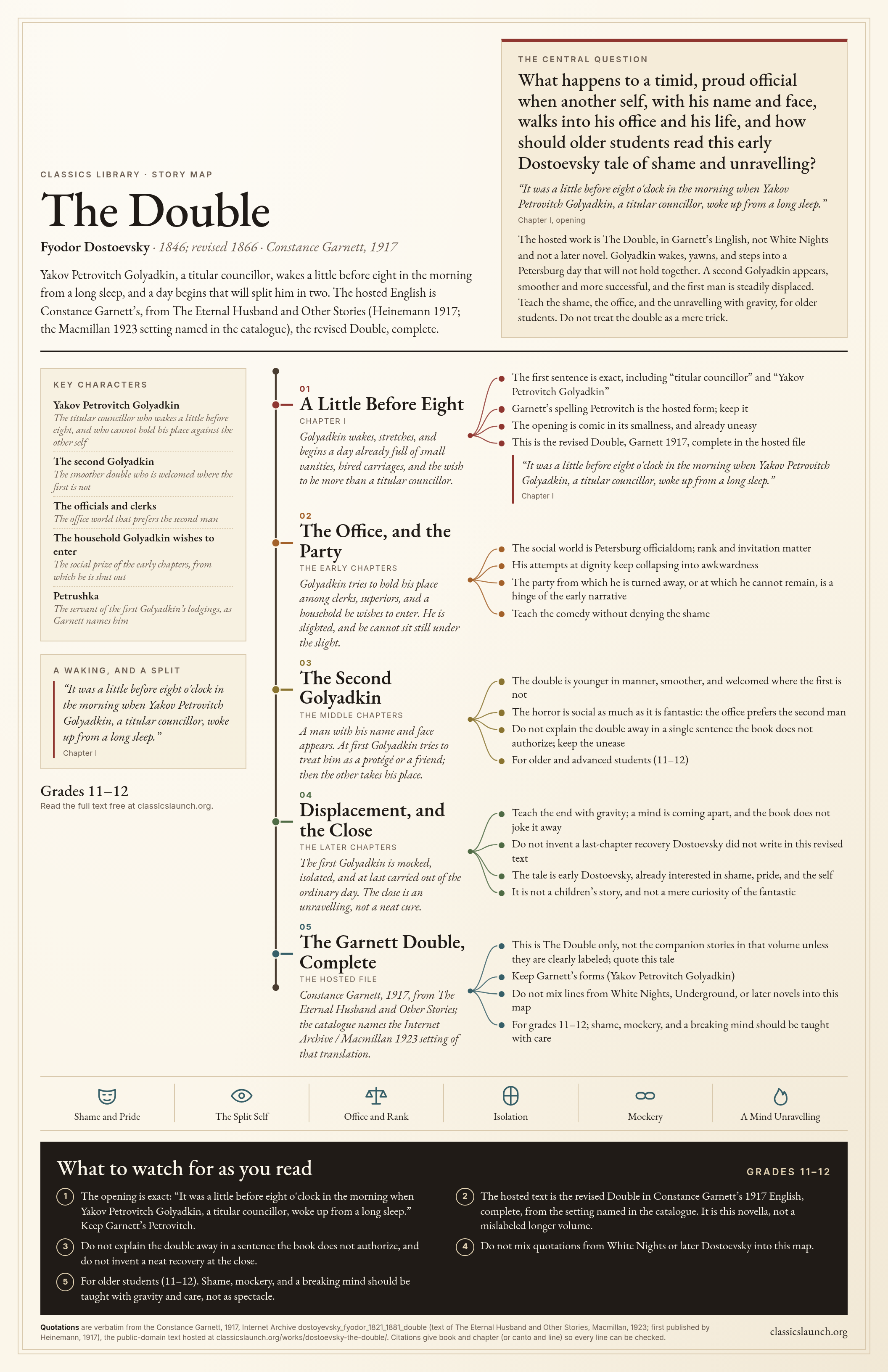
Yakov Petrovitch Golyadkin, a titular councillor, wakes a little before eight in the morning from a long sleep, and a day begins that will split him in two. The hosted English is Constance Garnett’s, from The Eternal Husband and Other Stories (Heinemann 1917; the Macmillan 1923 setting named in the catalogue), the revised Double, complete.
The central question
What happens to a timid, proud official when another self, with his name and face, walks into his office and his life, and how should older students read this early Dostoevsky tale of shame and unravelling?
“It was a little before eight o'clock in the morning when Yakov Petrovitch Golyadkin, a titular councillor, woke up from a long sleep.”
The hosted work is The Double, in Garnett’s English, not White Nights and not a later novel. Golyadkin wakes, yawns, and steps into a Petersburg day that will not hold together. A second Golyadkin appears, smoother and more successful, and the first man is steadily displaced. Teach the shame, the office, and the unravelling with gravity, for older students. Do not treat the double as a mere trick.
- 01
A Little Before Eight
Chapter I
Golyadkin wakes, stretches, and begins a day already full of small vanities, hired carriages, and the wish to be more than a titular councillor.
- The first sentence is exact, including “titular councillor” and “Yakov Petrovitch Golyadkin”
- Garnett’s spelling Petrovitch is the hosted form; keep it
- The opening is comic in its smallness, and already uneasy
- This is the revised Double, Garnett 1917, complete in the hosted file
“It was a little before eight o'clock in the morning when Yakov Petrovitch Golyadkin, a titular councillor, woke up from a long sleep.”
- 02
The Office, and the Party
The early chapters
Golyadkin tries to hold his place among clerks, superiors, and a household he wishes to enter. He is slighted, and he cannot sit still under the slight.
- The social world is Petersburg officialdom; rank and invitation matter
- His attempts at dignity keep collapsing into awkwardness
- The party from which he is turned away, or at which he cannot remain, is a hinge of the early narrative
- Teach the comedy without denying the shame
- 03
The Second Golyadkin
The middle chapters
A man with his name and face appears. At first Golyadkin tries to treat him as a protégé or a friend; then the other takes his place.
- The double is younger in manner, smoother, and welcomed where the first is not
- The horror is social as much as it is fantastic: the office prefers the second man
- Do not explain the double away in a single sentence the book does not authorize; keep the unease
- For older and advanced students (11–12)
- 04
Displacement, and the Close
The later chapters
The first Golyadkin is mocked, isolated, and at last carried out of the ordinary day. The close is an unravelling, not a neat cure.
- Teach the end with gravity; a mind is coming apart, and the book does not joke it away
- Do not invent a last-chapter recovery Dostoevsky did not write in this revised text
- The tale is early Dostoevsky, already interested in shame, pride, and the self
- It is not a children’s story, and not a mere curiosity of the fantastic
- 05
The Garnett Double, Complete
The hosted file
Constance Garnett, 1917, from The Eternal Husband and Other Stories; the catalogue names the Internet Archive / Macmillan 1923 setting of that translation.
- This is The Double only, not the companion stories in that volume unless they are clearly labeled; quote this tale
- Keep Garnett’s forms (Yakov Petrovitch Golyadkin)
- Do not mix lines from White Nights, Underground, or later novels into this map
- For grades 11–12; shame, mockery, and a breaking mind should be taught with care
- Shame and Pride
- The Split Self
- Office and Rank
- Isolation
- Mockery
- A Mind Unravelling
What to watch for as you read
Grades 11–12- The opening is exact: “It was a little before eight o'clock in the morning when Yakov Petrovitch Golyadkin, a titular councillor, woke up from a long sleep.” Keep Garnett’s Petrovitch.
- The hosted text is the revised Double in Constance Garnett’s 1917 English, complete, from the setting named in the catalogue. It is this novella, not a mislabeled longer volume.
- Do not explain the double away in a sentence the book does not authorize, and do not invent a neat recovery at the close.
- Do not mix quotations from White Nights or later Dostoevsky into this map.
- For older students (11–12). Shame, mockery, and a breaking mind should be taught with gravity and care, not as spectacle.
Every quotation is word for word from the Constance Garnett, 1917 hosted in this library and is checked against that text each time the site is built. Citations give book and chapter (or canto and line).