Story maps · Grades 11–12
Memoirs of Halide Edib: A Story Map
The PDF is one tabloid page (11 × 17 in). On letter paper, choose “Fit to page.”
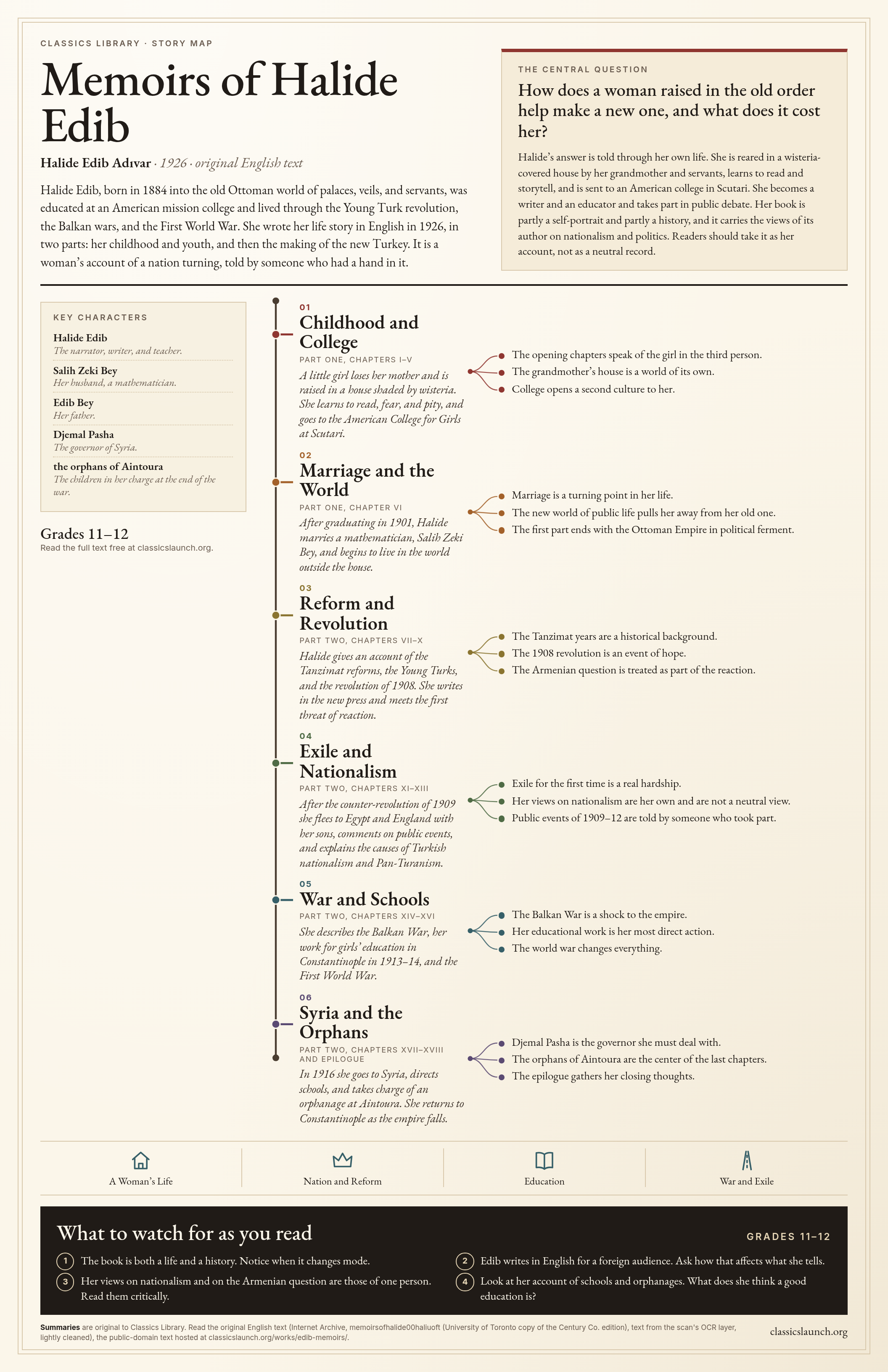
Halide Edib, born in 1884 into the old Ottoman world of palaces, veils, and servants, was educated at an American mission college and lived through the Young Turk revolution, the Balkan wars, and the First World War. She wrote her life story in English in 1926, in two parts: her childhood and youth, and then the making of the new Turkey. It is a woman’s account of a nation turning, told by someone who had a hand in it.
The central question
How does a woman raised in the old order help make a new one, and what does it cost her?
Halide’s answer is told through her own life. She is reared in a wisteria-covered house by her grandmother and servants, learns to read and storytell, and is sent to an American college in Scutari. She becomes a writer and an educator and takes part in public debate. Her book is partly a self-portrait and partly a history, and it carries the views of its author on nationalism and politics. Readers should take it as her account, not as a neutral record.
- 01
Childhood and College
Part One, Chapters I–V
A little girl loses her mother and is raised in a house shaded by wisteria. She learns to read, fear, and pity, and goes to the American College for Girls at Scutari.
- The opening chapters speak of the girl in the third person.
- The grandmother’s house is a world of its own.
- College opens a second culture to her.
- 02
Marriage and the World
Part One, Chapter VI
After graduating in 1901, Halide marries a mathematician, Salih Zeki Bey, and begins to live in the world outside the house.
- Marriage is a turning point in her life.
- The new world of public life pulls her away from her old one.
- The first part ends with the Ottoman Empire in political ferment.
- 03
Reform and Revolution
Part Two, Chapters VII–X
Halide gives an account of the Tanzimat reforms, the Young Turks, and the revolution of 1908. She writes in the new press and meets the first threat of reaction.
- The Tanzimat years are a historical background.
- The 1908 revolution is an event of hope.
- The Armenian question is treated as part of the reaction.
- 04
Exile and Nationalism
Part Two, Chapters XI–XIII
After the counter-revolution of 1909 she flees to Egypt and England with her sons, comments on public events, and explains the causes of Turkish nationalism and Pan-Turanism.
- Exile for the first time is a real hardship.
- Her views on nationalism are her own and are not a neutral view.
- Public events of 1909–12 are told by someone who took part.
- 05
War and Schools
Part Two, Chapters XIV–XVI
She describes the Balkan War, her work for girls’ education in Constantinople in 1913–14, and the First World War.
- The Balkan War is a shock to the empire.
- Her educational work is her most direct action.
- The world war changes everything.
- 06
Syria and the Orphans
Part Two, Chapters XVII–XVIII and Epilogue
In 1916 she goes to Syria, directs schools, and takes charge of an orphanage at Aintoura. She returns to Constantinople as the empire falls.
- Djemal Pasha is the governor she must deal with.
- The orphans of Aintoura are the center of the last chapters.
- The epilogue gathers her closing thoughts.
- A Woman’s Life
- Nation and Reform
- Education
- War and Exile
What to watch for as you read
Grades 11–12- The book is both a life and a history. Notice when it changes mode.
- Edib writes in English for a foreign audience. Ask how that affects what she tells.
- Her views on nationalism and on the Armenian question are those of one person. Read them critically.
- Look at her account of schools and orphanages. What does she think a good education is?
Every quotation is word for word from the original English text hosted in this library and is checked against that text each time the site is built. Citations give book and chapter (or canto and line).