Work record
Memoirs of Halide Edib
Halide EdibMemoirs; House with Wisteria; Memoirs of Halidé EdibMemoirs of Halide Edib by Halide Edib (1926)The Memoirs of Halide Edib is the life story of a Turkish woman who was born into the old Ottoman world of palaces, slave households and veils, who was educated in an American mission college, and who lived through the revolution of 1908, the Balkan…Also known as: Memoirs · House with Wisteria · Memoirs of Halidé Edib
1926 · Early 20th Century · Memoir · English
Read this when a woman must find the courage to teach and serve through war.
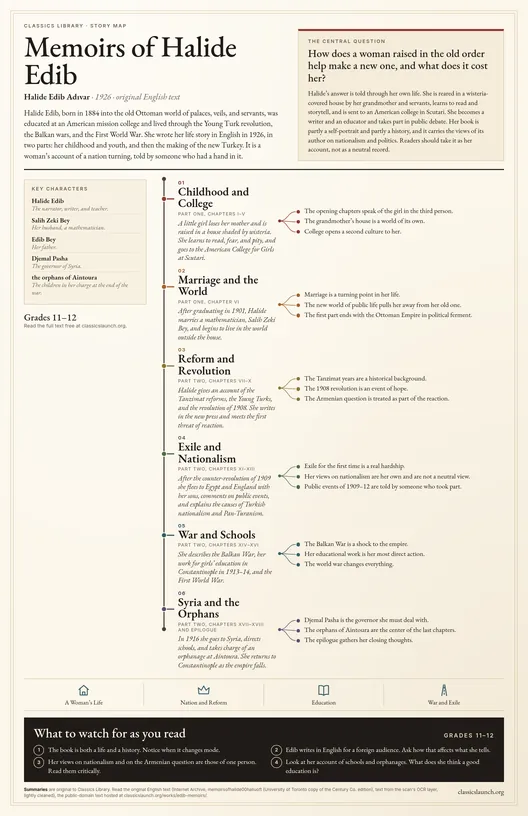 Story mapSee the story mapThe whole book on one page: the story in movements, the characters, and what to watch for. Free to print.
Abstract
Background. A Turkish woman who became a novelist, a teacher and a public figure wrote this account of her life for Western readers in 1926. She was born into the old Ottoman order and saw the empire come to its end.
Plot. Part One gives her childhood, her college years and her marriage. Part Two follows the revolution, her flight abroad, her work for women's education, the war years in Syria and the care of orphans at Aintoura.
Ideas. The memoir shows a woman who battles fear, asks hard questions of her faith and chooses practical service over despair. It also reflects her cause, so the reader must judge its account of the Armenian massacres against other evidence.
Text. The text hosted here is from the Internet Archive scan of the Century Company edition, lightly cleaned, and every quotation was checked against it. It is for older students with a teacher's guidance, and it can be read beside Lady Mary Wortley Montagu's earlier letters from Turkey to compare how two women saw the same country in different centuries. Teachers can pair this work with the library's study guide, seminar questions and memory-work selection to prepare a discussion, a short essay or a recitation. The full text is hosted on this site, and each quotation in the guide has been checked against the hosted text.
Key figures
- Halide Edib: The author, a writer and school reformer
- Salih Zeki Bey: Her husband and a mathematician
- Djemal Pasha: Ottoman governor of Syria in the First World War
- The orphans of Aintoura: Children in the orphanage she directed
Summary
The Memoirs of Halide Edib is the life story of a Turkish woman who was born into the old Ottoman world of palaces, slave households and veils, who was educated in an American mission college, and who lived through the revolution of 1908, the Balkan wars and the First World War. It was printed in New York in 1926, in English, and it is in two parts. Part One, 'Between the Old and the New Turkey', is a vivid account of childhood and youth. Halide loses her mother when she is small, is raised by a grandmother and by servants in a house shaded by a wisteria, learns to read and to tell stories, and is sent to the American College for Girls at Scutari. She graduates in 1901 and marries her mathematics tutor, Salih Zeki Bey. Part Two, 'New Turkey in the Making', turns to public events. She begins to write for the newspaper Tanine after the revolution of July 1908, receives an anonymous death threat, and in 1909, in the counter-revolution, takes her two small sons to Egypt and England as a refugee. The second half follows her work as a writer and an educator, her views on Turkish nationalism and pan-Turanism, the Balkan War of 1912, and her efforts in 1913 and 1914 to reform schools for girls. In 1916, at the request of the governor Djemal Pasha, she goes to Syria to organize schools in Beirut and Damascus and takes charge of the orphanage at Aintoura on Mount Lebanon, where hundreds of sick and starving children, Turkish, Kurdish and Armenian, are housed. She finds filth, fever and despair, and she and her staff turn it into a place of workshops, classes and laughter. The book ends with the Epilogue, as the armistice of 1918 closes the Ottoman world. The Memoirs is a rich primary source and an inspiring story of courage and service, but it is also a partisan one. Edib writes as a Turkish patriot and as a defender of her people, and her account of the Armenian massacres and the deportations of 1915 reflects the view that many Turkish writers of her day shared and that historians widely dispute. It should be read with a teacher and alongside other sources. It also shows a woman of deep, questioning faith, a mother, a teacher and a writer, who tries to practise pity and fairness in a time of war. The OCR text hosted here has been lightly cleaned and may still contain scanning errors.
Virtues in this work
- Fortitude: Edib keeps writing after a threat and keeps working through war, and she names her fear instead of hiding it.
- Charity: At Aintoura she cleans, feeds and teaches hundreds of sick orphans of every origin.
- Justice: She objects to giving Armenian orphans Moslem names and to the narrowness of the European press and the Turkish government alike.
- Industry: Her schools, her translations and her writing show disciplined labour for her people.
- Humility: She writes frankly of her own faults and fears.
Plot or Argument
- Part One: childhood and college (1885–1908)
Halide, called a little girl in the third person in the opening chapter, loses her mother and is raised in the wisteria-covered house of her grandmother. She learns to read, to fear and to pity, goes to the American College for Girls, and marries Salih Zeki Bey after graduating in 1901.
- Revolution and danger (1908–1909)
After the Young Turks restore the constitution in July 1908, Halide writes for Tanine and meets the first threat. In the counter-revolution of 1909 she flees to Egypt and England with her sons.
- Nationalism, war and schools (1909–1916)
She comments on Turkish nationalism, the Balkan War and the First World War, and she describes her work to reform schools for girls in Constantinople.
- Syria, the orphans and the end of the war (1916–1918)
She goes to Syria to direct the schools, takes charge of the orphanage at Aintoura, and returns to Constantinople at the end of the war as the empire falls.
Characters
- Halide Edib, narrator, writer and teacher
The author, who tells her life in the first person and, in the first chapter, in the third. She is a questioning Muslim, a writer for the daily press and a schoolmistress.
- Salih Zeki Bey, husband and mathematician
Her teacher and first husband, a scientist and author of a large work on mathematics in Turkish, who guides her education and her early married life.
- Edib Bey, father
A palace secretary who is tender to his daughter and later marries again, which brings the child into a new household.
- Djemal Pasha, governor of Syria
The Ottoman commander and governor who asks her to organize schools in Syria and who presides over the orphanage at Aintoura.
- The orphans of Aintoura, children
Turkish, Kurdish and Armenian children, sick, starved and parentless in 1916, who become weavers, shoemakers, carpenters and musicians.
Lessons
Courage that is afraid
When she receives an anonymous letter threatening her if she continues to write, Edib says she was never so cowardly and yet so brave. Her honest account shows that courage is not the absence of fear but the refusal to give in to it.
- How does Edib describe her fear and her choice?
- What does she mean by saying she did not capitulate to the physical terror?
Service in the midst of ruin
At Aintoura she finds hundreds of children sick and filthy and sets about cleaning, feeding, teaching and training them. The work is a model of practical charity that begins with boilers and beds and ends with schooling.
- What are the first things the staff do at Aintoura?
- How does teaching a trade help the children recover their dignity?
A faith that asks questions
As a student Edib says that she was a faithful Muslim in heart but not orthodox in mind, and she looks closely at Christianity, as she met it in her teachers. Her thoughtful, sometimes critical remarks give students a model of respectful inquiry across faiths.
- What does she admire in her teachers and what does she criticize in Christianity as she met it?
- How does she describe her longing for a higher reality?
A witness who is also an advocate
The memoir is both a record and a defence of her people and cause. A careful reader learns to separate what Edib saw, what she believed and what other sources show, especially on the Armenian massacres and deportations.
- Where does Edib speak as an eyewitness and where as a partisan?
- Which other sources would you consult to test her account?
Context
Edib's life spans the end of the Ottoman Empire: the long reign of Sultan Abdul Hamid, the Young Turk revolution of 1908, the counter-revolution of 1909, the Balkan Wars of 1912 and 1913, and the First World War, in which the empire sided with Germany. The book ends in 1918, before the Turkish national struggle in which she later took part and before the founding of the Turkish Republic in 1923.
Composition
The memoirs were written in English for Western readers and published in New York and London by the Century Company in 1926; a sequel, The Turkish Ordeal, followed in 1928. A later edition appeared under the title House with Wisteria.
Reception
The book was read in the West as a rare first-hand account of a Turkish woman's life and of the Ottoman collapse, and it has remained a key source for the history of Turkish feminism and education. Its treatment of the Armenian massacres is disputed by modern historians, who generally recognise the deportations and killings of 1915 as a genocide, and Edib's account, which blames mutual fear, wartime revolt and foreign policy, does not call it that.
Comparisons
- Up from Slavery
Booker T. Washington's memoir is also the story of a teacher who builds a school and a life from poverty and prejudice, and both books link education with moral courage.
- A Vindication of the Rights of Woman
Wollstonecraft argues for the education of women in theory; Edib's memoir shows it in a life lived in the Ottoman Empire.
- Memoirs of Usama ibn Munqidh
Another memoir from the lands of Islam, written by a medieval soldier and courtier, which shows how a Muslim writer sees war and its neighbours.
- Notes on Nursing: What It Is, and What It Is Not
Nightingale's handbook is about the order, cleanliness and care that Edib's staff apply in the orphanage at Aintoura.
- A Room of One's Own
Woolf argues that a woman needs a room and an income to write; Edib's memoir shows a Turkish woman winning that room in a very different world.
- Turkish Embassy Letters
Lady Mary Wortley Montagu looked at Turkish women from the outside in 1717; Edib writes from within the same world two centuries later.
Quotes
Frequently cited
“I can honestly say that I have never felt so cowardly and yet so brave, for I did not capitulate before the physical terror.”
Frequently cited
“I realized then for the first time that this face, which people as a rule considered something unusual and unlike its environment, was mine.”
Frequently cited
“As a whole, college had a liberating effect upon me, giving me a much greater balance and opening up to me the possibility of a personal life with enjoyments of a much more varied kind.”
Frequently cited
“The place was in a state of incredible filth and misery. Out of the eight hundred children over five hundred were sick.”
“Youth imagines death as an unbelievable horror, but youth is difficult to cow even with the vision of death and disgrace.”
“It is the feeling with which I have had to fight the hardest and longest. It is fear.”
“Could I stand and face the ugly truth of human realities without spiritual aid and still have the strength to serve my kind?”
“Each child had a drama, and each had had its parents massacred by the parents of the other children, and now all were stricken with the same misery and disaster. Each child had a Turkish or Moslem name.”
“I have to keep them alive. I do not care how. I cannot bear to see them die in the streets.”
“I had never hoped to hear laughter in Aintoura; the most I looked for was less tears and less sickness. Yet I saw sturdy legs and chubby faces, and I often heard laughter and sounds of gaiety.”
“I was in utter despair; the great calamity and hopeless misery which overwhelmed my country seemed to be everlasting.”
For Students
A reading companion for classical Christian high school students. See the student guide.
Reading Guide
Watch for
- The shift in Part One from third person ('the little girl') to first person at Chapter II.
- Each time Edib names fear and says what she did about it.
- The places where she writes as a witness and the places where she writes as a defender of her cause.
Key terms and names
- Hanum
- A Turkish title of respect for a lady, as in Halide Hanum.
- Young Turks
- The reform movement that restored the constitution in 1908, also called the Committee of Union and Progress.
- Evkaff
- Muslim charitable endowments, which ran a number of schools in the Ottoman Empire.
- Lala
- A male family servant who looks after a child in an old Turkish household.
- Bey and Pasha
- Turkish titles of rank for gentlemen and high officials.
- Armistice of Mudros
- The agreement in October 1918 that ended the war between the Ottoman Empire and the Allies.
Seminar Questions
- Comprehension What losses mark Halide's early childhood in Part One?
- Comprehension What is the threat that Edib receives in 1909, and what does she do?
- Interpretation Why does Edib write about herself as 'she' before she writes as 'I'?
- Interpretation How does her college education change her thinking about religion?
- Interpretation What methods do the staff use to rescue the children at Aintoura?
- Big Question Does a person who serves others in a war share in the blame of the government she works for?
- Big Question How should a student read a memoir that is both a true witness and a defence of a cause?
Faith Connections
- Matthew 25:35-40 (Scripture)
I was hungry and you gave me food; the care of the sick, hungry and orphaned children at Aintoura is a picture of these works of mercy.
- James 1:27 (Scripture)
Pure religion is to visit orphans in their affliction; Edib's work at Aintoura answers this verse across a difference of faith.
- Augustine, Confessions (Great Conversation)
Augustine's account of his early life as a restless, questioning mind may be read beside Edib's own account of a girl who asks about God.
Logic and Rhetoric
Central argument: The new Turkey grew out of the old through education, courage and service, and the author's own life shows how a woman can contribute to this in the midst of war.
Rhetorical device: first-person testimony and defence. The shift from the child as 'she' to the grown woman as 'I' lets Edib pass from private memory to public argument.
Debate: Resolved: That a memoir that defends its author's nation can still be a truthful witness to the suffering of others.
Memory Work
I can honestly say that I have never felt so cowardly and yet so brave, for I did not capitulate before the physical terror.
The place was in a state of incredible filth and misery. Out of the eight hundred children over five hundred were sick.
Writing Prompts
Essay: Choose one of Edib's passages on fear or service and explain how it shows a virtue. Then say where the memoir needs other sources.
Comparison with Up from Slavery: Compare Edib's account of building schools with Washington's, and say what each thinks education can do for a people.
Medical Lens
The memoir records conditions of epidemic, hunger and war in Syria in 1916 and 1917, and one author's practical attempts to reduce disease among children by cleaning, disinfecting and feeding. It is a primary source for public health in a wartime orphanage rather than a clinical text.
- Chapter XVIII
At Aintoura the new staff finds hundreds of children sick and covered in vermin; boilers are ordered to boil the furniture, typhus is feared, and a new doctor sets up a decent hospital and better hygiene.
- Chapter XII
After the revolution of 1909 her little son Hassan suffers shock, delirium and terror, and she writes through the night at his bedside.
- Chapter XVII
Djemal Pasha's governorship is said to include building roads, fighting disease and opening schools in Syria during the war.
Creative Prompts
- Essay
Edib says that she was never so cowardly and yet so brave. Write an essay that explains what she means and compares her courage with that of another figure in this library.
- Classroom
Divide the class into those who read Edib's account of Aintoura and those who read Nightingale's Notes on Nursing, and discuss what practical measures both put first.
- Dialogue
Write a conversation between Edib and a teacher at Scutari about why a girl should study mathematics, using only what the memoir says of her studies.
Further Reading
- The Turkish Ordeal: Being the Further Memoirs of Halidé Edib, Halide Edib
Edib's sequel, published by The Century Co. in 1928, which continues her story into the national struggle.
- House with Wisteria: Memoirs of Turkey Old and New, Halide Edib
A later edition of the memoirs issued by Transaction Publishers in 2009.
- Turkish Letters, Ogier Ghiselin de Busbecq
A sixteenth-century envoy's view of the same empire, in this library.
Verification notes
The hosted text is the Internet Archive scan of the 1926 Century Co. edition (University of Toronto copy, identifier memoirsofhalide00haliuoft), taken from the scan's OCR layer and lightly cleaned; running heads, page numbers and hyphenation were corrected by a script, so some scanning errors remain (for example a few garbled names). Quotations were checked against the hosted text, not against the page images. The Archive records the book as not in copyright in the United States; Edib died in 1964, so it remains protected in countries with life-plus-seventy terms. Biographical facts beyond the memoir (death in 1964, the later sequel) follow standard accounts. The memoir's treatment of the Armenian massacres is partisan and is set out in the guide as such.
- Edib's year of birth, which sources give as 1884 or 1885.
- The identity and later publication history of the Turkish originals of material in Part Two.