Story maps · Grades 9–12
The Story of Egil Skallagrimsson (Egil's Saga): A Story Map
The PDF is one tabloid page (11 × 17 in). On letter paper, choose “Fit to page.”
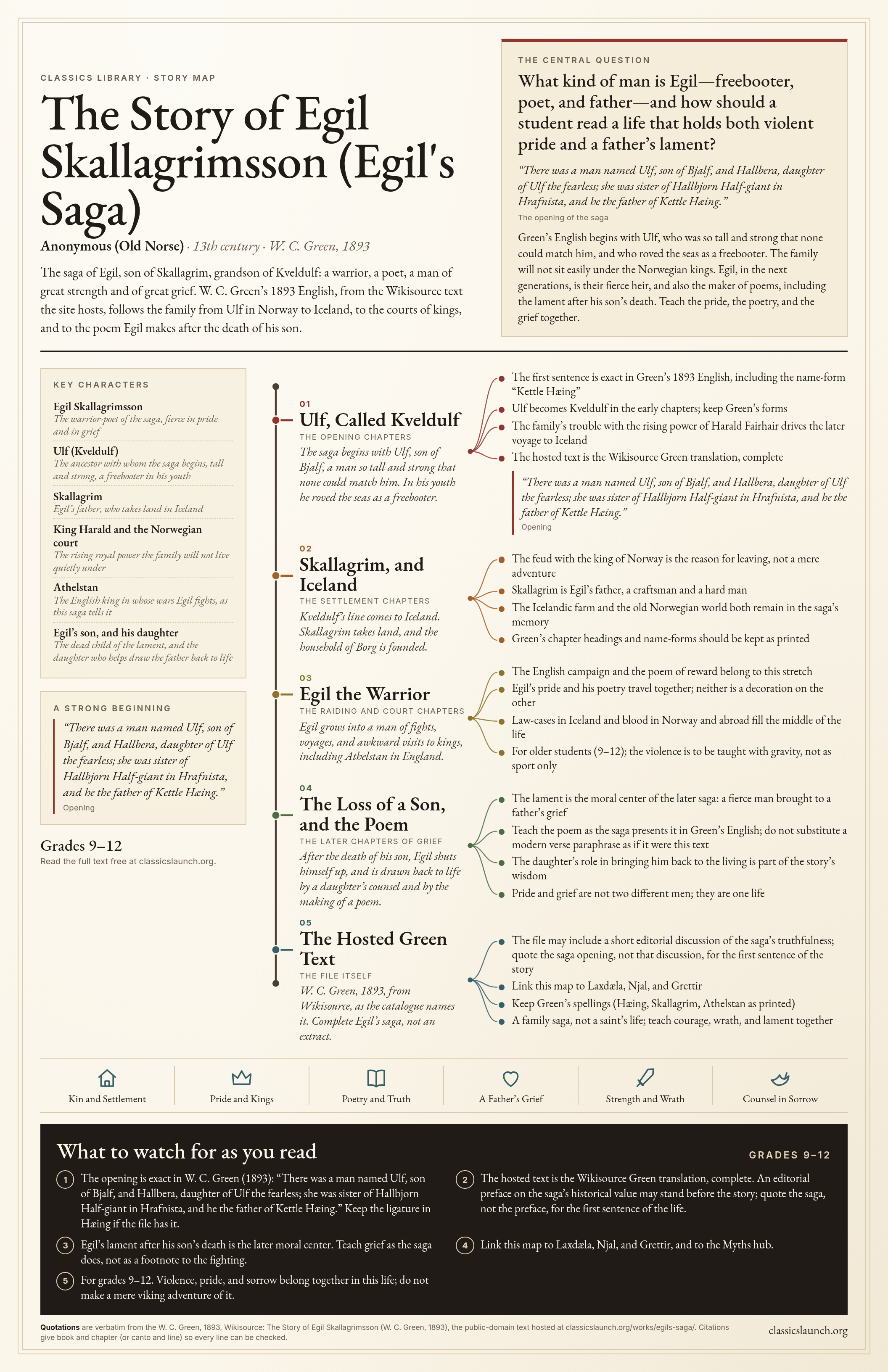
The saga of Egil, son of Skallagrim, grandson of Kveldulf: a warrior, a poet, a man of great strength and of great grief. W. C. Green’s 1893 English, from the Wikisource text the site hosts, follows the family from Ulf in Norway to Iceland, to the courts of kings, and to the poem Egil makes after the death of his son.
The central question
What kind of man is Egil—freebooter, poet, and father—and how should a student read a life that holds both violent pride and a father’s lament?
“There was a man named Ulf, son of Bjalf, and Hallbera, daughter of Ulf the fearless; she was sister of Hallbjorn Half-giant in Hrafnista, and he the father of Kettle Hæing.”
Green’s English begins with Ulf, who was so tall and strong that none could match him, and who roved the seas as a freebooter. The family will not sit easily under the Norwegian kings. Egil, in the next generations, is their fierce heir, and also the maker of poems, including the lament after his son’s death. Teach the pride, the poetry, and the grief together.
- 01
Ulf, Called Kveldulf
The opening chapters
The saga begins with Ulf, son of Bjalf, a man so tall and strong that none could match him. In his youth he roved the seas as a freebooter.
- The first sentence is exact in Green’s 1893 English, including the name-form “Kettle Hæing”
- Ulf becomes Kveldulf in the early chapters; keep Green’s forms
- The family’s trouble with the rising power of Harald Fairhair drives the later voyage to Iceland
- The hosted text is the Wikisource Green translation, complete
“There was a man named Ulf, son of Bjalf, and Hallbera, daughter of Ulf the fearless; she was sister of Hallbjorn Half-giant in Hrafnista, and he the father of Kettle Hæing.”
- 02
Skallagrim, and Iceland
The settlement chapters
Kveldulf’s line comes to Iceland. Skallagrim takes land, and the household of Borg is founded.
- The feud with the king of Norway is the reason for leaving, not a mere adventure
- Skallagrim is Egil’s father, a craftsman and a hard man
- The Icelandic farm and the old Norwegian world both remain in the saga’s memory
- Green’s chapter headings and name-forms should be kept as printed
- 03
Egil the Warrior
The raiding and court chapters
Egil grows into a man of fights, voyages, and awkward visits to kings, including Athelstan in England.
- The English campaign and the poem of reward belong to this stretch
- Egil’s pride and his poetry travel together; neither is a decoration on the other
- Law-cases in Iceland and blood in Norway and abroad fill the middle of the life
- For older students (9–12); the violence is to be taught with gravity, not as sport only
- 04
The Loss of a Son, and the Poem
The later chapters of grief
After the death of his son, Egil shuts himself up, and is drawn back to life by a daughter’s counsel and by the making of a poem.
- The lament is the moral center of the later saga: a fierce man brought to a father’s grief
- Teach the poem as the saga presents it in Green’s English; do not substitute a modern verse paraphrase as if it were this text
- The daughter’s role in bringing him back to the living is part of the story’s wisdom
- Pride and grief are not two different men; they are one life
- 05
The Hosted Green Text
The file itself
W. C. Green, 1893, from Wikisource, as the catalogue names it. Complete Egil’s saga, not an extract.
- The file may include a short editorial discussion of the saga’s truthfulness; quote the saga opening, not that discussion, for the first sentence of the story
- Link this map to Laxdæla, Njal, and Grettir
- Keep Green’s spellings (Hæing, Skallagrim, Athelstan as printed)
- A family saga, not a saint’s life; teach courage, wrath, and lament together
- Kin and Settlement
- Pride and Kings
- Poetry and Truth
- A Father’s Grief
- Strength and Wrath
- Counsel in Sorrow
What to watch for as you read
Grades 9–12- The opening is exact in W. C. Green (1893): “There was a man named Ulf, son of Bjalf, and Hallbera, daughter of Ulf the fearless; she was sister of Hallbjorn Half-giant in Hrafnista, and he the father of Kettle Hæing.” Keep the ligature in Hæing if the file has it.
- The hosted text is the Wikisource Green translation, complete. An editorial preface on the saga’s historical value may stand before the story; quote the saga, not the preface, for the first sentence of the life.
- Egil’s lament after his son’s death is the later moral center. Teach grief as the saga does, not as a footnote to the fighting.
- Link this map to Laxdæla, Njal, and Grettir, and to the Myths hub.
- For grades 9–12. Violence, pride, and sorrow belong together in this life; do not make a mere viking adventure of it.
Every quotation is word for word from the W. C. Green, 1893 hosted in this library and is checked against that text each time the site is built. Citations give book and chapter (or canto and line).