Work record
The Story of Egil Skallagrimsson (Egil's Saga)
Anonymous (Old Norse)The Story of Egil Skallagrimsson (Egil's Saga) by Anonymous (Old Norse) (13th century)Egil's Saga tells the life of Egil Skallagrimsson, the greatest poet of the Viking age and one of its most dangerous men, together with the history of his family from the days of Harald Fairhair to the coming of Christianity to Iceland.13th century · Medieval · Epic · Old Norse
Read this when grief, pride and a gift for words wrestle inside one fierce soul.
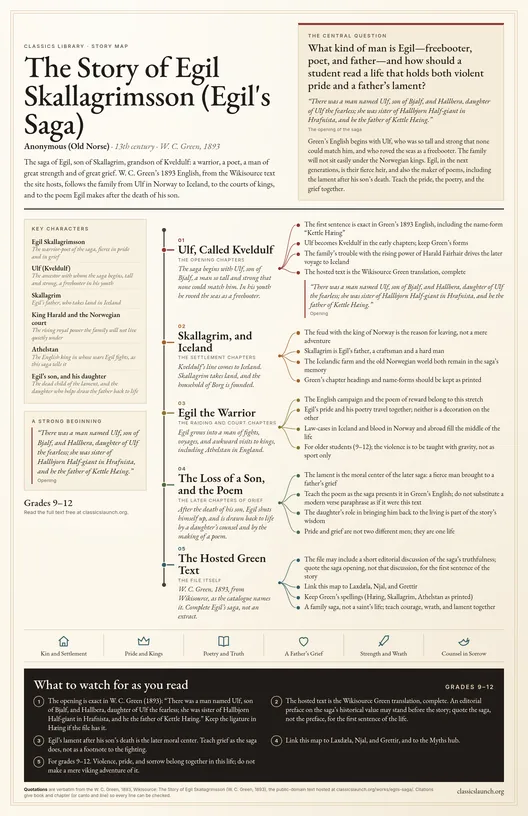 Story mapSee the story mapThe whole book on one page: the story in movements, the characters, and what to watch for. Free to print.
Abstract
Background. A thirteenth-century Icelander, possibly the historian of the Norwegian kings, set down this history of one strong-willed clan over three generations. W. C. Green's English rendering appeared in 1893 and turns the many verses into short English stanzas, with notes on their riddling kennings.
Narrative. A Norwegian family that defies Harald Fairhair loses its favourite son to the king's anger and flees west. In the new land a grandson grows up huge, ugly and quick with words and weapons. As a man he fights for an English king, loses his brother in battle, feuds with the royal house of Norway, and wins pardon at York with a poem.
Grief and age. Back home, the drowning of a beloved son nearly ends him. A daughter's cunning love keeps him alive to compose a lament. Blind and laughed at in old age, he buries his English treasure where no one can find it and dies outside the Church.
Themes. Independence and defiance of kings, the power of verse, loyalty among friends, and grief without hope are its great subjects. The closing pages, with a baptism and bones beneath an altar, point toward a faith Egil never knew, and leave the reader to weigh what his fierce world gained and lost in the change.
Main characters
- Egil: Viking, skald and settler's son
- Skallagrim: his father, the smith-farmer of Borg
- Thorolf: his elder brother, killed in English service
- Arinbjorn: his loyal Norwegian friend
- Eric Bloodaxe: king and lifelong enemy
- Thorgerd: his daughter, who saves him from despair
Summary
Egil's Saga tells the life of Egil Skallagrimsson, the greatest poet of the Viking age and one of its most dangerous men, together with the history of his family from the days of Harald Fairhair to the coming of Christianity to Iceland. Written down about 1230 and often attributed to Snorri Sturluson, it is among the oldest and most powerful of the family sagas. The library text is W. C. Green's translation of 1893, the first complete English version. The saga begins in Norway with Kveldulf and his two sons. The handsome Thorolf enters the service of King Harald Fairhair, is slandered by rivals and killed by the king. Kveldulf and his dark, ugly, gifted son Skallagrim take vengeance and sail for Iceland, where Skallagrim settles at Borg and works his land and forge with great industry. His son Egil is as ugly as his father, makes verses at three and kills a playmate at seven. Egil's adult life is spent largely abroad. He makes enemies of King Eric Bloodaxe and Queen Gunnhilda, raids in the Baltic, and with his brother Thorolf serves King Athelstan of England, who has them prime-signed with the cross. Thorolf falls at the battle of Vin-heath, and Athelstan pays Egil a rich compensation. Egil marries his brother's widow Asgerd, pleads her inheritance at the Gula-thing, kills King Eric's son, and sets up a curse-pole against Eric and Gunnhilda. Shipwrecked in England, he walks into Eric's hall at York and saves his life by composing in one night a praise-poem, the Head-Ransom, with the help of his loyal friend Arinbjorn. In Iceland Egil grows old. When his son Bodvar drowns, he shuts himself up to die, until his daughter Thorgerd tricks him into living long enough to compose the Sonatorrek, the Lament for his Sons, one of the great poems of grief in any language. Blind and mocked by the women of the house, he hides his English silver and dies a heathen. The saga's last chapters look forward. Grim, the husband of Egil's step-daughter, is baptized when Christianity becomes law, and Egil's bones are later found beneath a church altar. For Christian readers the saga is a portrait of the old Northern world at its strongest, its courage, loyalty and art, but also its pride, greed and vengeance, and of a grief that the old gods could not console. It prepares the reader to see why Iceland welcomed a faith that promised more than fame.
Virtues in this work
- Friendship: Arinbjorn stands by Egil at York at the risk of his own standing with King Eric, and Egil honours him in a poem.
- Fortitude: Egil walks into the hall of his enemy at York and faces death with a poem rather than flight.
- Industry: Skallagrim works his farm, fishery, sealing and smithy at Borg with tireless labour.
- Justice: Thorstein Egilsson is described as a man with no trickery, just, and never aggressive, though he defends his own.
Plot or Argument
- Translator's introduction
Green introduces the saga after Dasent's Burnt Njal, describes its three divisions, its picture of Norway, England and Iceland, and the difficulty of Egil's verses, and gives a chronology of the story.
- Chapters I-XXVII: Kveldulf, Thorolf and Harald Fairhair
Kveldulf refuses to serve Harald Fairhair; his son Thorolf becomes the king's man, grows rich in Halogaland and Finmark, is slandered by Hildirida's sons and slain by the king; Kveldulf and Skallagrim avenge him and sail for Iceland, and Kveldulf dies at sea.
- Chapters XXVIII-XLI: Skallagrim at Borg and Egil's childhood
Skallagrim takes land at Borg and works farm, fishery and smithy; his sons Thorolf and Egil are born; Egil makes his first verses at three, is nearly killed by his father in a game, and kills a playmate at seven.
- Chapters XLII-LV: Egil abroad and the battle of Vin-heath
Egil kills Bard at a feast in Norway, earning the enmity of Eric Bloodaxe and Gunnhilda; he and Thorolf raid in the east, serve King Athelstan of England, are prime-signed, and fight at Vin-heath, where Thorolf falls and Egil receives two chests of silver.
- Chapters LVI-LXI: Asgerd, the Gula-thing and the curse-pole
Egil marries Thorolf's widow Asgerd, pleads her inheritance at the Gula-thing against Bergonund, kills Bergonund and King Eric's son Rognvald, raises a curse-pole against Eric and Gunnhilda, and returns to Iceland, where Skallagrim dies.
- Chapters LXII-LXIX: York and the Head-Ransom
Shipwrecked in the Humber, Egil goes to Eric's court at York; with Arinbjorn's help he composes a praise-poem overnight and wins his life; he then kills the duellist Ljot the Pale in Norway.
- Chapters LXX-LXXIX: The journeys to Vermaland
Egil goes to collect tribute in Vermaland for King Hacon and survives ambushes in the forests and a fight against twenty-five men.
- Chapters LXXX-LXXXII: Sonatorrek
Egil's son Bodvar drowns; Egil buries him in Skallagrim's mound and shuts himself up to die, until his daughter Thorgerd persuades him to compose the Lament for his Sons; he also makes a poem in praise of Arinbjorn.
- Chapters LXXXIII-XC: Old age and death
Egil settles quarrels among his kin, grows blind and frail at Moss-fell, makes verses on his weakness, hides King Athelstan's silver and dies.
- Chapters XCI-XCII: Christianity and Egil's bones
Grim of Moss-fell is baptized when Christianity becomes law and builds a church; Egil's great bones are later found beneath its altar; the saga ends with Egil's descendants.
Characters
- Kveldulf, Egil's grandfather
A wealthy Norwegian landholder, wise and grim, said to change his nature at nightfall; he dies on the voyage to Iceland.
- Thorolf Kveldulfsson, Kveldulf's elder son
Handsome and generous, he serves Harald Fairhair and is killed by the king after slander.
- Skallagrim, Egil's father
Dark, bald and immensely strong; settler of Borg, a tireless farmer and smith who mistrusts kings.
- Egil Skallagrimsson, hero and poet
Ugly, greedy, violent and brilliant; the finest skald of his age, loyal to friends and terrible to enemies.
- Thorolf Skallagrimsson, Egil's elder brother
Brave and well-liked, he falls fighting for King Athelstan at Vin-heath.
- Asgerd, Egil's wife
Thorolf's widow, whom Egil loves and marries, and for whose inheritance he goes to law.
- Arinbjorn, Egil's friend
A Norwegian chieftain loyal both to King Eric and to Egil, whose counsel saves Egil's life at York.
- Eric Bloodaxe, king of Norway, later of York
Harald Fairhair's son and Egil's great enemy, who spares him for the sake of a poem.
- Gunnhilda, Eric's queen
A ruthless queen skilled in witchcraft, who tries to poison and destroy Egil.
- Athelstan, king of the English
Victor at Vin-heath, who has the brothers prime-signed and rewards Egil for Thorolf's death.
- Bodvar, Egil's son
A youth of great promise, drowned in Borgar-firth; his death moves Egil to compose Sonatorrek.
- Thorgerd, Egil's daughter
Married at Hjardarholt in the Dales, she shares her father's fast and gently tricks him into living and composing.
- Thorstein Egilsson, Egil's youngest son
Fair and just, unlike his father in temper, who keeps Borg after Egil.
- Grim of Moss-fell, Egil's step-son-in-law
Husband of Thordis, who cares for the blind Egil and is baptized when Christianity becomes law.
Lessons
The poet who is also a killer
Egil is the finest poet of his age and also greedy, proud and cruel. The saga refuses to separate the two: the same man kills at seven and composes the most tender lament in Old Norse. Readers are asked to admire his gifts without excusing his sins, and to see how talent without humility can serve violence.
- Which of Egil's deeds does the saga seem to admire, and which does it present as faults?
- How does Egil use poetry to save himself at York?
- Can great art come from a person of bad character? What does the saga suggest?
Grief that seeks a voice
When Bodvar drowns, Egil shuts himself away to starve. His daughter Thorgerd joins him, then turns the fast into a reason to live: he must first make a poem for his son. Grief, the saga shows, needs to be spoken and shared, and love can draw a mourner back to life.
- How does Thorgerd persuade her father to eat and live?
- Why does making the poem help Egil bear his grief?
- What comfort does Egil lack that a Christian mourner might have?
Loyalty between friends and to kings
Arinbjorn is loyal to King Eric and to Egil at once, and risks his standing to save his friend. Thorolf's death shows what happens when a king listens to slander instead of a faithful man. The saga weighs loyalty to a lord against loyalty to a friend.
- Why does Harald Fairhair turn against Thorolf Kveldulfsson?
- How does Arinbjorn keep faith with both Eric and Egil?
- When loyalties conflict, which should come first?
Context
The saga covers about 850 to 1000: the unification of Norway by Harald Fairhair, the emigration of Norwegian families to Iceland, the reign of Eric Bloodaxe at York in the mid-tenth century, and the wars of King Athelstan of England, whose victory at Brunanburh in 937 is usually identified with the saga's Vin-heath. It ends with the conversion of Iceland in 1000 and the discovery of Egil's bones in the twelfth century.
Composition
The saga was written down about 1220-1240, perhaps by Snorri Sturluson, and survives in several medieval manuscripts. Egil's great poems, the Head-Ransom, Sonatorrek and the poem on Arinbjorn, are preserved with it and are among the oldest Norse poems attributed to a named poet. W. C. Green published his English translation in 1893, with notes on the verses.
Reception
Egil's Saga has long been ranked with Njal's Saga and Laxdæla among the greatest sagas. Its account of Vin-heath is studied alongside the Old English poem on Brunanburh, and Sonatorrek is regarded as a landmark of personal poetry in the Middle Ages.
Comparisons
- Laxdæla Saga
Egil's daughter Thorgerd marries Olaf the Peacock, so Kjartan of Laxdæla Saga is Egil's grandson; the two sagas share a family and a district.
- The Story of Burnt Njal (Njal's Saga)
Njal's Saga shows the generation after Egil, when the law of the Althing has matured and the new faith arrives; Egil's world is the earlier and harder one.
- The Story of Grettir the Strong (Grettis Saga)
Both heroes are difficult, gifted and dangerous from boyhood, but Egil wins wealth and old age while Grettir is cursed into outlawry and loneliness.
- The Prose Edda
Snorri's Prose Edda explains the kennings and myths that fill Egil's verses; if Snorri also wrote the saga, the two books come from the same hand.
- The Poetic Edda
The Eddic poems show the gods Egil invokes, above all Odin, giver of poetry, whom Egil blames and thanks in the Sonatorrek.
- The Story of the Volsungs (Volsunga Saga)
The Volsunga Saga gives the heroic legend that Egil's generation sang; Egil's own life reads like a historical version of its pride and vengeance.
- Beowulf
Both works were written by Christians looking back on a heathen hero who fights, rewards his men and faces death without the hope of heaven.
- The Early Kings of Norway
Carlyle's sketch of the Norwegian kings covers Harald Fairhair, Eric Bloodaxe and Hacon, the rulers Egil served and defied.
Quotes
Frequently cited
“Father, open the door! I will that we both travel the same road”
Frequently cited
“Now I would fain, father, that we should lengthen our lives, so that you may compose a funeral poem on Bodvar, and I will grave it on a wooden roller; after that we can die, if we like”
“Egil loved him dearly, and Bodvar was very fond of his father”
“Thorolf and Egil did this at the king's request, and both let themselves be prime-signed”
“Great is this honour to thee, my lord, when thine enemies travel of their own free will from other lands, and deem they cannot endure thy wrath though thou be nowhere near”
“Here set I up a curse-pole, and this curse I turn on king Eric and queen Gunnhilda”
“tis not easy steering my feet now that I cannot see; a very dismal thing is blindness”
“Thorstein was a man with no trickery, just, and never aggressive on others, but he held his own if others attacked him”
“Grim of Moss-fell was baptized when Christianity was established by law in Iceland”
For Students
A reading companion for classical Christian high school students. See the student guide.
Reading Guide
Watch for
- How the saga describes the looks and temper of each generation, from Kveldulf to Thorstein.
- Every gift of gold, silver or weapons, and what it binds the giver and receiver to.
- Egil's verses at moments of danger, victory and grief.
- The prime-signing in Chapter L and Grim's baptism in Chapter XCI.
- How Egil treats kings compared with how he treats his friends.
Key terms and names
- Skald
- A court poet who composed intricate verse, often in praise of kings; Egil is the greatest of them.
- Kenning
- A compressed poetic metaphor, such as Odin's mead for poetry or the sea's steed for ship.
- Prime-signing
- Being marked with the cross as a first step toward baptism, which allowed heathens to deal with Christians.
- Curse-pole (nithing-pole)
- A pole topped with a horse's head, raised to curse an enemy and the spirits of his land.
- Gula-thing
- The great law assembly of western Norway, where Egil pleads Asgerd's inheritance.
- Head-Ransom
- Egil's praise-poem to King Eric at York, composed in one night to save his head.
- Sonatorrek
- The Lament for his Sons, Egil's poem of grief for Bodvar and Gunnar.
Seminar Questions
- Comprehension Why does Harald Fairhair kill Thorolf Kveldulfsson, and how does his family respond?
- Comprehension How does Egil escape death at Eric's court in York?
- Interpretation What does the saga gain by placing Egil's cruelty and his poetry side by side?
- Interpretation What does Thorgerd understand about grief that Egil does not?
- Interpretation Why might the saga end with Grim's baptism and the finding of Egil's bones beneath an altar?
- Big Question Is courage without humility a virtue or a vice?
- Big Question What can art do for grief, and what can it not do?
Faith Connections
- 2 Samuel 18:33 (Scripture)
David's cry over Absalom, O my son, is the Bible's great father's lament; set beside Sonatorrek it shows the same love and grief, but David mourns before the living God.
- 1 Thessalonians 4:13 (Scripture)
Paul tells Christians not to grieve as those who have no hope. Egil's grief, deep and honest, is the grief of a man without that hope.
- Proverbs 16:32 (Scripture)
He who rules his spirit is better than he who takes a city; Egil can take cities but rarely rules his own temper.
- Beowulf (Great Conversation)
Like the Beowulf poet, the saga author is a Christian writing of a heathen hero with admiration and sorrow, honouring courage while showing its limits.
Logic and Rhetoric
Central argument: The saga shows that the strength of Egil's family, independence, courage and skill, is also its curse: it will not bow to kings, so it wins wealth and fame but loses sons, brothers and peace, until a later generation accepts a Lord greater than any king.
Rhetorical device: Contrasting pairs. Each generation has a fair, generous son and a dark, difficult one: Thorolf and Skallagrim, then Thorolf and Egil, so that the reader weighs charm against strength in every chapter.
Debate: Resolved: Egil Skallagrimsson is more admirable than blameworthy.
Memory Work
Now I would fain, father, that we should lengthen our lives, so that you may compose a funeral poem on Bodvar, and I will grave it on a wooden roller; after that we can die, if we like
Thorstein was a man with no trickery, just, and never aggressive on others, but he held his own if others attacked him
Writing Prompts
Essay: Write an essay on how Egil's Saga presents the old heathen world at the edge of conversion, using the prime-signing, Sonatorrek and Grim's baptism.
Comparison with Beowulf: Compare Egil and Beowulf as heroes in old age: how does each face weakness and death, and what does each poet suggest about the hope of a heathen hero?
Medical Lens
The saga gives one of medieval literature's fullest portraits of grief, with a mourner's refusal of food and his recovery through speech, and an unsparing account of old age: deafness, blindness, falls and the mockery of the household. Egil's unusually heavy skull, found centuries later, has been discussed by modern writers as a possible sign of a bone disease.
- Chapter LXXXI
Egil shuts himself in his bed-closet to starve after Bodvar's drowning, and his daughter draws him back through a shared fast and the work of composing.
- Chapter XC
Egil grows heavy, deaf and blind, falls by the house-wall, is mocked by the women and laments his cold feet by the fire.
- Chapter XCI
Egil's skull, dug up under the church, is found to be unusually large, heavy and ridged, and does not break under the blow of an axe.
- Chapter XLIV
Egil detects a poisoned drink by cutting runes on the horn and smearing them with blood.
Creative Prompts
- Dialogue
Write the conversation between Egil and Thorgerd in the bed-closet in Chapter LXXXI as a short play, keeping her trick with the samphire and the milk.
- Poetry
Write a lament of eight to twelve lines for someone you have lost, using at least two kennings (such as whale-road for sea) in the manner of Egil's verses.
- Essay
Egil saves his life at York with a poem. Write an essay on the power and the dangers of praise in the saga.
- Classroom
Map Egil's journeys from Borg to Norway, the Baltic, England and Vermaland, and discuss how each journey changes his fortunes.
Further Reading
- Egil's Saga, trans. Hermann Pálsson and Paul Edwards
A widely read modern translation (1976).
- Viking Age Iceland, Jesse L. Byock
The settlement society in which Skallagrim and Egil lived.
- Heimskringla, Snorri Sturluson
The sagas of the Norwegian kings Egil served and defied, by the writer often credited with Egil's Saga.
- Epic and Romance, W. P. Ker
A classic 1897 study that places the Icelandic sagas beside the heroic epics.
Verification notes
All quotations were checked by exact search against the stored text of W. C. Green's 1893 translation, taken from the proofread Wikisource transcription of the Elliot Stock edition; opening quotation marks missing in that transcription were restored by comparison with the sacred-texts.com transcription, a Wikisource page overlap between Chapters LX and LXI was removed, and one duplicated sentence in Chapter XC was corrected. Green's endnotes and index are not included. Chapter numbers are Green's.
- Authorship by Snorri Sturluson is a scholarly attribution, not stated in the manuscripts.
- The identification of Vin-heath with Brunanburh (937) is generally accepted but not certain.