Story maps · Grades 5–12
Fairy and Folk Tales of the Irish Peasantry: A Story Map
The PDF is one tabloid page (11 × 17 in). On letter paper, choose “Fit to page.”
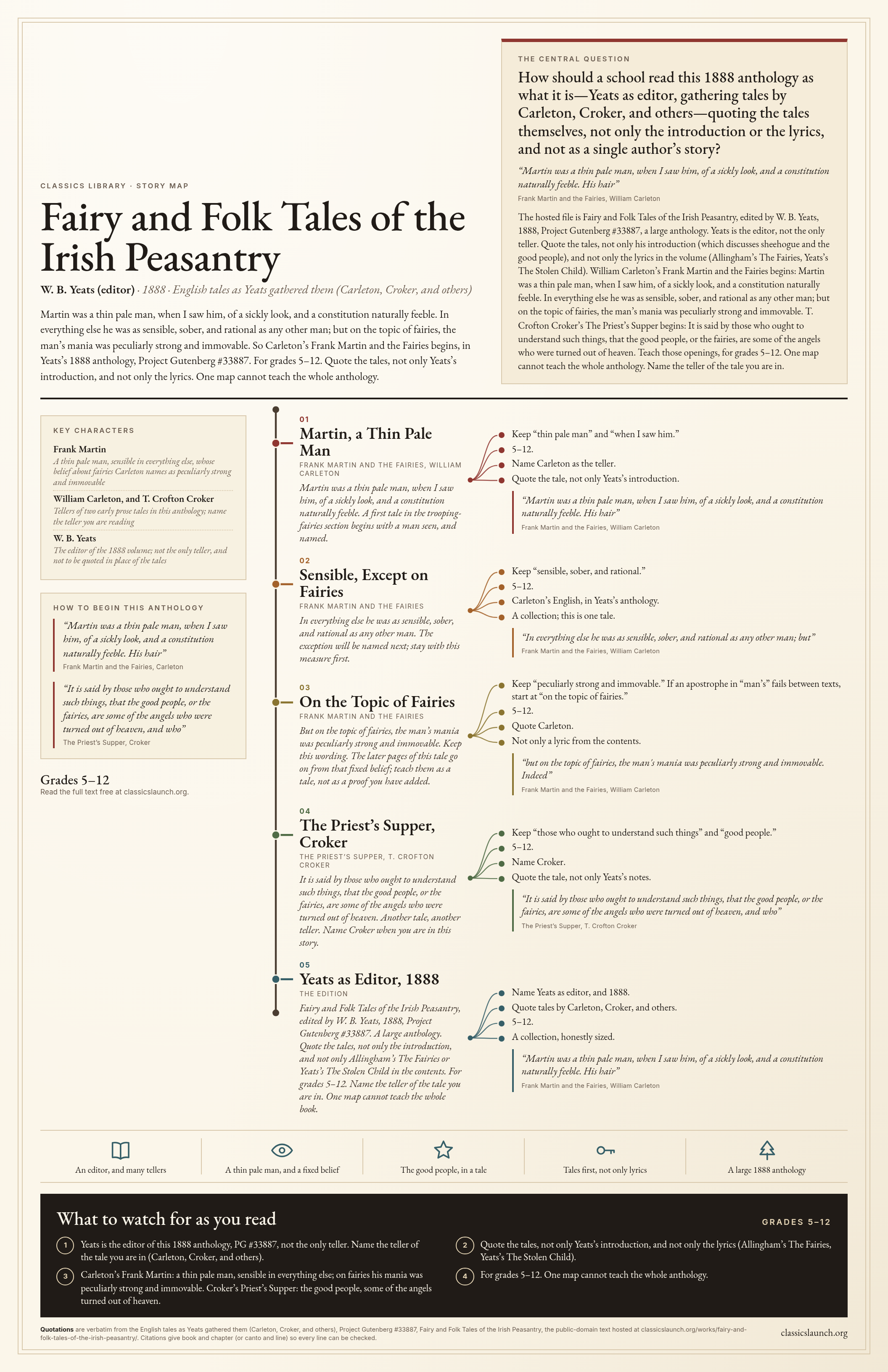
Martin was a thin pale man, when I saw him, of a sickly look, and a constitution naturally feeble. In everything else he was as sensible, sober, and rational as any other man; but on the topic of fairies, the man’s mania was peculiarly strong and immovable. So Carleton’s Frank Martin and the Fairies begins, in Yeats’s 1888 anthology, Project Gutenberg #33887. For grades 5–12. Quote the tales, not only Yeats’s introduction, and not only the lyrics. One map cannot teach the whole anthology.
The central question
How should a school read this 1888 anthology as what it is—Yeats as editor, gathering tales by Carleton, Croker, and others—quoting the tales themselves, not only the introduction or the lyrics, and not as a single author’s story?
“Martin was a thin pale man, when I saw him, of a sickly look, and a constitution naturally feeble. His hair”
The hosted file is Fairy and Folk Tales of the Irish Peasantry, edited by W. B. Yeats, 1888, Project Gutenberg #33887, a large anthology. Yeats is the editor, not the only teller. Quote the tales, not only his introduction (which discusses sheehogue and the good people), and not only the lyrics in the volume (Allingham’s The Fairies, Yeats’s The Stolen Child). William Carleton’s Frank Martin and the Fairies begins: Martin was a thin pale man, when I saw him, of a sickly look, and a constitution naturally feeble. In everything else he was as sensible, sober, and rational as any other man; but on the topic of fairies, the man’s mania was peculiarly strong and immovable. T. Crofton Croker’s The Priest’s Supper begins: It is said by those who ought to understand such things, that the good people, or the fairies, are some of the angels who were turned out of heaven. Teach those openings, for grades 5–12. One map cannot teach the whole anthology. Name the teller of the tale you are in.
- 01
Martin, a Thin Pale Man
Frank Martin and the Fairies, William Carleton
Martin was a thin pale man, when I saw him, of a sickly look, and a constitution naturally feeble. A first tale in the trooping-fairies section begins with a man seen, and named.
- Keep “thin pale man” and “when I saw him.”
- 5–12.
- Name Carleton as the teller.
- Quote the tale, not only Yeats’s introduction.
“Martin was a thin pale man, when I saw him, of a sickly look, and a constitution naturally feeble. His hair”
- 02
Sensible, Except on Fairies
Frank Martin and the Fairies
In everything else he was as sensible, sober, and rational as any other man. The exception will be named next; stay with this measure first.
- Keep “sensible, sober, and rational.”
- 5–12.
- Carleton’s English, in Yeats’s anthology.
- A collection; this is one tale.
“In everything else he was as sensible, sober, and rational as any other man; but”
- 03
On the Topic of Fairies
Frank Martin and the Fairies
But on the topic of fairies, the man’s mania was peculiarly strong and immovable. Keep this wording. The later pages of this tale go on from that fixed belief; teach them as a tale, not as a proof you have added.
- Keep “peculiarly strong and immovable.” If an apostrophe in “man’s” fails between texts, start at “on the topic of fairies.”
- 5–12.
- Quote Carleton.
- Not only a lyric from the contents.
“but on the topic of fairies, the man's mania was peculiarly strong and immovable. Indeed”
- 04
The Priest’s Supper, Croker
The Priest’s Supper, T. Crofton Croker
It is said by those who ought to understand such things, that the good people, or the fairies, are some of the angels who were turned out of heaven. Another tale, another teller. Name Croker when you are in this story.
- Keep “those who ought to understand such things” and “good people.”
- 5–12.
- Name Croker.
- Quote the tale, not only Yeats’s notes.
“It is said by those who ought to understand such things, that the good people, or the fairies, are some of the angels who were turned out of heaven, and who”
- 05
Yeats as Editor, 1888
The edition
Fairy and Folk Tales of the Irish Peasantry, edited by W. B. Yeats, 1888, Project Gutenberg #33887. A large anthology. Quote the tales, not only the introduction, and not only Allingham’s The Fairies or Yeats’s The Stolen Child in the contents. For grades 5–12. Name the teller of the tale you are in. One map cannot teach the whole book.
- Name Yeats as editor, and 1888.
- Quote tales by Carleton, Croker, and others.
- 5–12.
- A collection, honestly sized.
“Martin was a thin pale man, when I saw him, of a sickly look, and a constitution naturally feeble. His hair”
- An editor, and many tellers
- A thin pale man, and a fixed belief
- The good people, in a tale
- Tales first, not only lyrics
- A large 1888 anthology
What to watch for as you read
Grades 5–12- Yeats is the editor of this 1888 anthology, PG #33887, not the only teller. Name the teller of the tale you are in (Carleton, Croker, and others).
- Quote the tales, not only Yeats’s introduction, and not only the lyrics (Allingham’s The Fairies, Yeats’s The Stolen Child).
- Carleton’s Frank Martin: a thin pale man, sensible in everything else; on fairies his mania was peculiarly strong and immovable. Croker’s Priest’s Supper: the good people, some of the angels turned out of heaven.
- For grades 5–12. One map cannot teach the whole anthology.
Every quotation is word for word from the English tales as Yeats gathered them (Carleton, Croker, and others) hosted in this library and is checked against that text each time the site is built. Citations give book and chapter (or canto and line).