Story maps · Grades 11–12
The History of Tom Jones, a Foundling: A Story Map
The PDF is one tabloid page (11 × 17 in). On letter paper, choose “Fit to page.”
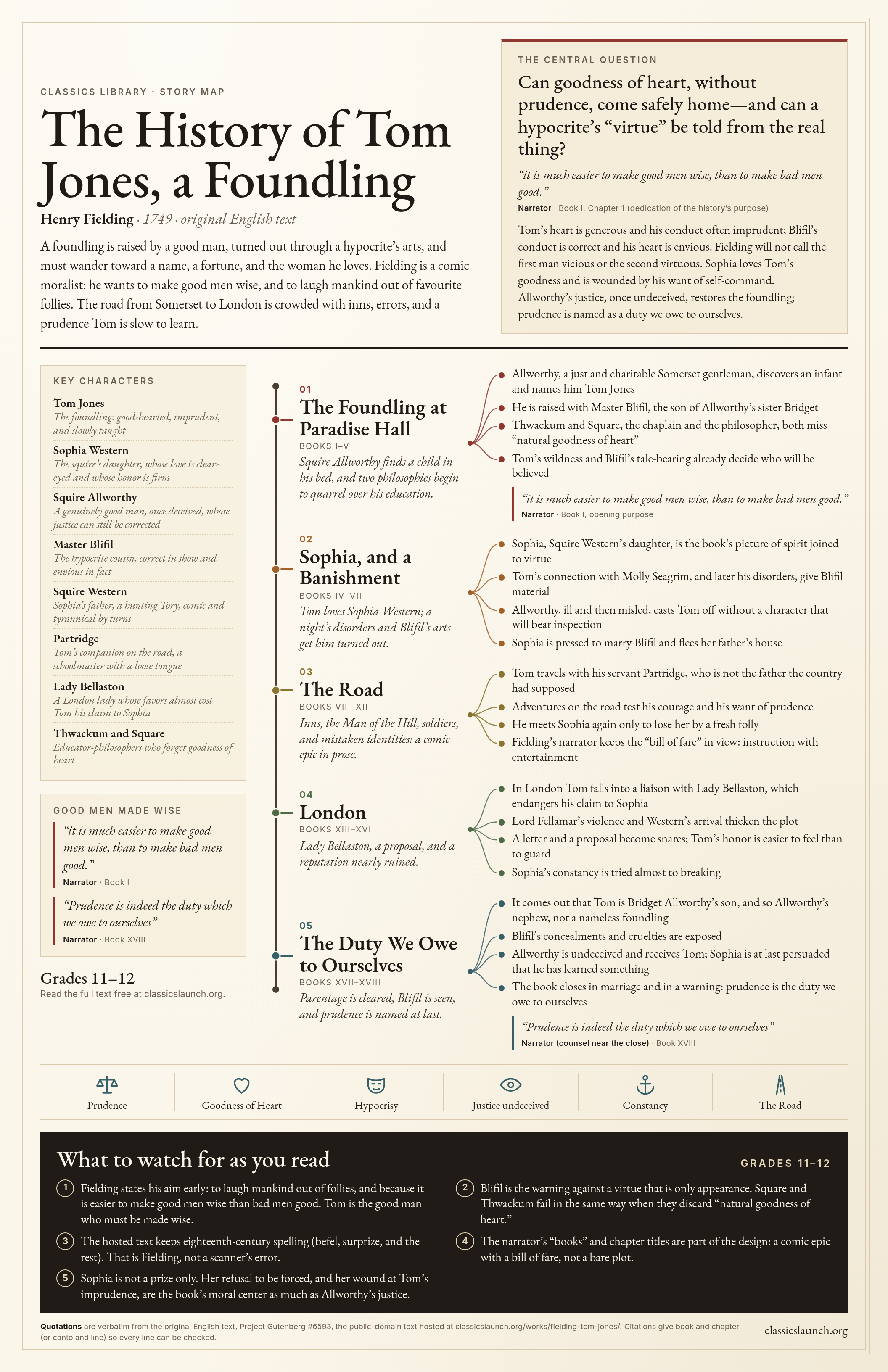
A foundling is raised by a good man, turned out through a hypocrite’s arts, and must wander toward a name, a fortune, and the woman he loves. Fielding is a comic moralist: he wants to make good men wise, and to laugh mankind out of favourite follies. The road from Somerset to London is crowded with inns, errors, and a prudence Tom is slow to learn.
The central question
Can goodness of heart, without prudence, come safely home—and can a hypocrite’s “virtue” be told from the real thing?
“it is much easier to make good men wise, than to make bad men good.”
Tom’s heart is generous and his conduct often imprudent; Blifil’s conduct is correct and his heart is envious. Fielding will not call the first man vicious or the second virtuous. Sophia loves Tom’s goodness and is wounded by his want of self-command. Allworthy’s justice, once undeceived, restores the foundling; prudence is named as a duty we owe to ourselves.
- 01
The Foundling at Paradise Hall
Books I–V
Squire Allworthy finds a child in his bed, and two philosophies begin to quarrel over his education.
- Allworthy, a just and charitable Somerset gentleman, discovers an infant and names him Tom Jones
- He is raised with Master Blifil, the son of Allworthy’s sister Bridget
- Thwackum and Square, the chaplain and the philosopher, both miss “natural goodness of heart”
- Tom’s wildness and Blifil’s tale-bearing already decide who will be believed
“it is much easier to make good men wise, than to make bad men good.”
- 02
Sophia, and a Banishment
Books IV–VII
Tom loves Sophia Western; a night’s disorders and Blifil’s arts get him turned out.
- Sophia, Squire Western’s daughter, is the book’s picture of spirit joined to virtue
- Tom’s connection with Molly Seagrim, and later his disorders, give Blifil material
- Allworthy, ill and then misled, casts Tom off without a character that will bear inspection
- Sophia is pressed to marry Blifil and flees her father’s house
- 03
The Road
Books VIII–XII
Inns, the Man of the Hill, soldiers, and mistaken identities: a comic epic in prose.
- Tom travels with his servant Partridge, who is not the father the country had supposed
- Adventures on the road test his courage and his want of prudence
- He meets Sophia again only to lose her by a fresh folly
- Fielding’s narrator keeps the “bill of fare” in view: instruction with entertainment
- 04
London
Books XIII–XVI
Lady Bellaston, a proposal, and a reputation nearly ruined.
- In London Tom falls into a liaison with Lady Bellaston, which endangers his claim to Sophia
- Lord Fellamar’s violence and Western’s arrival thicken the plot
- A letter and a proposal become snares; Tom’s honor is easier to feel than to guard
- Sophia’s constancy is tried almost to breaking
- 05
The Duty We Owe to Ourselves
Books XVII–XVIII
Parentage is cleared, Blifil is seen, and prudence is named at last.
- It comes out that Tom is Bridget Allworthy’s son, and so Allworthy’s nephew, not a nameless foundling
- Blifil’s concealments and cruelties are exposed
- Allworthy is undeceived and receives Tom; Sophia is at last persuaded that he has learned something
- The book closes in marriage and in a warning: prudence is the duty we owe to ourselves
“Prudence is indeed the duty which we owe to ourselves”
- Prudence
- Goodness of Heart
- Hypocrisy
- Justice undeceived
- Constancy
- The Road
What to watch for as you read
Grades 11–12- Fielding states his aim early: to laugh mankind out of follies, and because it is easier to make good men wise than bad men good. Tom is the good man who must be made wise.
- Blifil is the warning against a virtue that is only appearance. Square and Thwackum fail in the same way when they discard “natural goodness of heart.”
- The hosted text keeps eighteenth-century spelling (befel, surprize, and the rest). That is Fielding, not a scanner’s error.
- The narrator’s “books” and chapter titles are part of the design: a comic epic with a bill of fare, not a bare plot.
- Sophia is not a prize only. Her refusal to be forced, and her wound at Tom’s imprudence, are the book’s moral center as much as Allworthy’s justice.
Every quotation is word for word from the original English text hosted in this library and is checked against that text each time the site is built. Citations give book and chapter (or canto and line).