Story maps · Grades 11–12
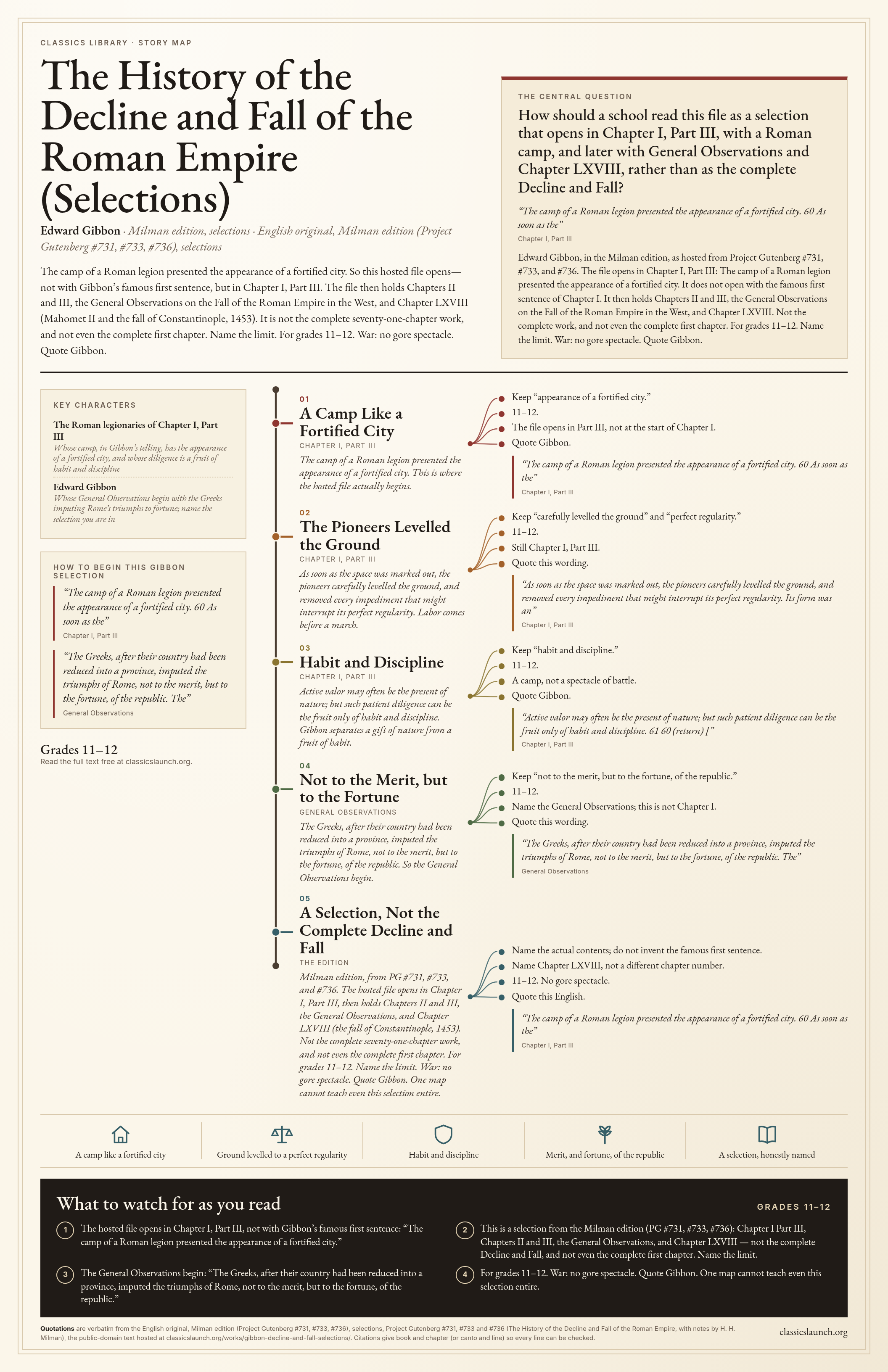
The History of the Decline and Fall of the Roman Empire (Selections): A Story Map
The PDF is one tabloid page (11 × 17 in). On letter paper, choose “Fit to page.”
The camp of a Roman legion presented the appearance of a fortified city. So this hosted file opens—not with Gibbon’s famous first sentence, but in Chapter I, Part III. The file then holds Chapters II and III, the General Observations on the Fall of the Roman Empire in the West, and Chapter LXVIII (Mahomet II and the fall of Constantinople, 1453). It is not the complete seventy-one-chapter work, and not even the complete first chapter. Name the limit. For grades 11–12. War: no gore spectacle. Quote Gibbon.
The central question
How should a school read this file as a selection that opens in Chapter I, Part III, with a Roman camp, and later with General Observations and Chapter LXVIII, rather than as the complete Decline and Fall?
“The camp of a Roman legion presented the appearance of a fortified city. 60 As soon as the”
Edward Gibbon, in the Milman edition, as hosted from Project Gutenberg #731, #733, and #736. The file opens in Chapter I, Part III: The camp of a Roman legion presented the appearance of a fortified city. It does not open with the famous first sentence of Chapter I. It then holds Chapters II and III, the General Observations on the Fall of the Roman Empire in the West, and Chapter LXVIII. Not the complete work, and not even the complete first chapter. For grades 11–12. Name the limit. War: no gore spectacle. Quote Gibbon.
- 01
A Camp Like a Fortified City
Chapter I, Part III
The camp of a Roman legion presented the appearance of a fortified city. This is where the hosted file actually begins.
- Keep “appearance of a fortified city.”
- 11–12.
- The file opens in Part III, not at the start of Chapter I.
- Quote Gibbon.
“The camp of a Roman legion presented the appearance of a fortified city. 60 As soon as the”
- 02
The Pioneers Levelled the Ground
Chapter I, Part III
As soon as the space was marked out, the pioneers carefully levelled the ground, and removed every impediment that might interrupt its perfect regularity. Labor comes before a march.
- Keep “carefully levelled the ground” and “perfect regularity.”
- 11–12.
- Still Chapter I, Part III.
- Quote this wording.
“As soon as the space was marked out, the pioneers carefully levelled the ground, and removed every impediment that might interrupt its perfect regularity. Its form was an”
- 03
Habit and Discipline
Chapter I, Part III
Active valor may often be the present of nature; but such patient diligence can be the fruit only of habit and discipline. Gibbon separates a gift of nature from a fruit of habit.
- Keep “habit and discipline.”
- 11–12.
- A camp, not a spectacle of battle.
- Quote Gibbon.
“Active valor may often be the present of nature; but such patient diligence can be the fruit only of habit and discipline. 61 60 (return) [”
- 04
Not to the Merit, but to the Fortune
General Observations
The Greeks, after their country had been reduced into a province, imputed the triumphs of Rome, not to the merit, but to the fortune, of the republic. So the General Observations begin.
- Keep “not to the merit, but to the fortune, of the republic.”
- 11–12.
- Name the General Observations; this is not Chapter I.
- Quote this wording.
“The Greeks, after their country had been reduced into a province, imputed the triumphs of Rome, not to the merit, but to the fortune, of the republic. The”
- 05
A Selection, Not the Complete Decline and Fall
The edition
Milman edition, from PG #731, #733, and #736. The hosted file opens in Chapter I, Part III, then holds Chapters II and III, the General Observations, and Chapter LXVIII (the fall of Constantinople, 1453). Not the complete seventy-one-chapter work, and not even the complete first chapter. For grades 11–12. Name the limit. War: no gore spectacle. Quote Gibbon. One map cannot teach even this selection entire.
- Name the actual contents; do not invent the famous first sentence.
- Name Chapter LXVIII, not a different chapter number.
- 11–12. No gore spectacle.
- Quote this English.
“The camp of a Roman legion presented the appearance of a fortified city. 60 As soon as the”
- A camp like a fortified city
- Ground levelled to a perfect regularity
- Habit and discipline
- Merit, and fortune, of the republic
- A selection, honestly named
What to watch for as you read
Grades 11–12- The hosted file opens in Chapter I, Part III, not with Gibbon’s famous first sentence: “The camp of a Roman legion presented the appearance of a fortified city.”
- This is a selection from the Milman edition (PG #731, #733, #736): Chapter I Part III, Chapters II and III, the General Observations, and Chapter LXVIII — not the complete Decline and Fall, and not even the complete first chapter. Name the limit.
- The General Observations begin: “The Greeks, after their country had been reduced into a province, imputed the triumphs of Rome, not to the merit, but to the fortune, of the republic.”
- For grades 11–12. War: no gore spectacle. Quote Gibbon. One map cannot teach even this selection entire.
Every quotation is word for word from the English original, Milman edition (Project Gutenberg #731, #733, #736), selections hosted in this library and is checked against that text each time the site is built. Citations give book and chapter (or canto and line).