Story maps · Grades 9–12
Italian Journey: A Story Map
The PDF is one tabloid page (11 × 17 in). On letter paper, choose “Fit to page.”
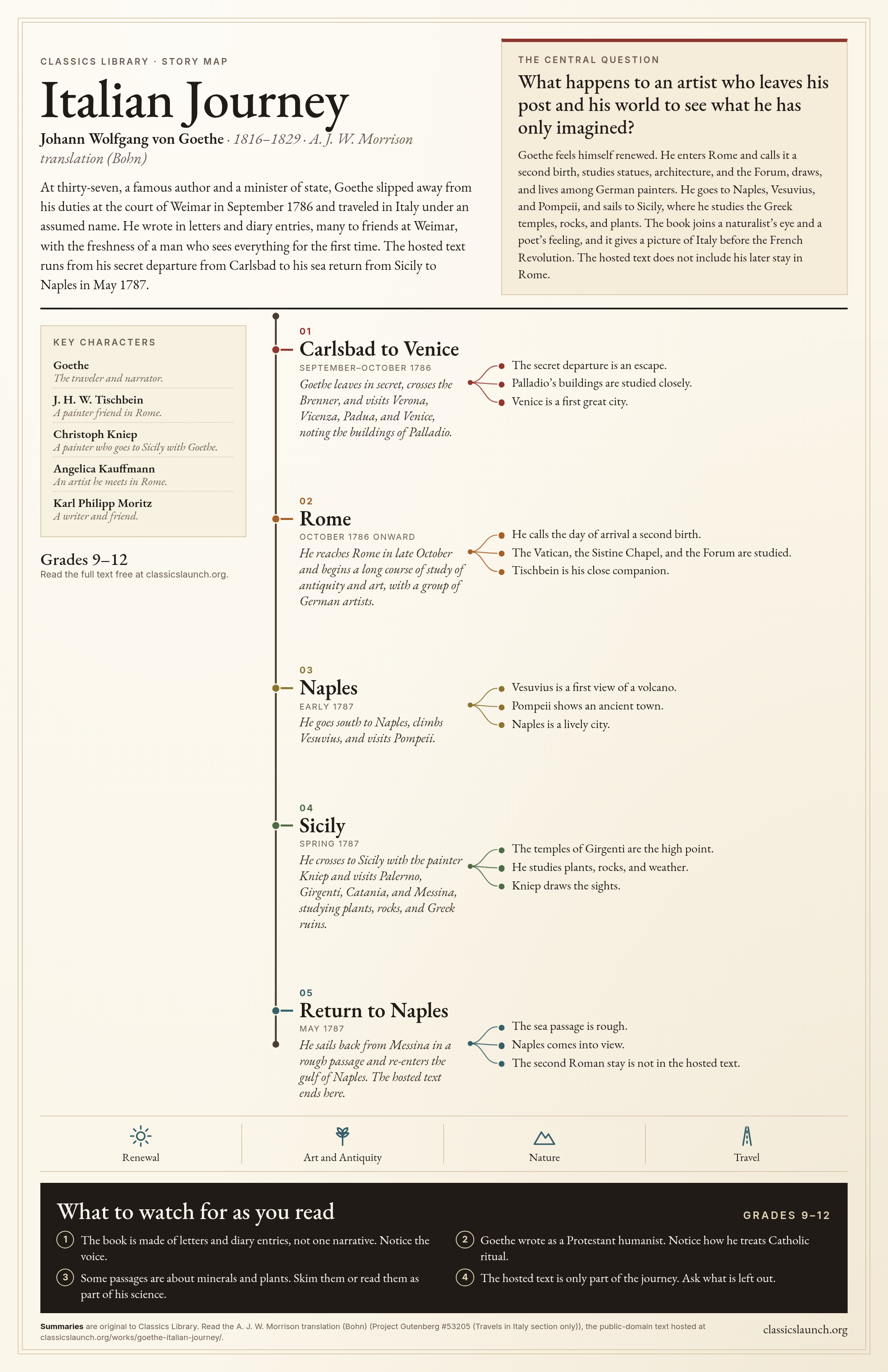
At thirty-seven, a famous author and a minister of state, Goethe slipped away from his duties at the court of Weimar in September 1786 and traveled in Italy under an assumed name. He wrote in letters and diary entries, many to friends at Weimar, with the freshness of a man who sees everything for the first time. The hosted text runs from his secret departure from Carlsbad to his sea return from Sicily to Naples in May 1787.
The central question
What happens to an artist who leaves his post and his world to see what he has only imagined?
Goethe feels himself renewed. He enters Rome and calls it a second birth, studies statues, architecture, and the Forum, draws, and lives among German painters. He goes to Naples, Vesuvius, and Pompeii, and sails to Sicily, where he studies the Greek temples, rocks, and plants. The book joins a naturalist’s eye and a poet’s feeling, and it gives a picture of Italy before the French Revolution. The hosted text does not include his later stay in Rome.
- 01
Carlsbad to Venice
September–October 1786
Goethe leaves in secret, crosses the Brenner, and visits Verona, Vicenza, Padua, and Venice, noting the buildings of Palladio.
- The secret departure is an escape.
- Palladio’s buildings are studied closely.
- Venice is a first great city.
- 02
Rome
October 1786 onward
He reaches Rome in late October and begins a long course of study of antiquity and art, with a group of German artists.
- He calls the day of arrival a second birth.
- The Vatican, the Sistine Chapel, and the Forum are studied.
- Tischbein is his close companion.
- 03
Naples
Early 1787
He goes south to Naples, climbs Vesuvius, and visits Pompeii.
- Vesuvius is a first view of a volcano.
- Pompeii shows an ancient town.
- Naples is a lively city.
- 04
Sicily
Spring 1787
He crosses to Sicily with the painter Kniep and visits Palermo, Girgenti, Catania, and Messina, studying plants, rocks, and Greek ruins.
- The temples of Girgenti are the high point.
- He studies plants, rocks, and weather.
- Kniep draws the sights.
- 05
Return to Naples
May 1787
He sails back from Messina in a rough passage and re-enters the gulf of Naples. The hosted text ends here.
- The sea passage is rough.
- Naples comes into view.
- The second Roman stay is not in the hosted text.
- Renewal
- Art and Antiquity
- Nature
- Travel
What to watch for as you read
Grades 9–12- The book is made of letters and diary entries, not one narrative. Notice the voice.
- Goethe wrote as a Protestant humanist. Notice how he treats Catholic ritual.
- Some passages are about minerals and plants. Skim them or read them as part of his science.
- The hosted text is only part of the journey. Ask what is left out.
Every quotation is word for word from the A. J. W. Morrison translation (Bohn) hosted in this library and is checked against that text each time the site is built. Citations give book and chapter (or canto and line).