Work record
Italian Journey (Travels in Italy)
Johann Wolfgang von GoetheItalienische Reise; Travels in Italy; Goethe's Travels in ItalyItalian Journey (Travels in Italy) by Johann Wolfgang von Goethe (1816)Italian Journey is Goethe's account of the two years, 1786 to 1788, when he slipped away from his duties at the court of Weimar and travelled in Italy.Also known as: Italienische Reise · Travels in Italy · Goethe's Travels in Italy
1816 · 19th Century · Travel · German
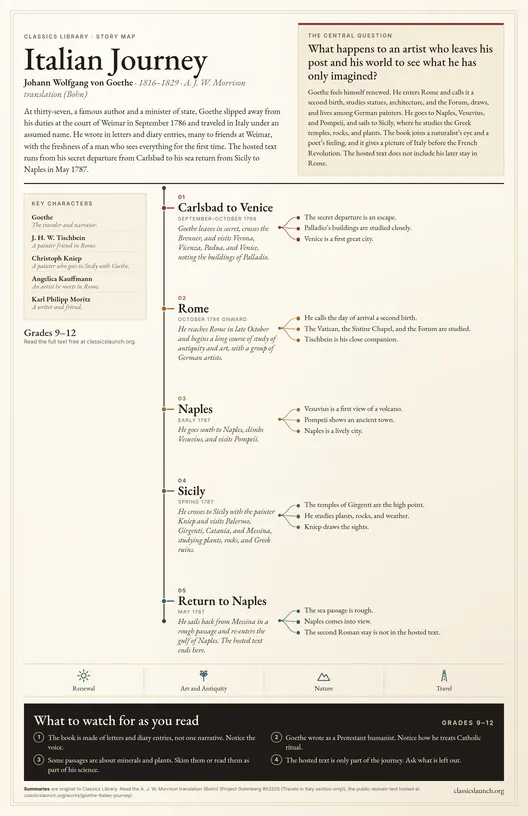 Story mapSee the story mapThe whole book on one page: the story in movements, the characters, and what to watch for. Free to print.
Abstract
Background. Goethe, then thirty-seven and a minister at Weimar, slipped away in 1786 for two years in Italy and published his account three decades later, in 1816 and 1817. The hosted part ends in 1787.
Plot. He crosses the Alps, visits Venice, spends long months in Rome, and goes south to Naples and Sicily. He studies art, the ruins of antiquity, rocks and plants, and thinks of the journey as a new birth. The hosted part ends with the voyage back from Sicily.
Ideas. The book argues for patient attention and for classical ideals of form. It joins the natural scientist and the poet, and shows how seeing the great things of the past can renew an artist.
Text. The hosted text is the Travels in Italy part of the Bohn translation by the Rev. A. J. W. Morrison, with dated letters and diary entries in order. It has long scientific digressions. The hosted text is complete as printed here, with its section headings kept as a guide to the reader, and every quotation on this page is drawn directly from that text. Teachers can pair this work with the library's study guide, seminar questions and memory-work selection to prepare a discussion, a short essay or a recitation. The full text is hosted on this site, and each quotation in the guide has been checked against the hosted translation.
Key figures
- Goethe: The poet-statesman as traveller
- Tischbein: A painter friend in Rome
- Kniep: A draughtsman in Sicily
- Kauffmann: A Swiss painter in Rome
- Moritz: A writer friend
Summary
Italian Journey is Goethe's account of the two years, 1786 to 1788, when he slipped away from his duties at the court of Weimar and travelled in Italy. He was thirty-seven, a famous author and a minister of state, and he felt he was in danger of drying up. In September 1786 he left Carlsbad in secret under an assumed name, without telling even the Duke, and crossed the Brenner into the Italian lakes, Verona, Vicenza and Venice. He writes in letters and diary entries, many of them addressed to his friends in Weimar, with the freshness of a man who sees everything for the first time. He stays longest in Rome, which he enters in late October and calls the capital of the world. He reports the day he arrived as a second birth, and he gives himself to a daily round of study: antique statues, the Vatican and the Sistine Chapel, the architecture of Palladio and the ruins of the Forum. He draws, sketches, and lives among a circle of German painters, especially Tischbein, and he refines his sense of what the ancients meant by form. A journey to Naples brings him to Vesuvius and Pompeii, and a sea voyage to Sicily takes him to Palermo, to Girgenti with its ancient Greek temples, and to Catania and Messina. He studies rocks, plants and weather with the same attention, and he reads his own verse drama Iphigenia aloud to his friends in Rome. The hosted text runs from his secret departure from Carlsbad in September 1786 to his return by sea from Sicily to Naples in May 1787. It does not include the Letters from Switzerland printed before it in the source volume, nor the later part of the journey, including his second stay in Rome. It is among the great travel books because it joins the objective eye of a naturalist with the feelings of a poet and gives an exact picture of Italy before the French Revolution. It is also a record of how an artist is renewed by what he sees. Goethe returns to Weimar a different man, and his classical works follow. Readers should know that he is writing as a Protestant humanist and views Catholic ritual and religious art partly as spectacle. He speaks of common people with warmth, sometimes with the condescension of his age, and there are long passages on minerals, clouds and plants.
Virtues in this work
- Prudence: Goethe plans his studies carefully and warns against hurrying.
- Industry: He draws, writes and studies every day of the journey.
- Temperance: He praises restraint and order in art and in the conduct of life.
- Humility: He accepts the lessons of the old masters as a pupil.
Plot or Argument
- From Carlsbad to Venice
Goethe leaves in secret, crosses the Brenner, and visits Verona, Vicenza, Padua and Venice, noting the buildings of Palladio.
- First Roman stay
He reaches Rome in late October 1786 and begins a long course of study of antiquity and art, with a group of German artists.
- Naples
In February 1787 he goes south to Naples, climbs Vesuvius and visits Pompeii.
- Sicily
He crosses to Sicily with the painter Kniep and visits Palermo, Girgenti, Catania and Messina, studying plants, rocks and Greek ruins.
- Return to Naples
He sails back from Messina in a rough passage and re-enters the gulf of Naples.
Characters
- Goethe, traveller and narrator
A middle-aged poet and statesman seeking to renew himself by seeing.
- Johann Heinrich Wilhelm Tischbein, painter friend
A German painter in Rome who guides Goethe and paints his portrait.
- Christoph Kniep, painter
A draughtsman who accompanies Goethe in Sicily.
- Angelica Kauffmann, artist
A Swiss painter in Rome whom Goethe admires.
- Karl Philipp Moritz, writer
A German author and friend in Rome, with whom Goethe discusses language and art.
Lessons
To see well is to be renewed
Goethe speaks of a new birth when he first sees Rome. The book is an account of how attention, long study and humility in the presence of great works can refresh a mind grown stale.
- What does Goethe say he was escaping?
- How does he describe the effect of seeing the things he had known only in pictures?
Slow and sure study
Goethe repeatedly says that he will not hurry, and that sure steps in art must be slow. He gives a picture of careful education in the arts.
- What does Goethe do daily in Rome?
- Why does he refuse to hurry?
Beauty is lawful
In Palladio and in Greek temples, Goethe finds a lawful order of proportion that he contrasts with the careless Gothic or baroque. The book is a source for classical ideals of form.
- What does he admire in Palladio?
- How does he judge the baroque?
Context
Italy in the 1780s was a patchwork of states, with Rome ruled by the Pope and Naples by the Bourbons. The Grand Tour was an established part of an educated man's life, though few stayed as long as Goethe did.
Composition
Goethe kept letters and a diary during the journey of 1786–88, and published the Italian Journey only in 1816–17, shaping the material. The translation hosted here is the Bohn edition of the Rev. A. J. W. Morrison.
Reception
The book fixed for many readers the picture of Italy as a land of light and classical form, and later travellers, such as Byron and Ruskin, wrote in its wake.
Comparisons
- Childe Harold's Pilgrimage
Byron's poem gives a Romantic view of the same Italian cities.
- The Aeneid
Goethe sees the Italian landscape and its ruins through the Latin poets, and Virgil is among them.
- Faust, Part One
Goethe's drama was finished in the shadow of the Italian experience and shares its longing for renewal.
- The Sorrows of Young Werther
Goethe's early novel shows the despair from which the journey was a flight.
Quotes
Frequently cited
“a new life begins when a man once sees with his own eyes all that before he has but partially heard or read of.”
Frequently cited
“I reckon a new-birth day,--a true new birth from the day that I entered Rome.”
“God be praised! whatever from my youth up appeared to me of worth, is beginning once more to be dear to me.”
For Students
A reading companion for classical Christian high school students. See the student guide.
Reading Guide
Watch for
- What Goethe says he was escaping and what he hopes to find.
- His reasons for admiring Palladio and the Greek temples.
- How his attention to rocks and plants shapes his view of art.
Key terms and names
- Grand Tour
- The journey through Europe, especially Italy, that educated young men took in the eighteenth and early nineteenth centuries.
- Palladio
- Andrea Palladio (1508–1580), the Venetian architect whose classical villas and churches Goethe admired.
- Classicism
- An approach to art that values order, proportion and the example of antiquity.
- Sirocco
- The hot, humid south wind of the Mediterranean, which Goethe notes in Naples and Sicily.
Seminar Questions
- Comprehension Why does Goethe leave Weimar in secret?
- Comprehension What does he say about his first days in Rome?
- Interpretation How does Goethe join science to art in this book?
- Interpretation What does he mean by slow and sure study?
- Interpretation How does he treat ordinary Italians?
- Big Question Can travel change a person?
- Big Question What is the value of studying the past?
Faith Connections
- Psalm 19:1 (Scripture)
'The heavens declare the glory of God.' Goethe's attention to creation is a kind of praise, though he does not frame it so.
- Acts 17:22–28 (Scripture)
Paul in Athens appeals to what the pagans knew of God in their poetry and their altars, which is a model for a Christian reading of classical art.
- Augustine, Confessions, Book I (Great Conversation)
Augustine, too, reflects on how a restless heart is shaped by what it loves; Goethe's journey is a secular parallel.
Logic and Rhetoric
Central argument: Direct and sustained attention to real things, ancient art and nature, can renew a mind grown dry.
Rhetorical device: the diary as argument. By dating entries and reporting small facts, Goethe makes his claims of renewal credible.
Debate: Resolved: That travel is an essential part of a good education.
Memory Work
a new life begins when a man once sees with his own eyes all that before he has but partially heard or read of.
I reckon a new-birth day,--a true new birth from the day that I entered Rome.
Writing Prompts
Essay: Goethe says that he dates a new birth from the day he entered Rome. What does this tell us about the purpose of the journey?
Comparison with Childe Harold's Pilgrimage: Compare Goethe's and Byron's responses to Rome.
Creative Prompts
- Essay
Choose one city that Goethe visits and show how he sees it differently from a modern tourist.
- Classroom
Keep a travel diary for a week in the manner of Goethe, noting what you see and what you learn.
- Poetry
Write a poem in which a traveller first sees a place he has long known only in pictures.
Further Reading
- Faust, Part One, Johann Wolfgang von Goethe
Goethe's drama, hosted in this library.
- Childe Harold's Pilgrimage, Lord Byron
A Romantic poem on the same Italian cities.
- The Stones of Venice, John Ruskin
A Victorian study of Venetian architecture.
- The Life of Friedrich Schiller, Thomas Carlyle
Carlyle's biography, hosted in this library.
Verification notes
Hosted text is the Travels in Italy section of Rev. A. J. W. Morrison's Bohn translation (Project Gutenberg #53205), in public domain: Carlsbad to the return voyage from Sicily to Naples. The Letters from Switzerland and the later second Roman stay are not hosted. Quotes were checked against the hosted text.
- The first year of Morrison's translation in Bohn's series.
- That the hosted volume ends with the return from Sicily; the second Roman stay (Part III of the standard German text) is a separate Bohn volume.