Story maps · Grades 11–12
The Sorrows of Young Werther: A Story Map
The PDF is one tabloid page (11 × 17 in). On letter paper, choose “Fit to page.”
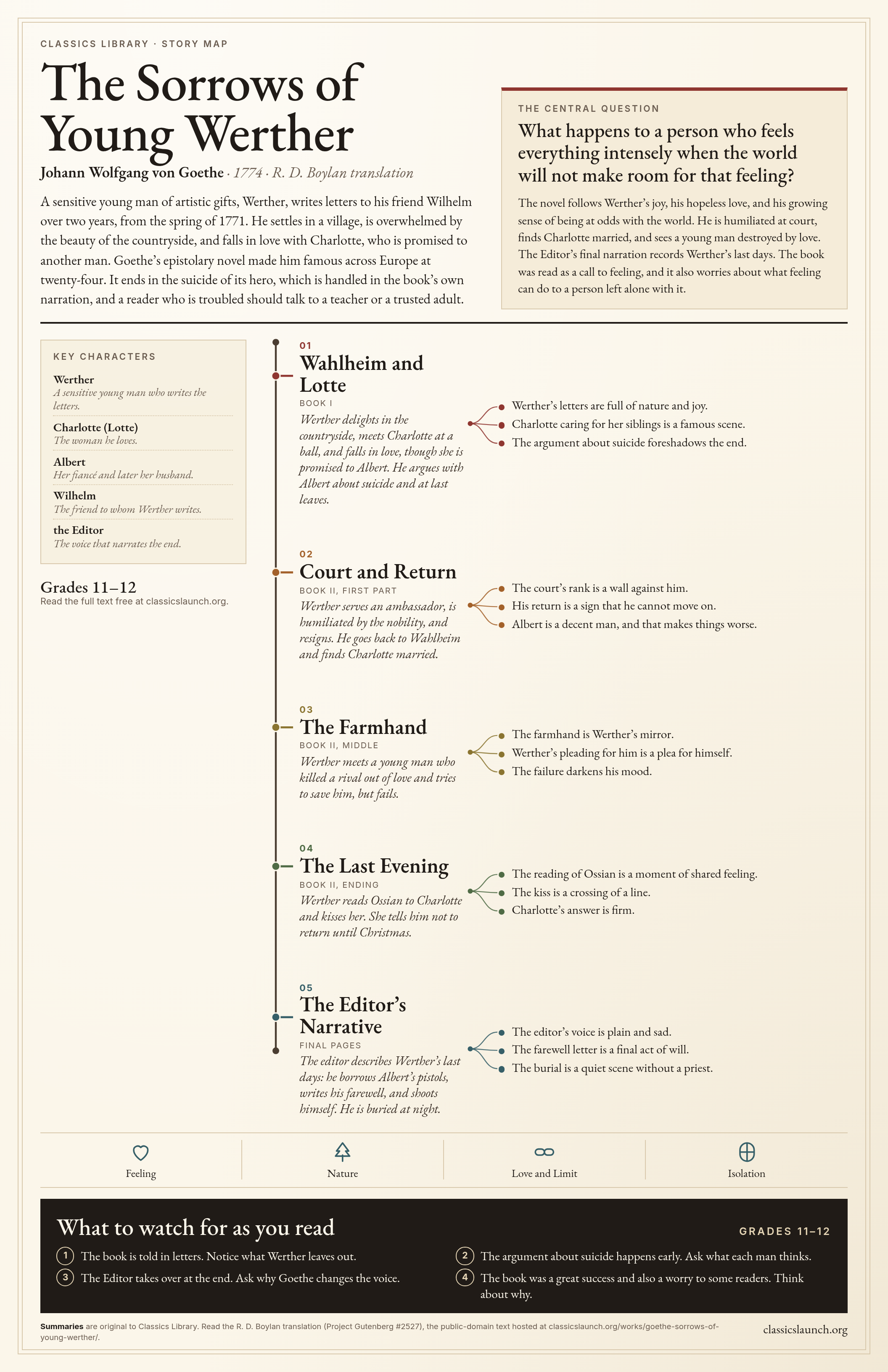
A sensitive young man of artistic gifts, Werther, writes letters to his friend Wilhelm over two years, from the spring of 1771. He settles in a village, is overwhelmed by the beauty of the countryside, and falls in love with Charlotte, who is promised to another man. Goethe’s epistolary novel made him famous across Europe at twenty-four. It ends in the suicide of its hero, which is handled in the book’s own narration, and a reader who is troubled should talk to a teacher or a trusted adult.
The central question
What happens to a person who feels everything intensely when the world will not make room for that feeling?
The novel follows Werther’s joy, his hopeless love, and his growing sense of being at odds with the world. He is humiliated at court, finds Charlotte married, and sees a young man destroyed by love. The Editor’s final narration records Werther’s last days. The book was read as a call to feeling, and it also worries about what feeling can do to a person left alone with it.
- 01
Wahlheim and Lotte
Book I
Werther delights in the countryside, meets Charlotte at a ball, and falls in love, though she is promised to Albert. He argues with Albert about suicide and at last leaves.
- Werther’s letters are full of nature and joy.
- Charlotte caring for her siblings is a famous scene.
- The argument about suicide foreshadows the end.
- 02
Court and Return
Book II, first part
Werther serves an ambassador, is humiliated by the nobility, and resigns. He goes back to Wahlheim and finds Charlotte married.
- The court’s rank is a wall against him.
- His return is a sign that he cannot move on.
- Albert is a decent man, and that makes things worse.
- 03
The Farmhand
Book II, middle
Werther meets a young man who killed a rival out of love and tries to save him, but fails.
- The farmhand is Werther’s mirror.
- Werther’s pleading for him is a plea for himself.
- The failure darkens his mood.
- 04
The Last Evening
Book II, ending
Werther reads Ossian to Charlotte and kisses her. She tells him not to return until Christmas.
- The reading of Ossian is a moment of shared feeling.
- The kiss is a crossing of a line.
- Charlotte’s answer is firm.
- 05
The Editor’s Narrative
Final pages
The editor describes Werther’s last days: he borrows Albert’s pistols, writes his farewell, and shoots himself. He is buried at night.
- The editor’s voice is plain and sad.
- The farewell letter is a final act of will.
- The burial is a quiet scene without a priest.
- Feeling
- Nature
- Love and Limit
- Isolation
What to watch for as you read
Grades 11–12- The book is told in letters. Notice what Werther leaves out.
- The argument about suicide happens early. Ask what each man thinks.
- The Editor takes over at the end. Ask why Goethe changes the voice.
- The book was a great success and also a worry to some readers. Think about why.
Every quotation is word for word from the R. D. Boylan translation hosted in this library and is checked against that text each time the site is built. Citations give book and chapter (or canto and line).