Work record
The Sorrows of Young Werther
Johann Wolfgang von GoetheDie Leiden des jungen Werthers; Sorrows of Werther; The Sorrows of WerterThe Sorrows of Young Werther by Johann Wolfgang von Goethe (1774)The Sorrows of Young Werther is the epistolary novel that made Goethe famous across Europe at twenty-four.Also known as: Die Leiden des jungen Werthers · Sorrows of Werther · The Sorrows of Werter
1774 · 18th Century · Novel · German
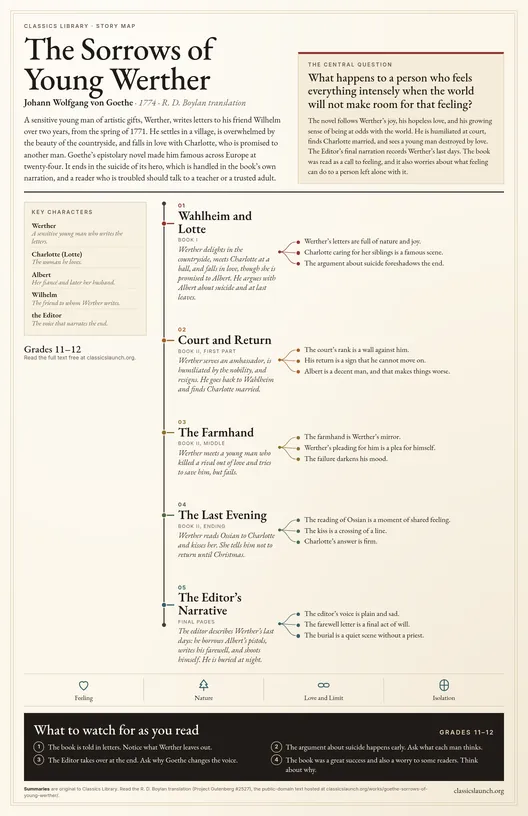 Story mapSee the story mapThe whole book on one page: the story in movements, the characters, and what to watch for. Free to print.
Abstract
Background. Goethe wrote this book in a few weeks in 1774 at the age of twenty-four, drawing on his own failed love and on the suicide of an acquaintance. It was a sensation across Europe and made him famous.
Plot. A young man comes to a village, is delighted by nature, and falls in love with a woman promised to another. As the engagement becomes a marriage, his love turns into torment, he loses his place in the world, and he takes his own life.
Ideas. The novel examines the dangers of feeling cut off from work, community and faith. It also records the debate over suicide, and sets Werther's romantic rhetoric against Albert's common sense.
Text. The hosted translation is by R. D. Boylan in the Bohn edition, in two books of letters with an editor's closing narrative. The suicide is told directly, so teachers should read the last pages first. The hosted text is complete as printed here, with its section headings kept as a guide to the reader, and every quotation on this page is drawn directly from that text. Teachers can pair this work with the library's study guide, seminar questions and memory-work selection to prepare a discussion, a short essay or a recitation. The full text is hosted on this site, and each quotation in the guide has been checked against the hosted translation.
Main characters
- Werther: A sensitive young artist
- Charlotte: The young woman he loves
- Albert: Her steady fiancé and later husband
- Wilhelm: Werther's unseen correspondent
- The Editor: The voice of the final chapter
Summary
The Sorrows of Young Werther is the epistolary novel that made Goethe famous across Europe at twenty-four. It is a series of letters from Werther, a sensitive young man of artistic gifts, to his friend Wilhelm, written during two years from the spring of 1771. Werther has gone to the village of Wahlheim to settle a family matter. He is overwhelmed by the beauty of the countryside, and for a few weeks he is almost perfectly happy: he reads Homer, draws, and befriends the villagers and their children. At a country ball he meets Charlotte, the eldest daughter of the district judge, who is mothering her many younger brothers and sisters. She is gentle, intelligent and warm, and he falls in love with her at once. He learns that she is promised to Albert, an absent, honest and steady man. When Albert returns, Werther tries to be a friend to both, but his feeling grows every day into an obsession. The first book ends with his decision to leave. In the second, he takes a post with an ambassador, but the work irks him and the nobility humiliates him at a party for being a commoner, and he resigns. He wanders, returns, and finds Charlotte married. His love now turns to torment. He meets a young farmhand who is mad with love for his employer, and who has killed a rival; he tries to save him, and fails. The same night he reads aloud to Charlotte from Ossian, the two of them embrace, and she tells him they must not meet again before Christmas. The last letters are dark, and the story ends in an editor's narration, in which Werther borrows Albert's pistols and shoots himself. He dies the next day, and the book closes with a burial at which no priest is present. It is a mistake to treat this novel as a model for the heart. Goethe, who had known and escaped such a state himself, set a gifted young man in the grip of feeling that has cut itself off from work, friends, duty and faith, and that makes every circumstance an argument for despair. The novel was blamed in its day for causing imitation among young readers, and it has been read ever since as both a masterpiece of feeling and a warning. Teachers should know that the suicide is stated plainly and that the debate about it is central to the book. If you or a student are struggling with thoughts of suicide, call or text 988, the Suicide and Crisis Lifeline, in the United States.
Virtues in this work
- Prudence: Albert's calm judgment is set against Werther's rashness, and the novel leaves no doubt which is wiser.
- Temperance: The novel shows what happens when passion is allowed to rule without restraint.
- Hope: Werther's loss of hope is the book's tragedy.
- Charity: Charlotte shows patient kindness to Werther while remaining faithful to her promise.
Plot or Argument
- Book I: Wahlheim and Lotte
Werther delights in the countryside, meets Charlotte at a ball, and falls in love, though she is promised to Albert. He argues with Albert about suicide, and at last leaves.
- Book II: Court and return
Werther serves an ambassador, is humiliated by the nobility, and resigns. He goes back to Wahlheim and finds Charlotte married.
- Book II: The farmhand
Werther meets a young man who killed a rival out of love and tries to save him, but fails.
- Book II: The last evening
Werther reads Ossian to Charlotte and kisses her; she tells him not to return until Christmas.
- The Editor's narrative
The editor describes Werther's last days: he borrows Albert's pistols, writes his farewell and shoots himself. He is buried at night.
Characters
- Werther, letter writer
A sensitive young artist whose passions and imagination overpower his judgment.
- Charlotte (Lotte), beloved
A warm and sensible young woman who cares for her siblings and is loyal to her promise.
- Albert, Charlotte's husband
A steady, honest, rational man, whose temper is the opposite of Werther's.
- Wilhelm, friend
The friend to whom Werther writes; we never read his replies.
- The Editor, narrator of the end
The voice that supplies the last events from the testimony of others.
Lessons
Feeling without anchors becomes a prison
Werther's love of nature and of Lotte begins in delight, but he gradually shuts out work, friends and God, and everything turns into evidence against him. Goethe shows the descent without making it admirable.
- How do Werther's letters change from May to the last winter?
- What does he stop doing as the book goes on?
The argument about suicide is the key to the book
In Book I, Albert says that suicide is weakness and Werther replies that it is a disease that none can judge. The book does not endorse Werther's view; his own death is presented as a failure of mercy and of hope.
- What is Albert's argument, and what is Werther's reply?
- Does the Editor's closing narration support Werther?
Rank and class can wound
The humiliation at the Count's party shows how birth, not merit, shuts a gifted commoner out. Goethe gives a social reason for part of Werther's pain.
- What does Werther suffer at the party?
- How does this episode alter his state of mind?
Context
The novel belongs to the Sturm und Drang of the 1770s, when German writers reacted against Enlightenment rationalism by praising feeling, nature and genius. It was based in part on Goethe's own unrequited love for Charlotte Buff and on the suicide of a young acquaintance, Karl Wilhelm Jerusalem.
Composition
Goethe wrote the first version in about four weeks in 1774, at the age of twenty-four, and revised it substantially in 1787. The hosted text follows the English translation by R. D. Boylan.
Reception
The book was a sensation across Europe, and Napoleon is said to have read it many times. It was banned in some places for fear of imitation, and Goethe himself later said that writing it had helped him to free himself from the despair it describes.
Comparisons
- Frankenstein
Shelley's creature reads Werther, among other books, to learn what it is to be human.
- Faust, Part One
Goethe's later drama also follows a man whose striving for experience leads to guilt.
- Hamlet
Both works give a long study of a sensitive mind in distress, and both raise the question of whether to endure.
- The Robbers
Schiller's early play is another landmark of Storm and Stress, with a similar passion and rebellion.
- Notes from Underground
Dostoevsky's narrator is a later descendant of Werther, with a similar self-torment, though more bitter.
Quotes
Frequently cited
“Oh, would I could describe these conceptions, could impress upon paper all that is living so full and warm within me, that it might be the mirror of my soul, as my soul is the mirror of the infinite God!”
“I am so happy, my dear friend, so absorbed in the exquisite sense of mere tranquil existence, that I neglect my talents. I should be incapable of drawing a single stroke at the present moment; and yet I feel that I never was a greater artist than now.”
“The human race is but a monotonous affair. Most of them labour the greater part of their time for mere subsistence; and the scanty portion of freedom which remains to them so troubles them that they use every exertion to get rid of it. Oh, the destiny of man!”
“It is much easier to die than to bear a life of misery with fortitude.”
“The body was carried by labourers. No priest attended.”
For Students
A reading companion for classical Christian high school students. See the student guide.
Reading Guide
Watch for
- How the tone of Werther's letters changes from the first to the last.
- Who is missing from the correspondence, and what that suggests.
- The arguments made on either side in the debate on suicide.
Key terms and names
- Epistolary novel
- A novel told through letters; here, only Werther's letters are given, with the editor's narration at the end.
- Sturm und Drang
- 'Storm and Stress', the German literary movement of the 1770s that celebrated feeling, nature and genius.
- Ossian
- A set of poems published by James Macpherson as the work of a Gaelic bard, which Werther loves.
- Pietism
- A German Protestant movement stressing personal feeling in religion, which lies behind some of the book's language.
Seminar Questions
- Comprehension Who is Charlotte engaged to, and what does Werther decide in Book I?
- Comprehension What does Werther's letter to Wilhelm say about nature at the beginning?
- Interpretation Why does Goethe withhold Wilhelm's replies?
- Interpretation How does the Editor's narration change the book's tone?
- Interpretation What does Werther's reading of Ossian tell us about his state of mind?
- Big Question Is Werther a victim, a warning, or both?
- Big Question What can a community do for a person in despair?
Faith Connections
- Psalm 42:5 (Scripture)
'Why are you cast down, O my soul, and why are you in turmoil within me? Hope in God.' The psalmist addresses despair with hope.
- 1 Corinthians 13 (Scripture)
Paul's account of love contrasts with the consuming passion Werther calls love; true love is patient and kind.
- Augustine, City of God, Book I, chapter 20 (Great Conversation)
Augustine argues that suicide is a sin against the commandment not to kill, and that Christians are called to endure.
Logic and Rhetoric
Central argument: A gifted heart that cuts itself off from work, friends and faith will turn all things into evidence for despair.
Rhetorical device: epistolary voice. Because we read only Werther's letters, we see the world through his mind and feel the pull of his reasoning, but cannot check it.
Debate: Resolved: That Goethe's novel is a warning against, and not an invitation to, despair.
Memory Work
I am so happy, my dear friend, so absorbed in the exquisite sense of mere tranquil existence, that I neglect my talents. I should be incapable of drawing a single stroke at the present moment; and yet I feel that I never was a greater artist than now.
Oh, would I could describe these conceptions, could impress upon paper all that is living so full and warm within me, that it might be the mirror of my soul, as my soul is the mirror of the infinite God!
Writing Prompts
Essay: How does Goethe use the contrast of Albert and Werther to question the cult of feeling?
Comparison with Frankenstein: Compare what Shelley's creature learns from Werther with what the novel itself teaches.
Medical Lens
Suicide is the end of the novel and is described plainly. The book is a major early literary study of depression, obsession and suicide, and was blamed in its own time for imitation. The hosted text is for grades 11 and 12, with guidance from a teacher or parent. If you or a student are in crisis, call or text 988 (Suicide and Crisis Lifeline, United States).
- Book I (August)
Werther and Albert argue whether suicide is weakness or illness; Albert says it is easier to die than to bear misery with fortitude.
- Book II
Werther's letters show growing obsession, insomnia and despair as he withdraws from friends and work.
- The Editor's narrative
The editor tells of Werther's last night and death by a pistol shot.
Creative Prompts
- Essay
Albert and Werther argue about suicide. Which of them does Goethe's narrative support, and by what means?
- Dialogue
Write a letter from Wilhelm to Werther in Book II, answering his last letter and urging him to come home.
- Classroom
Trace Werther's use of nature imagery from the first letter to the last. What changes in his way of seeing?
Further Reading
- Faust, Part One, Johann Wolfgang von Goethe
Goethe's later drama of a striving man, hosted in this library.
- Frankenstein, Mary Shelley
The creature in this novel reads Werther and quotes it.
- Poetry and Truth, Johann Wolfgang von Goethe
Goethe's own account of his youth, including the origin of Werther.
- The Life of Friedrich Schiller, Thomas Carlyle
Carlyle's biography, which places Goethe's early fame alongside Schiller's.
Verification notes
Full text from Project Gutenberg, R. D. Boylan's English translation (Bohn's Standard Library, nineteenth century), in public domain. Quotes were checked against the hosted text. The hosted text follows the 1787 revised version. The suicide content has been flagged for teachers.
- Exact year of Boylan's translation in Bohn's series.
- Whether the hosted text follows the 1774 or the 1787 version in every passage.