Story maps · Grades 9–12
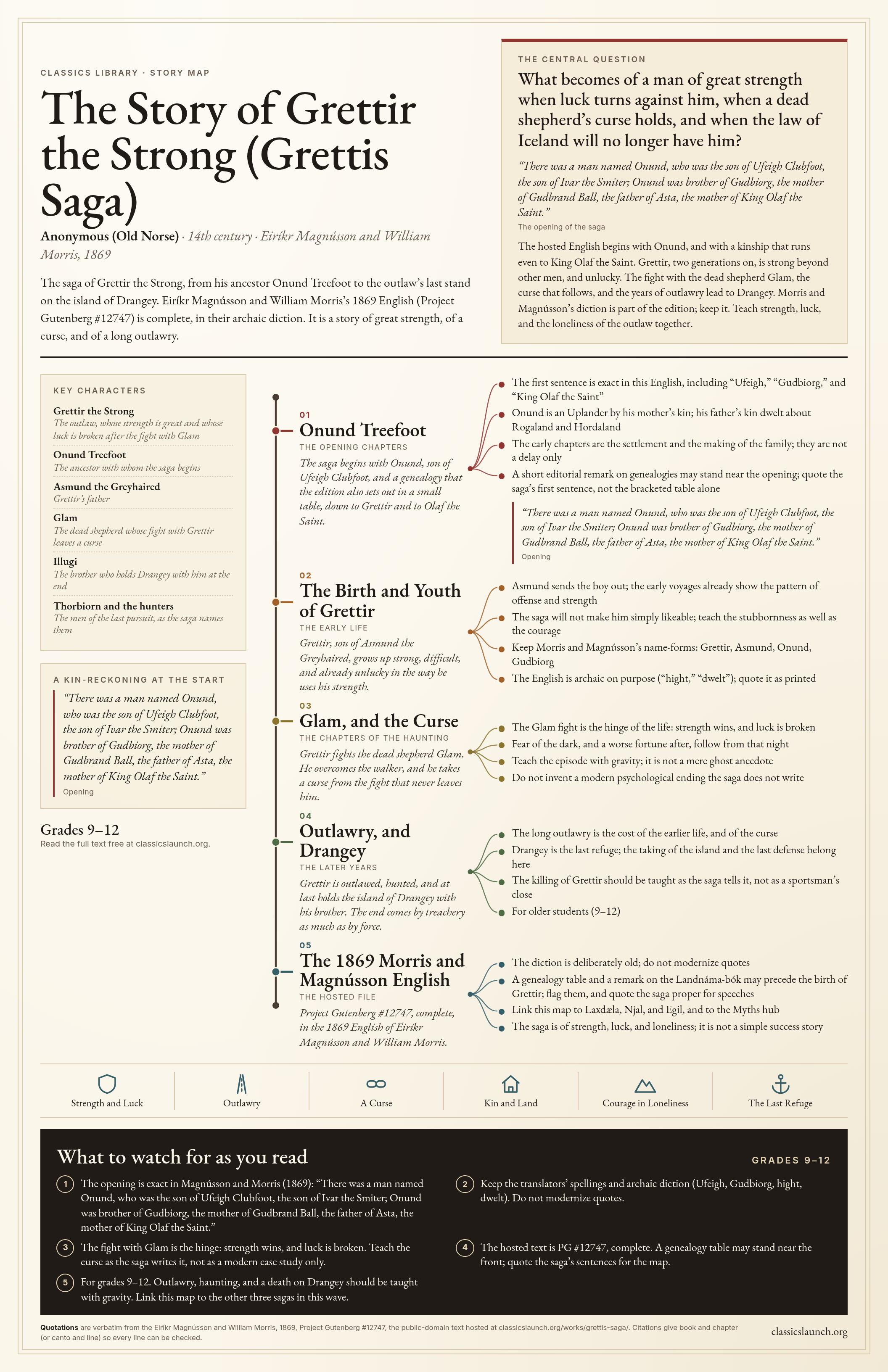
The Story of Grettir the Strong (Grettis Saga): A Story Map
The PDF is one tabloid page (11 × 17 in). On letter paper, choose “Fit to page.”
The saga of Grettir the Strong, from his ancestor Onund Treefoot to the outlaw’s last stand on the island of Drangey. Eiríkr Magnússon and William Morris’s 1869 English (Project Gutenberg #12747) is complete, in their archaic diction. It is a story of great strength, of a curse, and of a long outlawry.
The central question
What becomes of a man of great strength when luck turns against him, when a dead shepherd’s curse holds, and when the law of Iceland will no longer have him?
“There was a man named Onund, who was the son of Ufeigh Clubfoot, the son of Ivar the Smiter; Onund was brother of Gudbiorg, the mother of Gudbrand Ball, the father of Asta, the mother of King Olaf the Saint.”
The hosted English begins with Onund, and with a kinship that runs even to King Olaf the Saint. Grettir, two generations on, is strong beyond other men, and unlucky. The fight with the dead shepherd Glam, the curse that follows, and the years of outlawry lead to Drangey. Morris and Magnússon’s diction is part of the edition; keep it. Teach strength, luck, and the loneliness of the outlaw together.
- 01
Onund Treefoot
The opening chapters
The saga begins with Onund, son of Ufeigh Clubfoot, and a genealogy that the edition also sets out in a small table, down to Grettir and to Olaf the Saint.
- The first sentence is exact in this English, including “Ufeigh,” “Gudbiorg,” and “King Olaf the Saint”
- Onund is an Uplander by his mother’s kin; his father’s kin dwelt about Rogaland and Hordaland
- The early chapters are the settlement and the making of the family; they are not a delay only
- A short editorial remark on genealogies may stand near the opening; quote the saga’s first sentence, not the bracketed table alone
“There was a man named Onund, who was the son of Ufeigh Clubfoot, the son of Ivar the Smiter; Onund was brother of Gudbiorg, the mother of Gudbrand Ball, the father of Asta, the mother of King Olaf the Saint.”
- 02
The Birth and Youth of Grettir
The early life
Grettir, son of Asmund the Greyhaired, grows up strong, difficult, and already unlucky in the way he uses his strength.
- Asmund sends the boy out; the early voyages already show the pattern of offense and strength
- The saga will not make him simply likeable; teach the stubbornness as well as the courage
- Keep Morris and Magnússon’s name-forms: Grettir, Asmund, Onund, Gudbiorg
- The English is archaic on purpose (“hight,” “dwelt”); quote it as printed
- 03
Glam, and the Curse
The chapters of the haunting
Grettir fights the dead shepherd Glam. He overcomes the walker, and he takes a curse from the fight that never leaves him.
- The Glam fight is the hinge of the life: strength wins, and luck is broken
- Fear of the dark, and a worse fortune after, follow from that night
- Teach the episode with gravity; it is not a mere ghost anecdote
- Do not invent a modern psychological ending the saga does not write
- 04
Outlawry, and Drangey
The later years
Grettir is outlawed, hunted, and at last holds the island of Drangey with his brother. The end comes by treachery as much as by force.
- The long outlawry is the cost of the earlier life, and of the curse
- Drangey is the last refuge; the taking of the island and the last defense belong here
- The killing of Grettir should be taught as the saga tells it, not as a sportsman’s close
- For older students (9–12)
- 05
The 1869 Morris and Magnússon English
The hosted file
Project Gutenberg #12747, complete, in the 1869 English of Eiríkr Magnússon and William Morris.
- The diction is deliberately old; do not modernize quotes
- A genealogy table and a remark on the Landnáma-bók may precede the birth of Grettir; flag them, and quote the saga proper for speeches
- Link this map to Laxdæla, Njal, and Egil, and to the Myths hub
- The saga is of strength, luck, and loneliness; it is not a simple success story
- Strength and Luck
- Outlawry
- A Curse
- Kin and Land
- Courage in Loneliness
- The Last Refuge
What to watch for as you read
Grades 9–12- The opening is exact in Magnússon and Morris (1869): “There was a man named Onund, who was the son of Ufeigh Clubfoot, the son of Ivar the Smiter; Onund was brother of Gudbiorg, the mother of Gudbrand Ball, the father of Asta, the mother of King Olaf the Saint.”
- Keep the translators’ spellings and archaic diction (Ufeigh, Gudbiorg, hight, dwelt). Do not modernize quotes.
- The fight with Glam is the hinge: strength wins, and luck is broken. Teach the curse as the saga writes it, not as a modern case study only.
- The hosted text is PG #12747, complete. A genealogy table may stand near the front; quote the saga’s sentences for the map.
- For grades 9–12. Outlawry, haunting, and a death on Drangey should be taught with gravity. Link this map to the other three sagas in this wave.
Every quotation is word for word from the Eiríkr Magnússon and William Morris, 1869 hosted in this library and is checked against that text each time the site is built. Citations give book and chapter (or canto and line).