Work record
The Story of Grettir the Strong (Grettis Saga)
Anonymous (Old Norse)The Story of Grettir the Strong (Grettis Saga) by Anonymous (Old Norse) (14th century)The Story of Grettir the Strong tells the life of Grettir Asmundarson, the strongest man in Iceland and its most famous outlaw, who lived in the early eleventh century and spent nearly twenty years under sentence of outlawry.14th century · Medieval · Epic · Old Norse
Read this when strength is not enough and loneliness becomes the hardest enemy to face.
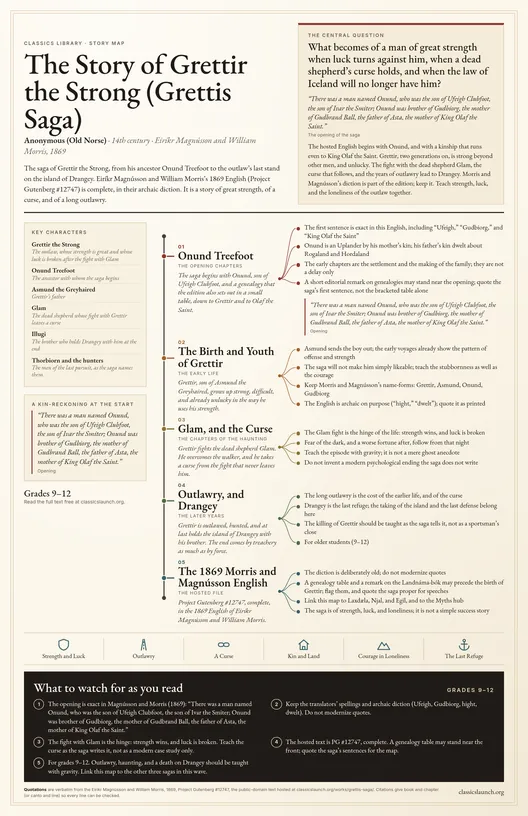 Story mapSee the story mapThe whole book on one page: the story in movements, the characters, and what to watch for. Free to print.
Abstract
Background. Composed after the Commonwealth fell, around 1315, this saga drew together tales of an eleventh-century outlaw, the verses credited to him, Icelandic ghost lore and a Byzantine romance. Magnússon and Morris made it their first joint translation in 1869.
Narrative. An awkward, mocking boy becomes the mightiest man in the land. Abroad he robs a haunted mound and destroys berserks; at home he wrestles a walking corpse and wins great fame, but the dead man's curse takes his luck. Wrongly blamed for a fatal fire in Norway, he loses the chance to clear himself before a saintly king and is declared an outlaw.
Outlawry. For many years he hides on moors and in caves, defeats a troll and a giant behind a waterfall, and finally holds a cliff-bound island with his brother. A witch's spell brings his death, and the brother dies refusing to give up revenge.
Ending. His half-brother takes revenge in Constantinople, then joins a clever lady in penance at Rome. The closing couplet commends every reader to God, so that the outlaw's sorrowful tale ends in hope. Its themes are the limits of strength, the terror of loneliness, the claims of family and the long reach of law and fate.
Main characters
- Grettir: strongest man in Iceland, outlaw for nearly twenty years
- Asdis: his loving mother at Biarg
- Illugi: his young brother, who shares his fate
- Glam: dead shepherd who curses Grettir
- Thorbiorn Angle: his slayer, aided by witchcraft
- Thorstein Dromund: half-brother and avenger
- Spes: lady of Constantinople, later a penitent
Summary
The Story of Grettir the Strong tells the life of Grettir Asmundarson, the strongest man in Iceland and its most famous outlaw, who lived in the early eleventh century and spent nearly twenty years under sentence of outlawry. Written down about 1315, it is one of the last and most haunting of the family sagas. The library text is the translation by Eiríkr Magnússon and William Morris, first published in 1869, in the edition of 1900. The first part tells of Grettir's forefathers, above all Onund Tree-foot, who loses a leg fighting against Harald Fairhair and settles in Iceland. Grettir himself is a difficult child, idle, sarcastic and cruel to his father's geese and horses, though his mother Asdis loves him. At sixteen he kills a man and is sent abroad, where he breaks into a haunted barrow, kills berserks who attack a farm at Yule, and slays a bear. Back in Iceland he becomes the hero of the land by destroying Glam, a shepherd who has come back from the dead to haunt a farm. But as Glam dies he curses Grettir: his strength will grow no more, his deeds will turn to misfortune, and he will be unable to bear the dark or to be alone. From that night Grettir's luck fails. In Norway he tries to fetch fire for his shipmates, a house burns with men inside, and he is blamed. He offers to prove his innocence by the ordeal of hot iron before King Olaf the Saint, but the ordeal is spoiled when he strikes a youth who mocks him in the church, and he is outlawed at home. For years he lives on the fells and in caves, helped by a few friends and hunted by many enemies. At Sand-heaps he fights a troll-wife and a giant in a cave behind a waterfall, in scenes that recall Beowulf, and brings the bones of slain men to the church. At last he takes refuge on the island of Drangey with his young brother Illugi, who chooses to share his fate. A witch's curse wounds him, and he is killed in his sickbed. Illugi refuses to buy his life by forswearing vengeance. The saga ends far from Iceland. Grettir's half-brother Thorstein Dromund avenges him in Constantinople, is freed from prison by the noble lady Spes, and the two later go to Rome, confess their sins, and end their lives in stone cells as penitents. For a Christian reader the saga is a moving study of a gifted man whose pride and misfortune leave him alone in the dark, and of the mercy that ends the book: its last lines pray that all folk may go to the good God.
Virtues in this work
- Fortitude: Grettir faces Glam alone in the dark at Thorhall-stead, and endures nearly twenty years of outlawry.
- Friendship: Illugi gives up a safe life at home to share Grettir's exile on Drangey and dies with him.
- Charity: Asdis loves her difficult son to the end and lets Illugi go with him so that he will not be alone.
- Humility: Thorstein Dromund and Spes confess their sins in Rome and accept a life of penance in stone cells.
Plot or Argument
- Morris's sonnet, preface and chronology
The 1900 edition opens with Morris's sonnet on the outlaw's life, the translators' preface on the saga's age, sources and the romance of Spes, and a chronology of the story.
- Chapters I-XIII: The forefathers of Grettir
Onund loses a leg at the battle of Hafrsfirth against Harald Fairhair, raids in the west and settles in Iceland; his descendants include Asmund the Greyhaired, Grettir's father.
- Chapters XIV-XXVII: Grettir's youth and first exile
Grettir quarrels with his father, kills Skeggi and is sent abroad; in Norway he plunders Karr the Old's barrow, saves a household from berserks at Yule, kills a bear and Biorn, and is fined for further slayings.
- Chapters XXVIII-XXXV: Glam
Grettir returns to Iceland; at Thorhall-stead the dead shepherd Glam haunts the farm, Grettir wrestles and beheads him, and Glam's dying curse dooms him to misfortune, loneliness and terror of the dark.
- Chapters XXXVI-XLVI: The fire, the ordeal and the sentence
In Norway Grettir fetches fire for his shipmates and the house burns with Thorir's sons inside; his attempt at the ordeal of iron before King Olaf the Saint fails, and at home he is outlawed after his brother Atli is slain.
- Chapters XLVII-LXIII: The outlaw on the fells
Grettir kills Atli's slayer Thorbiorn Oxmain, survives capture by farmers, lives on Ernewaterheath and in Fairwoodfell, befriends the giant Hallmund, and escapes many who try to kill him for the price on his head.
- Chapters LXIV-LXVIII: Sand-heaps
Disguised as Guest, Grettir defends a farm from a troll-wife, dives behind a waterfall to kill a giant in a cave, and brings the bones of the giant's victims to the priest for burial.
- Chapters LXIX-LXXXIV: Drangey
With his brother Illugi and the thrall Noise, Grettir takes the island of Drangey; he swims to the mainland for fire, wrestles at a Thing under a truce, and is at last struck by a log cursed by Thorbiorn Angle's foster-mother; Thorbiorn's men kill him in his sickbed.
- Chapters LXXXV-LXXXVII: Illugi, the head and the Althing
Illugi refuses to swear off vengeance and is slain; Thorbiorn Angle brings Grettir's head to his mother at Biarg, and the Althing outlaws Thorbiorn for using witchcraft and killing a dying man.
- Chapters LXXXVIII-XCV: Thorstein Dromund and Spes
Thorstein Dromund recognizes Grettir's notched short-sword in Constantinople and kills Thorbiorn; the lady Spes frees him from prison, deceives her husband with a famous oath, marries Thorstein, and the two end their lives as penitents in Rome.
- Notes and corrections
The translators' notes discuss genealogies, places, verses and textual problems; the edition's indexes of persons, places and things are not included in the library text.
Characters
- Grettir Asmundarson, hero and outlaw
The strongest man in Iceland, witty, proud and quarrelsome, who defeats ghosts and trolls but cannot defeat his own ill luck.
- Asmund the Greyhaired, Grettir's father
A worthy farmer at Biarg who finds his younger son hard to love.
- Asdis, Grettir's mother
Loves Grettir faithfully, gives her sons to each other's keeping and is honoured by all to the end.
- Atli Asmundarson, Grettir's elder brother
Gentle and peaceable, killed by Thorbiorn Oxmain.
- Illugi Asmundarson, Grettir's youngest brother
Goes with Grettir to Drangey and dies rather than promise to give up vengeance.
- Thorstein Dromund, Grettir's half-brother
Slow and strong, he avenges Grettir in Constantinople and ends as a penitent in Rome.
- Spes, lady of Constantinople
Clever and noble, she rescues Thorstein, marries him, and with him chooses a life of penance.
- Glam, Swedish shepherd and revenant
A grim heathen who refuses to fast at Yule, is killed by an evil spirit and returns to haunt Thorhall-stead until Grettir destroys him.
- Thorhall of Thorhall-stead, farmer
Hires Glam on the advice of Skapti the Lawman and welcomes Grettir to fight him.
- Thorir of Garth, Grettir's enemy
Father of the men burned in Norway, who pursues Grettir's outlawry and sends men to kill him.
- Thorbiorn Oxmain, slayer of Atli
A violent chieftain whom Grettir kills in revenge for his brother.
- Hallmund, giant of the Keel
Grettir's friend and protector in the wilderness, who sings of his life as he dies.
- Noise, thrall on Drangey
A lazy servant whose neglect lets the fire go out and the ladder be left down.
- Thorbiorn Angle, Grettir's slayer
Buys a share of Drangey and kills Grettir with the help of his foster-mother's witchcraft.
- Thurid, Thorbiorn Angle's foster-mother
An old witch who sends a cursed log that wounds Grettir mortally.
- Olaf the Saint, king of Norway
Grettir's kinsman, who allows the ordeal but will not keep him because of his ill luck.
Lessons
Strength without good fortune
Grettir is stronger and braver than any man, yet everything he does turns against him after Glam's curse. The saga asks what strength is for, and shows that courage cannot save a man from loneliness or from the consequences of his own pride. Sturla's praise at the end honours his gifts, but the story shows what they could not buy.
- How much of Grettir's misfortune comes from Glam's curse and how much from his own temper?
- Why does Grettir strike the youth in the church before the ordeal?
- What does the saga suggest a strong man needs besides strength?
The loyalty of a brother
Illugi is young and could live safely at home, but he chooses to share Grettir's exile on Drangey, and when offered his life he refuses to promise to give up vengeance. Asdis gives up both sons with grief so that Grettir will not be alone. The saga honours family love that bears another's burden.
- Why does Illugi go with Grettir to Drangey?
- Is Illugi's refusal at the end courage, stubbornness or love?
- How does Asdis show love for her difficult son throughout the saga?
Penitence at the end
The saga does not end with Grettir's death but with Thorstein Dromund and Spes, who confess their deceptions in Rome, accept penance and live out their lives in stone cells so that others may follow a good example. The book closes with a prayer that all folk may go to the good God, setting the outlaw's story inside a Christian hope.
- Why might the author have added the story of Thorstein and Spes to Grettir's saga?
- What does Spes mean by wanting to make an end that good men also may follow?
- How does the closing prayer change the way we read Grettir's life?
Context
Grettir lived from about 996 to 1031, in the first generation after Iceland accepted Christianity; his outlawry, sometimes said to be the longest in Icelandic history, ran under the law of the Commonwealth and its Althing. The saga's Norwegian chapters fall in the reign of King Olaf Haraldsson, later Saint Olaf (1015-1028), and its final chapters take place among the Norsemen of the Varangian guard in Constantinople.
Composition
An unknown author wrote the saga about 1310-1320, after the end of the Commonwealth, drawing on older traditions about Grettir, the verses attributed to him, folk tales of revenants and trolls, and a romance motif in the Spes episode. The saga survives in several late medieval manuscripts. Magnússon and Morris's translation of 1869 was their first joint saga translation, and Morris prefaced the book with a sonnet on Grettir.
Reception
Grettir became a folk hero in Iceland, and the Sand-heaps episode, with a fight against a troll-wife and a giant beneath a waterfall, has been compared with Beowulf's fights with Grendel and his mother since the nineteenth century. Morris and later writers saw in Grettir the type of the doomed Northern hero.
Comparisons
- Beowulf
Grettir's fight with the troll-wife at Sand-heaps and with the giant in the cave behind the waterfall closely parallels Beowulf's fights with Grendel and Grendel's mother.
- The Story of Burnt Njal (Njal's Saga)
Both sagas turn on outlawry and the law of the Althing; Gunnar refuses exile and dies at home, while Grettir endures nearly twenty years as an outlaw.
- The Story of Egil Skallagrimsson (Egil's Saga)
Egil and Grettir are both strong, ugly, gifted and quarrelsome from childhood; Egil wins wealth and old age, Grettir only fame and loneliness.
- Laxdæla Saga
Both sagas end with a turn to Christian penitence: Gudrun as a recluse in Iceland, Thorstein Dromund and Spes in their stone cells at Rome.
- The Story of the Volsungs (Volsunga Saga)
Morris translated both sagas with Magnússon; Grettir's doom and courage belong to the same heroic tradition as Sigurd's, brought down into ordinary Icelandic life.
- The Poetic Edda
The Eddic poems show the old heroic ideal of facing fate bravely that Grettir lives out, and the revenants and giants of Northern belief.
- The Prose Edda
Snorri's account of the giants and of Thor's journeys gives the mythical background to Grettir's wrestling with trolls and ghosts.
Quotes
Frequently cited
“therefore this weird I lay on thee, ever in those days to see these eyes with thine eyes, and thou wilt find it hard to be alone--and that shall drag thee unto death”
Frequently cited
“so let us go bargain with those who are deft in stone-craft; that they make for each of us a cell of stone, that we may thereby atone for what we have done against God”
“Hitherto hast thou earned fame by thy deeds, but henceforth will wrongs and man-slayings fall on thee, and the most part of thy doings will turn to thy woe and ill-hap”
“Marvellous is now the custom in this land, as men are called Christians therein, that ill-doers, and folk riotous, and thieves shall go their ways in peace”
“howsoever it grieves me, O my sons, to see you both turn your backs on me, yet thus much will I do, if Grettir might thereby be somewhat more holpen than heretofore”
“now nowise is it to be thought, that I will do so much for the keeping of my life, as to become base, even as thou art”
“Goodwife Asdis abode at home at Biarg, and so well beloved she was, that no trouble was ever brought against her, no, not even while Grettir was in outlawry”
“Sturla the Lawman says so much as that he deems no outlawed man ever to have been so mighty as Grettir the Strong”
“GOOD PEOPLE, HERE THE WORK HATH END: MAY ALL FOLK TO THE GOOD GOD WEND”
For Students
A reading companion for classical Christian high school students. See the student guide.
Reading Guide
Watch for
- Grettir's quarrels with his father and the tasks he spoils as a boy in Chapter XIV.
- Every encounter with the supernatural: Karr's barrow, Glam, the troll-wife and the giant, and the witch's log.
- The words of Glam's curse in Chapter XXXV and each later moment when it seems to come true.
- The people who help Grettir in his outlawry, and why they do it.
- The Christian setting of the ordeal in Chapter XXXIX and of the final chapters in Rome.
Key terms and names
- Outlawry
- A legal sentence that put a man outside the protection of the law; anyone could kill him, and full outlawry was for life unless lifted.
- Revenant
- A dead man who walks again and harms the living, as Glam does at Thorhall-stead.
- Barrow
- A burial mound; Grettir breaks into Karr the Old's barrow and takes the treasure.
- Ordeal of iron
- A trial in which the accused carried hot iron; if the burn healed cleanly he was judged innocent.
- Weird
- Fate or doom, especially a doom laid on someone by a curse.
- Drangey
- A steep island in Skagafirth, reached by ladders, where Grettir spends his last years.
- Micklegarth
- The Norse name for Constantinople, where Thorstein Dromund avenges Grettir.
Seminar Questions
- Comprehension What does Glam's curse say will happen to Grettir?
- Comprehension How does Grettir come to be outlawed, and why do his enemies find him hard to kill?
- Interpretation Is Grettir a victim of fate or the author of his own misfortunes?
- Interpretation Why does the saga give so much space to Illugi and Asdis?
- Interpretation What is the purpose of the Thorstein and Spes story at the end?
- Big Question Why is loneliness so hard to bear, even for the strongest person?
- Big Question Can a person be heroic and still deserve the punishment the law gives him?
Faith Connections
- Genesis 4:10-16 (Scripture)
Cain is driven out to be a fugitive and wanderer, and fears that anyone who meets him will kill him. Grettir's outlawry is a Northern picture of that same exile.
- 1 John 4:18 (Scripture)
Perfect love casts out fear. Grettir can master any man but not his fear of the dark, a fear the saga's Christian ending answers with penitence and prayer.
- Proverbs 17:17 (Scripture)
A brother is born for adversity. Illugi, who shares Grettir's exile and death, lives out this proverb.
- Beowulf (Great Conversation)
Both works were written by Christians about heroes who fight monsters from the dark; Grettir's Sand-heaps episode is the closest parallel to Beowulf in Norse literature.
Logic and Rhetoric
Central argument: The saga argues that strength and courage, however great, cannot secure a good life without good fortune, self-mastery and friends; Grettir's gifts win him fame but his pride and Glam's curse leave him alone, and the book points beyond heroic fame to penitence and the mercy of God.
Rhetorical device: Curse and fulfilment. Glam's dying words in Chapter XXXV predict that Grettir's deeds will turn to woe and that he will fear being alone; the rest of the saga fulfils each clause, down to Grettir's last refuge with his brother on Drangey.
Debate: Resolved: Grettir's misfortunes are more his own fault than the result of Glam's curse.
Memory Work
now nowise is it to be thought, that I will do so much for the keeping of my life, as to become base, even as thou art
GOOD PEOPLE, HERE THE WORK HATH END: MAY ALL FOLK TO THE GOOD GOD WEND
Writing Prompts
Essay: Write an essay on whether Grettir is a tragic hero, using Glam's curse, the failed ordeal and his death on Drangey.
Comparison with Beowulf: Compare Grettir's fight with the troll-wife and the giant at Sand-heaps with Beowulf's fights with Grendel and his mother, and explain how each poet uses the monster fight to show the hero's character.
Medical Lens
The saga is not a medical text, but Glam's curse is a vivid medieval picture of fear of the dark and of being alone, and Grettir's death follows a wound that festers into a fatal infection, blamed on witchcraft.
- Chapter XXXV
After meeting Glam, Grettir becomes so afraid of the dark that he dares not go anywhere alone at night.
- Chapter LXXXI
Grettir cuts his leg on a log sent by a witch; the wound swells and festers until he cannot stand.
- Chapter LXXXVI
Asdis receives the news of her sons' deaths and answers Thorbiorn Angle with dignity.
Creative Prompts
- Fiction
Retell the night of Glam's death from Thorhall's point of view as he listens from his bed.
- Essay
Compare Grettir's fight at Sand-heaps with Beowulf's fight with Grendel's mother, and argue which hero is more admirable and why.
- Dialogue
Write the conversation between Asdis, Grettir and Illugi in Chapter LXIX before the brothers leave Biarg for Drangey.
- Poetry
Write a sonnet on Grettir in answer to Morris's sonnet at the front of the book, giving your own judgment of his life.
Further Reading
- Grettir's Saga, trans. Denton Fox and Hermann Pálsson
A modern prose translation (1974).
- Beowulf: An Introduction to the Study of the Poem, R. W. Chambers
Includes a classic discussion of the parallels between Beowulf and Grettir's Saga.
- Viking Age Iceland, Jesse L. Byock
Outlawry, feud and law in the Commonwealth.
- Epic and Romance, W. P. Ker
Ker's 1897 study, with discussion of the Icelandic sagas and their heroes.
Verification notes
All quotations were checked by exact search against the stored Project Gutenberg text (#12747) of the Magnússon and Morris translation in the 1900 edition, with line breaks collapsed to single spaces and the translators' archaic spelling kept; italics are shown with underscores. Chapter numbers are those of the translation. The edition's indexes are not included in the library text.
- The date of composition (c. 1310-1320) is a scholarly estimate.
- The dates of Grettir's life (c. 996-1031) follow the translators' chronology and standard reference works.