Story maps · Grades 10–12
The Harz Journey: A Story Map
The PDF is one tabloid page (11 × 17 in). On letter paper, choose “Fit to page.”
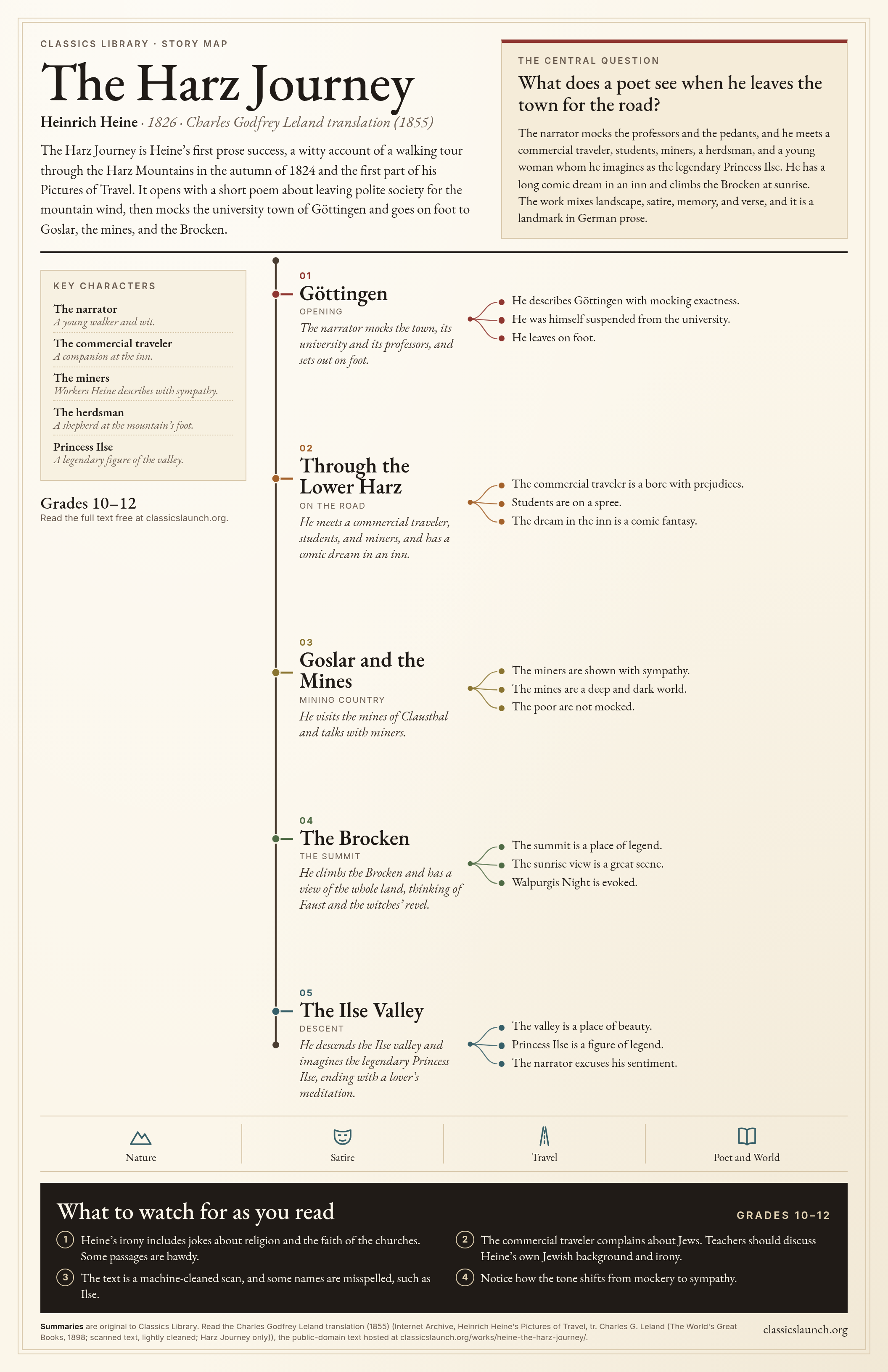
The Harz Journey is Heine’s first prose success, a witty account of a walking tour through the Harz Mountains in the autumn of 1824 and the first part of his Pictures of Travel. It opens with a short poem about leaving polite society for the mountain wind, then mocks the university town of Göttingen and goes on foot to Goslar, the mines, and the Brocken.
The central question
What does a poet see when he leaves the town for the road?
The narrator mocks the professors and the pedants, and he meets a commercial traveler, students, miners, a herdsman, and a young woman whom he imagines as the legendary Princess Ilse. He has a long comic dream in an inn and climbs the Brocken at sunrise. The work mixes landscape, satire, memory, and verse, and it is a landmark in German prose.
- 01
Göttingen
Opening
The narrator mocks the town, its university and its professors, and sets out on foot.
- He describes Göttingen with mocking exactness.
- He was himself suspended from the university.
- He leaves on foot.
- 02
Through the Lower Harz
On the road
He meets a commercial traveler, students, and miners, and has a comic dream in an inn.
- The commercial traveler is a bore with prejudices.
- Students are on a spree.
- The dream in the inn is a comic fantasy.
- 03
Goslar and the Mines
Mining country
He visits the mines of Clausthal and talks with miners.
- The miners are shown with sympathy.
- The mines are a deep and dark world.
- The poor are not mocked.
- 04
The Brocken
The summit
He climbs the Brocken and has a view of the whole land, thinking of Faust and the witches’ revel.
- The summit is a place of legend.
- The sunrise view is a great scene.
- Walpurgis Night is evoked.
- 05
The Ilse Valley
Descent
He descends the Ilse valley and imagines the legendary Princess Ilse, ending with a lover’s meditation.
- The valley is a place of beauty.
- Princess Ilse is a figure of legend.
- The narrator excuses his sentiment.
- Nature
- Satire
- Travel
- Poet and World
What to watch for as you read
Grades 10–12- Heine’s irony includes jokes about religion and the faith of the churches. Some passages are bawdy.
- The commercial traveler complains about Jews. Teachers should discuss Heine’s own Jewish background and irony.
- The text is a machine-cleaned scan, and some names are misspelled, such as Ilse.
- Notice how the tone shifts from mockery to sympathy.
Every quotation is word for word from the Charles Godfrey Leland translation (1855) hosted in this library and is checked against that text each time the site is built. Citations give book and chapter (or canto and line).