Work record
The Harz Journey
Heinrich HeineDie Harzreise; Journey in the Harz; Pictures of Travel: The Harz JourneyThe Harz Journey by Heinrich Heine (1826)The Harz Journey is Heine's first prose success, a witty account of a walking tour through the Harz Mountains in the autumn of 1824, and the first part of his Pictures of Travel.Also known as: Die Harzreise · Journey in the Harz · Pictures of Travel: The Harz Journey
1826 · 19th Century · Travel · German
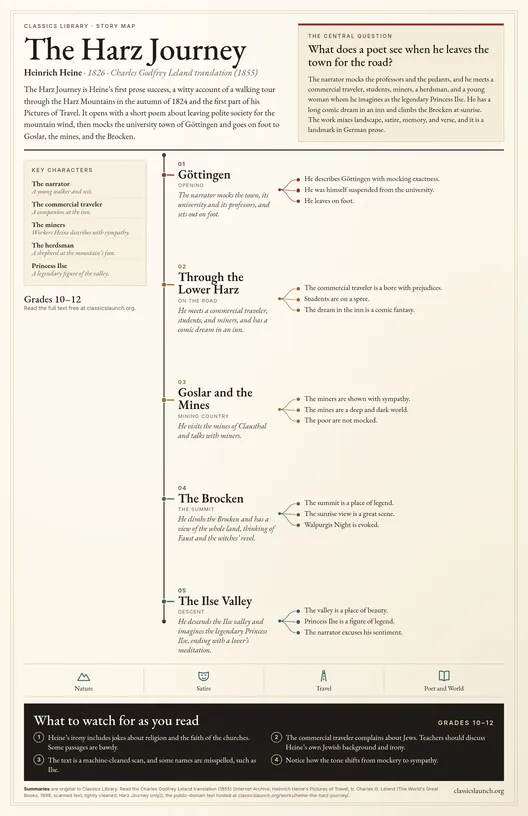 Story mapSee the story mapThe whole book on one page: the story in movements, the characters, and what to watch for. Free to print.
Abstract
Background. Heine made this walking tour in the autumn of 1824, when he was a law student at Göttingen. He wrote it up in 1825 and 1826, and it was his first prose success.
Plot. A student leaves a university town on foot, laughing at its professors. He meets travellers, students and miners, climbs the Brocken, remembers Faust and the witches, and descends the Ilse valley with a lover's thoughts.
Ideas. The work joins satire, nature description and verse. It shows a writer's fondness for the world he mocks, and honours the poor and the beauty of nature.
Text. The hosted text is Leland's English translation, scanned from a print edition of 1898 and cleaned by machine. Some small scanning errors remain, and the reader will find a few misspelt words, but the sense is clear and the prose is lively throughout. The hosted text is complete as printed here, with its section headings kept as a guide to the reader, and every quotation on this page is drawn directly from that text. Teachers can pair this work with the library's study guide, seminar questions and memory-work selection to prepare a discussion, a short essay or a recitation. The full text is hosted on this site, and each quotation in the guide has been checked against the hosted translation.
Key figures
- The Narrator: A student on a walking tour
- The commercial traveller: A grumbling companion at an inn
- The miners: Poor and devout workers
- The herdsman: A shepherd at the foot of the Brocken
- Princess Ilse: A legendary water-nymph
Summary
The Harz Journey is Heine's first prose success, a witty account of a walking tour through the Harz Mountains in the autumn of 1824, and the first part of his Pictures of Travel. It opens with a little poem, in which the speaker has had enough of polite society, black coats and silk stockings and soft speeches, and will climb the mountains where the wind blows free. It then turns to the university town of Göttingen, which the narrator describes with mocking exactness, with its sausages, its professors, its beadles and its learned 'Topography' by his own physician. Heine had studied law there and been suspended from the university for a duelling challenge, and he spares nothing. The narrator sets out on foot, and the journey wanders from Göttingen through Nordheim, Goslar and the mining country, to the Brocken, the highest peak, where legend places the witches' revel of Walpurgis Night. He meets a number of figures along the way: a commercial traveller in a tavern, who complains about the Jews; students on a spree; miners, whom he describes with sympathy; the herdsman at the foot of the mountain; and a young woman at the Ilse valley, whom he imagines as the legendary Princess Ilse. In a night in a mountain inn he has a long comic dream of a law opera. He climbs the Brocken at sunrise and sees the whole land spread out. The work mixes landscape, satire, memory and verse. Heine mocks the bookish, the pedantic, and the sentimental, and is never more serious than when he describes the poor miners or the beauty of nature. He is also making a point about literature: a poet can be a good observer, a mocker and a lover of nature at once. In the last paragraph he excuses himself, saying that on the first of May even the lowest errand boy has the right to be sentimental, and that a poet may be allowed the same. The Harz Journey is a landmark in German prose, with its mixture of travel, fantasy and satire. It offers readers a sharp and often hilarious picture of German student and small-town life in the 1820s. Teachers should note that Heine's irony includes jokes about religion, doctors, Jews and Christians, and the faith of the churches, and that some passages are bawdy. The hosted text comes from a scanned print edition that was cleaned by machine, and some small errors remain, for example in the spelling of the name Ilse.
Virtues in this work
- Humility: The narrator honours the poor miners and their labour.
- Temperance: The walk is a retreat from the excess of the salon.
- Friendship: The narrator shares meals and talk with strangers on the road.
Plot or Argument
- Göttingen
The narrator mocks the town, its university and its professors, and sets out on foot.
- Through the lower Harz
He meets a commercial traveller, students and miners, and has a comic dream in an inn.
- Goslar and the mines
He visits the mines of Clausthal and talks with miners.
- The Brocken
He climbs the Brocken and has a view of the whole land, thinking of Faust and the witches' revel.
- The Ilse valley
He descends the Ilse valley and imagines the legendary Princess Ilse, ending with a lover's meditation.
Characters
- The Narrator, walker
A young law student and poet who mocks and loves the world he sees.
- The commercial traveller, companion at the inn
A merchant who complains about the Jews and about everything.
- The miners, workers
Poor and pious men whom the narrator respects.
- The herdsman, shepherd
A young man who shares his meal at the foot of the Brocken.
- Princess Ilse, legendary figure
A water-nymph of the Ilse who is the narrator's image of a beloved.
Lessons
Satire as a form of attention
Heine ridicules the pedantry of Göttingen with exact detail. Satire here is a kind of close observation.
- What does Heine mock in Göttingen?
- How does exact detail make the mockery effective?
The poor deserve respect
In the mines, the humour gives way to sympathy. Heine honours the miners' labour and faith.
- How does the tone change in the mine?
- What does Heine admire in the miners?
Nature as the cure for society
The poem at the start sets the mountains against the salon. The journey is a flight from artifice to the open air.
- What does the speaker leave behind?
- What does he seek in the mountains?
Context
The tour took place in September–October 1824, when Heine was a law student in Göttingen. Germany was then a federation of states under the Restoration, with censorship and police surveillance of students.
Composition
Heine wrote the account in 1825–26 and published it in 1826 in the first volume of Pictures of Travel. Leland's translation, printed in Philadelphia in 1855, was the first widely read English version.
Reception
The Harz Journey was an instant success and made Heine's name as a prose writer. Its mixture of reportage, satire and verse became a model for German feuilleton writing.
Comparisons
- Book of Songs (selection)
The poems of the Harz journey are printed in Heine's Book of Songs.
- Faust, Part One
The Brocken is the scene of Faust's Walpurgis Night.
- Italian Journey (Travels in Italy)
Goethe's diary of travel is a more serious and classical model of the genre.
- The Canterbury Tales
Chaucer's pilgrims are another company of types observed with humour on a journey.
Quotes
Frequently cited
“I will climb upon the mountains Where the quiet cabin stands, Where the wind blows freely o'er us, Where the heart at ease expands.”
Frequently cited
“It is the first of May, the lowest errand boy has to-day a right to be sentimental, and would you deny the privilege to a poet?”
“The town of Göttingen, celebrated for its sausages and University, belongs to the King of Hanover, and contains nine hundred and ninety-nine dwellings, divers churches, a lying-in asylum, an observatory, a prison, a library, and a “council-cellar,” where the beer is excellent.”
For Students
A reading companion for classical Christian high school students. See the student guide.
Reading Guide
Watch for
- What the narrator says about Göttingen and its scholars.
- The change of tone in the mine.
- The Brocken as a place of legend and of Faust.
Key terms and names
- Brocken
- The highest peak of the Harz, the legendary site of the witches' Walpurgis Night.
- Göttingen
- The Hanoverian university town where Heine studied.
- Feuilleton
- A newspaper's section of light, cultural writing; Heine's travel prose became a model.
- Satire
- The use of wit to criticise folly and vice.
Seminar Questions
- Comprehension Where does the narrator begin his walk, and what does he say of the town he leaves?
- Comprehension What does the herdsman offer the narrator at the foot of the Brocken?
- Interpretation Why does Heine begin with a poem?
- Interpretation What does the miners' episode add to the book?
- Interpretation How does the end of the journey differ from the beginning?
- Big Question Can satire be affectionate?
- Big Question What is the value of walking as a way of seeing?
Faith Connections
- Psalm 121:1–2 (Scripture)
'I lift up my eyes to the hills. From where does my help come?' The pilgrim's ascent has a long tradition.
- Proverbs 14:15 (Scripture)
'The simple believes everything, but the prudent gives thought to his steps.' Heine's irony protects against credulity but can also lead to cynicism.
- Augustine, Confessions, Book X (Great Conversation)
Augustine praises the beauty of nature and warns against curiosity for its own sake, a double theme in Heine's walk.
Logic and Rhetoric
Central argument: A young poet can mock the world and love it at once, and the journey on foot restores the senses that society dulls.
Rhetorical device: comic catalogue. Heine lists the Göttingen sausages, beadles and professors in a single sentence to make the town absurd.
Debate: Resolved: That satire is a stronger form of criticism than argument.
Memory Work
I will climb upon the mountains Where the quiet cabin stands, Where the wind blows freely o'er us, Where the heart at ease expands.
It is the first of May, the lowest errand boy has to-day a right to be sentimental, and would you deny the privilege to a poet?
Writing Prompts
Essay: How does the tone of the Harz Journey change as the narrator climbs from the town to the mountain?
Comparison with Italian Journey (Travels in Italy): Compare Heine's treatment of travel with Goethe's.
Creative Prompts
- Essay
How does Heine blend satire with lyrical description in the Harz Journey?
- Classroom
Write a short mocking description of your own town in Heine's style, using exact detail.
- Poetry
Write a poem in which a speaker leaves a crowded room for the mountains.
Further Reading
- Book of Songs, Heinrich Heine
Heine's lyric collection, hosted in this library.
- Faust, Part One, Johann Wolfgang von Goethe
The Brocken's Walpurgis Night, hosted in this library.
- Italian Journey, Johann Wolfgang von Goethe
Goethe's diary of travel, hosted in this library.
- Heinrich Heine: Pictures of Travel, Charles Godfrey Leland (tr.)
The volume from which the hosted text is taken.
Verification notes
Hosted text is Charles G. Leland's translation (first published Philadelphia, 1855) as reprinted in 1898, from an Internet Archive scan that was cleaned by machine; minor scanning errors may remain, for example 'Use' for 'Ilse' in some places. Public domain in the United States. Quotes were checked against the hosted text.
- Scanning errors that remain in the hosted text (for example the name Ilse).
- The year of Leland's first edition of this chapter.