Story maps · Grades 9–12
Henry IV, Part 1: A Story Map
The PDF is one tabloid page (11 × 17 in). On letter paper, choose “Fit to page.”
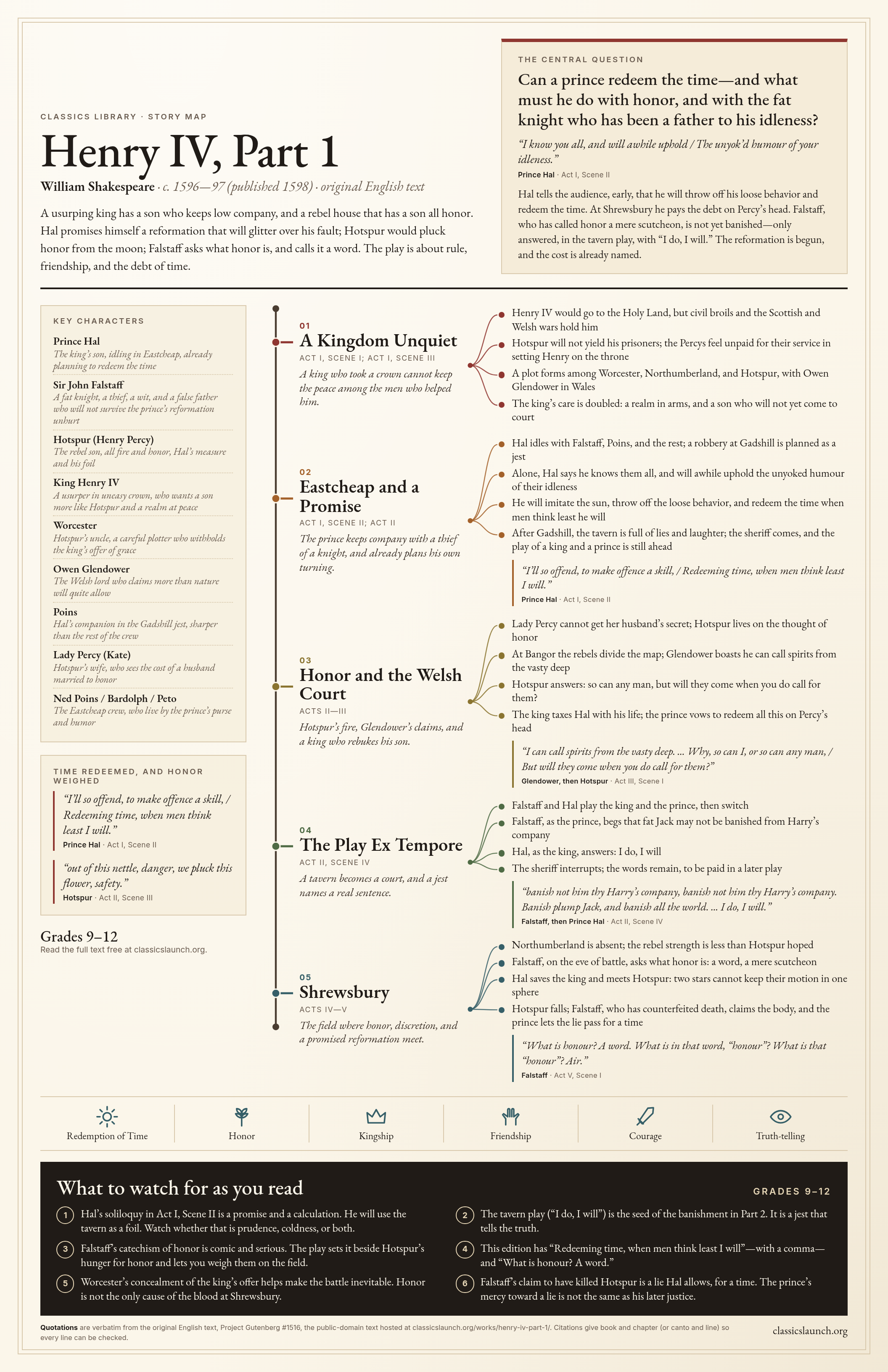
A usurping king has a son who keeps low company, and a rebel house that has a son all honor. Hal promises himself a reformation that will glitter over his fault; Hotspur would pluck honor from the moon; Falstaff asks what honor is, and calls it a word. The play is about rule, friendship, and the debt of time.
The central question
Can a prince redeem the time—and what must he do with honor, and with the fat knight who has been a father to his idleness?
“I know you all, and will awhile uphold / The unyok’d humour of your idleness.”
Hal tells the audience, early, that he will throw off his loose behavior and redeem the time. At Shrewsbury he pays the debt on Percy’s head. Falstaff, who has called honor a mere scutcheon, is not yet banished—only answered, in the tavern play, with “I do, I will.” The reformation is begun, and the cost is already named.
- 01
A Kingdom Unquiet
Act I, Scene I; Act I, Scene III
A king who took a crown cannot keep the peace among the men who helped him.
- Henry IV would go to the Holy Land, but civil broils and the Scottish and Welsh wars hold him
- Hotspur will not yield his prisoners; the Percys feel unpaid for their service in setting Henry on the throne
- A plot forms among Worcester, Northumberland, and Hotspur, with Owen Glendower in Wales
- The king’s care is doubled: a realm in arms, and a son who will not yet come to court
- 02
Eastcheap and a Promise
Act I, Scene II; Act II
The prince keeps company with a thief of a knight, and already plans his own turning.
- Hal idles with Falstaff, Poins, and the rest; a robbery at Gadshill is planned as a jest
- Alone, Hal says he knows them all, and will awhile uphold the unyoked humour of their idleness
- He will imitate the sun, throw off the loose behavior, and redeem the time when men think least he will
- After Gadshill, the tavern is full of lies and laughter; the sheriff comes, and the play of a king and a prince is still ahead
“I’ll so offend, to make offence a skill, / Redeeming time, when men think least I will.”
- 03
Honor and the Welsh Court
Acts II—III
Hotspur’s fire, Glendower’s claims, and a king who rebukes his son.
- Lady Percy cannot get her husband’s secret; Hotspur lives on the thought of honor
- At Bangor the rebels divide the map; Glendower boasts he can call spirits from the vasty deep
- Hotspur answers: so can any man, but will they come when you do call for them?
- The king taxes Hal with his life; the prince vows to redeem all this on Percy’s head
“I can call spirits from the vasty deep. ... Why, so can I, or so can any man, / But will they come when you do call for them?”
- 04
The Play Ex Tempore
Act II, Scene IV
A tavern becomes a court, and a jest names a real sentence.
- Falstaff and Hal play the king and the prince, then switch
- Falstaff, as the prince, begs that fat Jack may not be banished from Harry’s company
- Hal, as the king, answers: I do, I will
- The sheriff interrupts; the words remain, to be paid in a later play
“banish not him thy Harry’s company, banish not him thy Harry’s company. Banish plump Jack, and banish all the world. ... I do, I will.”
- 05
Shrewsbury
Acts IV—V
The field where honor, discretion, and a promised reformation meet.
- Northumberland is absent; the rebel strength is less than Hotspur hoped
- Falstaff, on the eve of battle, asks what honor is: a word, a mere scutcheon
- Hal saves the king and meets Hotspur: two stars cannot keep their motion in one sphere
- Hotspur falls; Falstaff, who has counterfeited death, claims the body, and the prince lets the lie pass for a time
“What is honour? A word. What is in that word, “honour”? What is that “honour”? Air.”
- Redemption of Time
- Honor
- Kingship
- Friendship
- Courage
- Truth-telling
What to watch for as you read
Grades 9–12- Hal’s soliloquy in Act I, Scene II is a promise and a calculation. He will use the tavern as a foil. Watch whether that is prudence, coldness, or both.
- The tavern play (“I do, I will”) is the seed of the banishment in Part 2. It is a jest that tells the truth.
- Falstaff’s catechism of honor is comic and serious. The play sets it beside Hotspur’s hunger for honor and lets you weigh them on the field.
- This edition has “Redeeming time, when men think least I will”—with a comma—and “What is honour? A word.”
- Worcester’s concealment of the king’s offer helps make the battle inevitable. Honor is not the only cause of the blood at Shrewsbury.
- Falstaff’s claim to have killed Hotspur is a lie Hal allows, for a time. The prince’s mercy toward a lie is not the same as his later justice.
Every quotation is word for word from the original English text hosted in this library and is checked against that text each time the site is built. Citations give book and chapter (or canto and line).