Story maps · Grades 9–12
Henry V: A Story Map
The PDF is one tabloid page (11 × 17 in). On letter paper, choose “Fit to page.”
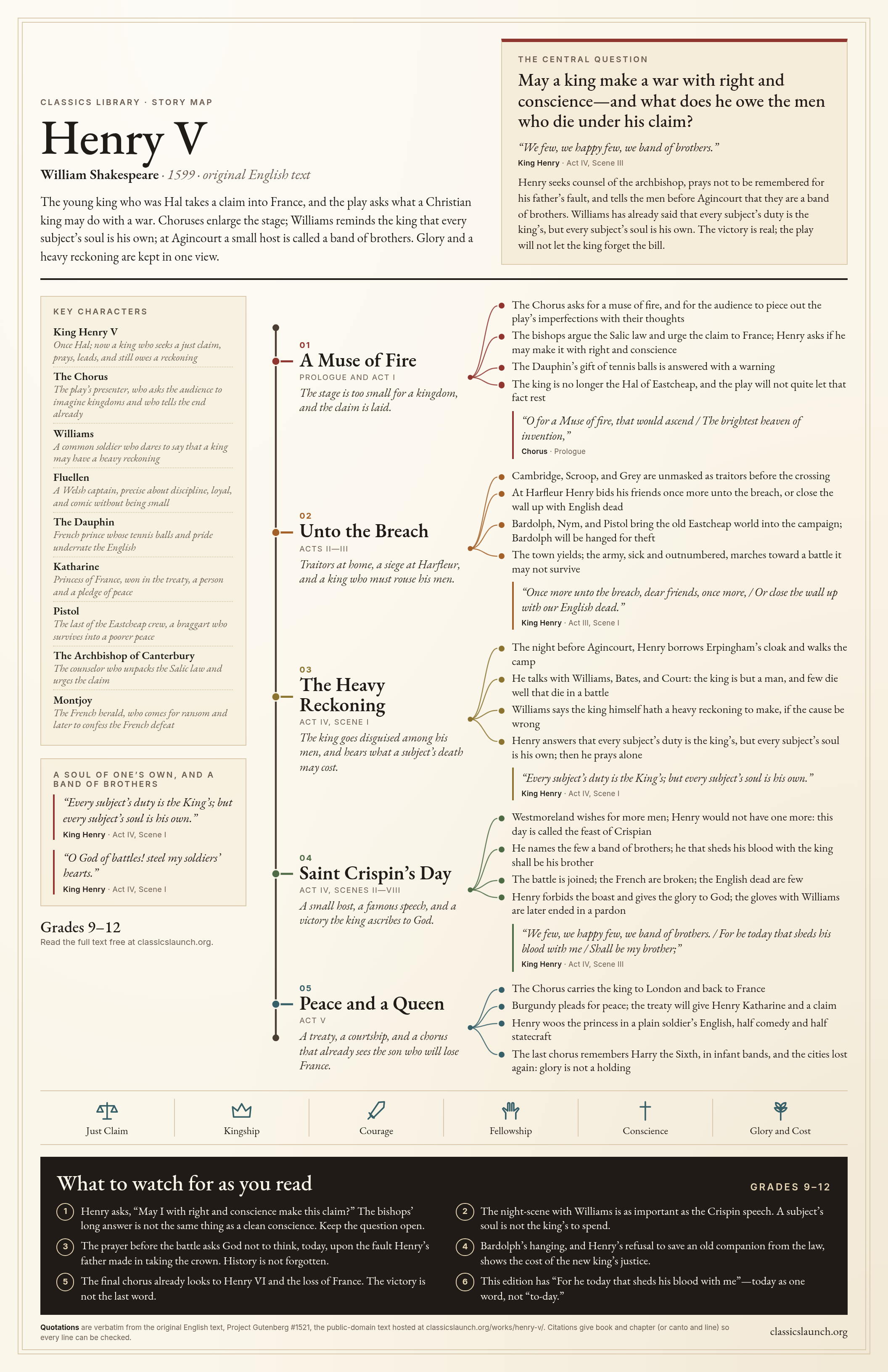
The young king who was Hal takes a claim into France, and the play asks what a Christian king may do with a war. Choruses enlarge the stage; Williams reminds the king that every subject’s soul is his own; at Agincourt a small host is called a band of brothers. Glory and a heavy reckoning are kept in one view.
The central question
May a king make a war with right and conscience—and what does he owe the men who die under his claim?
“We few, we happy few, we band of brothers.”
Henry seeks counsel of the archbishop, prays not to be remembered for his father’s fault, and tells the men before Agincourt that they are a band of brothers. Williams has already said that every subject’s duty is the king’s, but every subject’s soul is his own. The victory is real; the play will not let the king forget the bill.
- 01
A Muse of Fire
Prologue and Act I
The stage is too small for a kingdom, and the claim is laid.
- The Chorus asks for a muse of fire, and for the audience to piece out the play’s imperfections with their thoughts
- The bishops argue the Salic law and urge the claim to France; Henry asks if he may make it with right and conscience
- The Dauphin’s gift of tennis balls is answered with a warning
- The king is no longer the Hal of Eastcheap, and the play will not quite let that fact rest
“O for a Muse of fire, that would ascend / The brightest heaven of invention,”
- 02
Unto the Breach
Acts II—III
Traitors at home, a siege at Harfleur, and a king who must rouse his men.
- Cambridge, Scroop, and Grey are unmasked as traitors before the crossing
- At Harfleur Henry bids his friends once more unto the breach, or close the wall up with English dead
- Bardolph, Nym, and Pistol bring the old Eastcheap world into the campaign; Bardolph will be hanged for theft
- The town yields; the army, sick and outnumbered, marches toward a battle it may not survive
“Once more unto the breach, dear friends, once more, / Or close the wall up with our English dead.”
- 03
The Heavy Reckoning
Act IV, Scene I
The king goes disguised among his men, and hears what a subject’s death may cost.
- The night before Agincourt, Henry borrows Erpingham’s cloak and walks the camp
- He talks with Williams, Bates, and Court: the king is but a man, and few die well that die in a battle
- Williams says the king himself hath a heavy reckoning to make, if the cause be wrong
- Henry answers that every subject’s duty is the king’s, but every subject’s soul is his own; then he prays alone
“Every subject’s duty is the King’s; but every subject’s soul is his own.”
- 04
Saint Crispin’s Day
Act IV, Scenes II—VIII
A small host, a famous speech, and a victory the king ascribes to God.
- Westmoreland wishes for more men; Henry would not have one more: this day is called the feast of Crispian
- He names the few a band of brothers; he that sheds his blood with the king shall be his brother
- The battle is joined; the French are broken; the English dead are few
- Henry forbids the boast and gives the glory to God; the gloves with Williams are later ended in a pardon
“We few, we happy few, we band of brothers. / For he today that sheds his blood with me / Shall be my brother;”
- 05
Peace and a Queen
Act V
A treaty, a courtship, and a chorus that already sees the son who will lose France.
- The Chorus carries the king to London and back to France
- Burgundy pleads for peace; the treaty will give Henry Katharine and a claim
- Henry woos the princess in a plain soldier’s English, half comedy and half statecraft
- The last chorus remembers Harry the Sixth, in infant bands, and the cities lost again: glory is not a holding
- Just Claim
- Kingship
- Courage
- Fellowship
- Conscience
- Glory and Cost
What to watch for as you read
Grades 9–12- Henry asks, “May I with right and conscience make this claim?” The bishops’ long answer is not the same thing as a clean conscience. Keep the question open.
- The night-scene with Williams is as important as the Crispin speech. A subject’s soul is not the king’s to spend.
- The prayer before the battle asks God not to think, today, upon the fault Henry’s father made in taking the crown. History is not forgotten.
- Bardolph’s hanging, and Henry’s refusal to save an old companion from the law, shows the cost of the new king’s justice.
- The final chorus already looks to Henry VI and the loss of France. The victory is not the last word.
- This edition has “For he today that sheds his blood with me”—today as one word, not “to-day.”
Every quotation is word for word from the original English text hosted in this library and is checked against that text each time the site is built. Citations give book and chapter (or canto and line).