Story maps · Grades 9–12
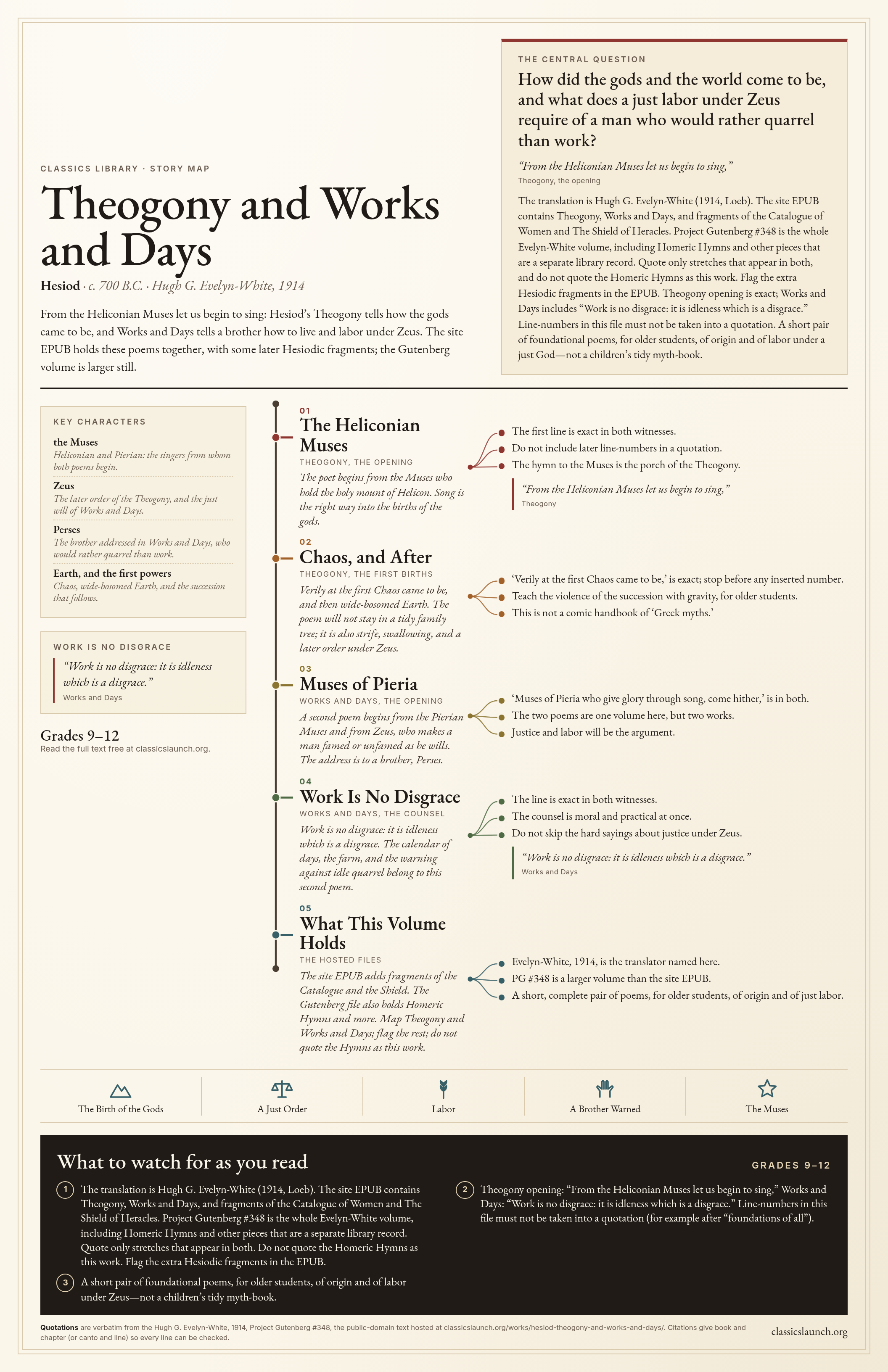
Theogony and Works and Days: A Story Map
The PDF is one tabloid page (11 × 17 in). On letter paper, choose “Fit to page.”
From the Heliconian Muses let us begin to sing: Hesiod’s Theogony tells how the gods came to be, and Works and Days tells a brother how to live and labor under Zeus. The site EPUB holds these poems together, with some later Hesiodic fragments; the Gutenberg volume is larger still.
The central question
How did the gods and the world come to be, and what does a just labor under Zeus require of a man who would rather quarrel than work?
“From the Heliconian Muses let us begin to sing,”
The translation is Hugh G. Evelyn-White (1914, Loeb). The site EPUB contains Theogony, Works and Days, and fragments of the Catalogue of Women and The Shield of Heracles. Project Gutenberg #348 is the whole Evelyn-White volume, including Homeric Hymns and other pieces that are a separate library record. Quote only stretches that appear in both, and do not quote the Homeric Hymns as this work. Flag the extra Hesiodic fragments in the EPUB. Theogony opening is exact; Works and Days includes “Work is no disgrace: it is idleness which is a disgrace.” Line-numbers in this file must not be taken into a quotation. A short pair of foundational poems, for older students, of origin and of labor under a just God—not a children’s tidy myth-book.
- 01
The Heliconian Muses
Theogony, the opening
The poet begins from the Muses who hold the holy mount of Helicon. Song is the right way into the births of the gods.
- The first line is exact in both witnesses.
- Do not include later line-numbers in a quotation.
- The hymn to the Muses is the porch of the Theogony.
“From the Heliconian Muses let us begin to sing,”
- 02
Chaos, and After
Theogony, the first births
Verily at the first Chaos came to be, and then wide-bosomed Earth. The poem will not stay in a tidy family tree; it is also strife, swallowing, and a later order under Zeus.
- ‘Verily at the first Chaos came to be,’ is exact; stop before any inserted number.
- Teach the violence of the succession with gravity, for older students.
- This is not a comic handbook of ‘Greek myths.’
- 03
Muses of Pieria
Works and Days, the opening
A second poem begins from the Pierian Muses and from Zeus, who makes a man famed or unfamed as he wills. The address is to a brother, Perses.
- ‘Muses of Pieria who give glory through song, come hither,’ is in both.
- The two poems are one volume here, but two works.
- Justice and labor will be the argument.
- 04
Work Is No Disgrace
Works and Days, the counsel
Work is no disgrace: it is idleness which is a disgrace. The calendar of days, the farm, and the warning against idle quarrel belong to this second poem.
- The line is exact in both witnesses.
- The counsel is moral and practical at once.
- Do not skip the hard sayings about justice under Zeus.
“Work is no disgrace: it is idleness which is a disgrace.”
- 05
What This Volume Holds
The hosted files
The site EPUB adds fragments of the Catalogue and the Shield. The Gutenberg file also holds Homeric Hymns and more. Map Theogony and Works and Days; flag the rest; do not quote the Hymns as this work.
- Evelyn-White, 1914, is the translator named here.
- PG #348 is a larger volume than the site EPUB.
- A short, complete pair of poems, for older students, of origin and of just labor.
- The Birth of the Gods
- A Just Order
- Labor
- A Brother Warned
- The Muses
What to watch for as you read
Grades 9–12- The translation is Hugh G. Evelyn-White (1914, Loeb). The site EPUB contains Theogony, Works and Days, and fragments of the Catalogue of Women and The Shield of Heracles. Project Gutenberg #348 is the whole Evelyn-White volume, including Homeric Hymns and other pieces that are a separate library record. Quote only stretches that appear in both. Do not quote the Homeric Hymns as this work. Flag the extra Hesiodic fragments in the EPUB.
- Theogony opening: “From the Heliconian Muses let us begin to sing,” Works and Days: “Work is no disgrace: it is idleness which is a disgrace.” Line-numbers in this file must not be taken into a quotation (for example after “foundations of all”).
- A short pair of foundational poems, for older students, of origin and of labor under Zeus—not a children’s tidy myth-book.
Every quotation is word for word from the Hugh G. Evelyn-White, 1914 hosted in this library and is checked against that text each time the site is built. Citations give book and chapter (or canto and line).