Story maps · Grades 9–12
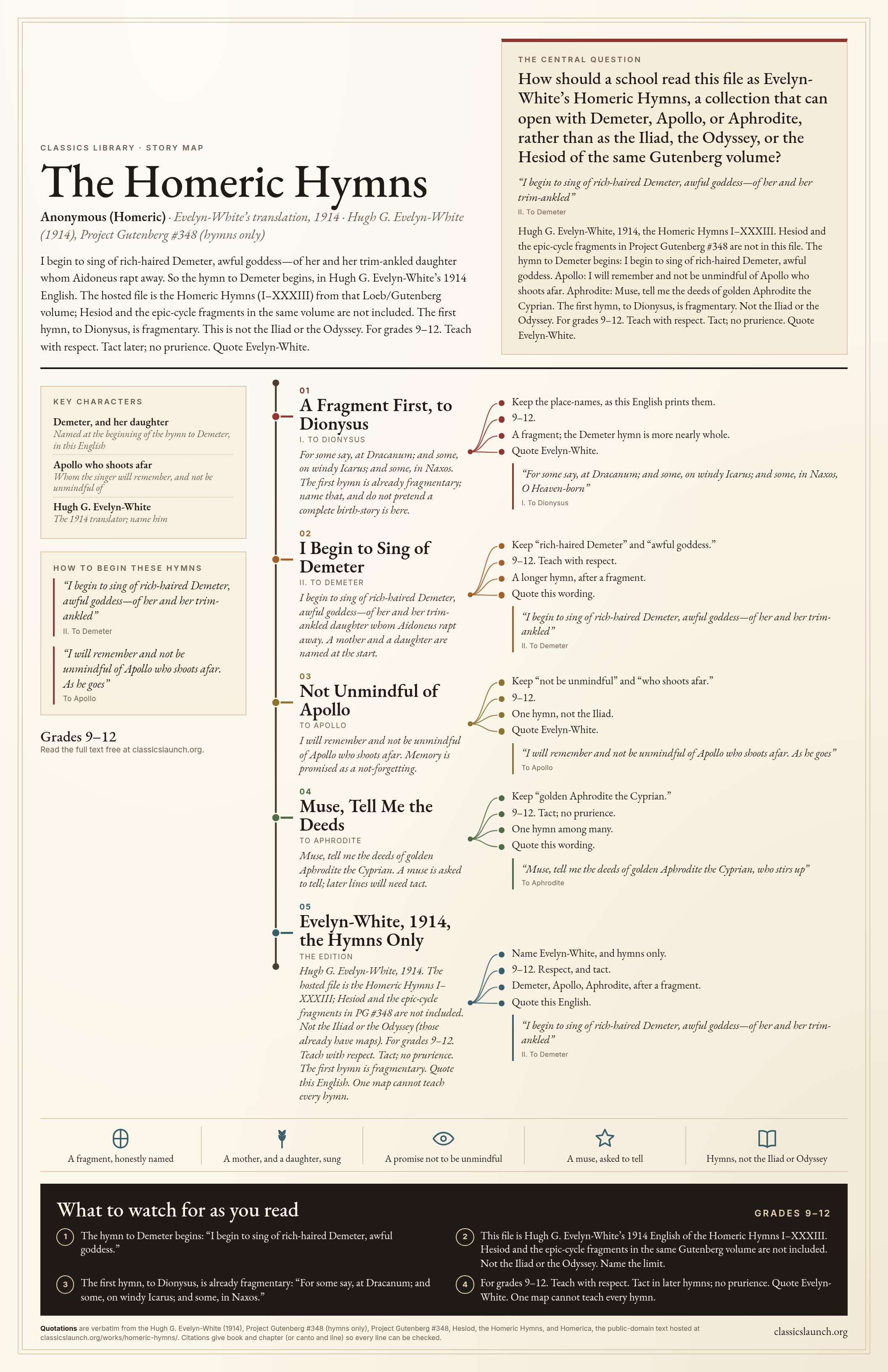
The Homeric Hymns: A Story Map
The PDF is one tabloid page (11 × 17 in). On letter paper, choose “Fit to page.”
I begin to sing of rich-haired Demeter, awful goddess—of her and her trim-ankled daughter whom Aidoneus rapt away. So the hymn to Demeter begins, in Hugh G. Evelyn-White’s 1914 English. The hosted file is the Homeric Hymns (I–XXXIII) from that Loeb/Gutenberg volume; Hesiod and the epic-cycle fragments in the same volume are not included. The first hymn, to Dionysus, is fragmentary. This is not the Iliad or the Odyssey. For grades 9–12. Teach with respect. Tact later; no prurience. Quote Evelyn-White.
The central question
How should a school read this file as Evelyn-White’s Homeric Hymns, a collection that can open with Demeter, Apollo, or Aphrodite, rather than as the Iliad, the Odyssey, or the Hesiod of the same Gutenberg volume?
“I begin to sing of rich-haired Demeter, awful goddess—of her and her trim-ankled”
Hugh G. Evelyn-White, 1914, the Homeric Hymns I–XXXIII. Hesiod and the epic-cycle fragments in Project Gutenberg #348 are not in this file. The hymn to Demeter begins: I begin to sing of rich-haired Demeter, awful goddess. Apollo: I will remember and not be unmindful of Apollo who shoots afar. Aphrodite: Muse, tell me the deeds of golden Aphrodite the Cyprian. The first hymn, to Dionysus, is fragmentary. Not the Iliad or the Odyssey. For grades 9–12. Teach with respect. Tact; no prurience. Quote Evelyn-White.
- 01
A Fragment First, to Dionysus
I. To Dionysus
For some say, at Dracanum; and some, on windy Icarus; and some, in Naxos. The first hymn is already fragmentary; name that, and do not pretend a complete birth-story is here.
- Keep the place-names, as this English prints them.
- 9–12.
- A fragment; the Demeter hymn is more nearly whole.
- Quote Evelyn-White.
“For some say, at Dracanum; and some, on windy Icarus; and some, in Naxos, O Heaven-born”
- 02
I Begin to Sing of Demeter
II. To Demeter
I begin to sing of rich-haired Demeter, awful goddess—of her and her trim-ankled daughter whom Aidoneus rapt away. A mother and a daughter are named at the start.
- Keep “rich-haired Demeter” and “awful goddess.”
- 9–12. Teach with respect.
- A longer hymn, after a fragment.
- Quote this wording.
“I begin to sing of rich-haired Demeter, awful goddess—of her and her trim-ankled”
- 03
Not Unmindful of Apollo
To Apollo
I will remember and not be unmindful of Apollo who shoots afar. Memory is promised as a not-forgetting.
- Keep “not be unmindful” and “who shoots afar.”
- 9–12.
- One hymn, not the Iliad.
- Quote Evelyn-White.
“I will remember and not be unmindful of Apollo who shoots afar. As he goes”
- 04
Muse, Tell Me the Deeds
To Aphrodite
Muse, tell me the deeds of golden Aphrodite the Cyprian. A muse is asked to tell; later lines will need tact.
- Keep “golden Aphrodite the Cyprian.”
- 9–12. Tact; no prurience.
- One hymn among many.
- Quote this wording.
“Muse, tell me the deeds of golden Aphrodite the Cyprian, who stirs up”
- 05
Evelyn-White, 1914, the Hymns Only
The edition
Hugh G. Evelyn-White, 1914. The hosted file is the Homeric Hymns I–XXXIII; Hesiod and the epic-cycle fragments in PG #348 are not included. Not the Iliad or the Odyssey (those already have maps). For grades 9–12. Teach with respect. Tact; no prurience. The first hymn is fragmentary. Quote this English. One map cannot teach every hymn.
- Name Evelyn-White, and hymns only.
- 9–12. Respect, and tact.
- Demeter, Apollo, Aphrodite, after a fragment.
- Quote this English.
“I begin to sing of rich-haired Demeter, awful goddess—of her and her trim-ankled”
- A fragment, honestly named
- A mother, and a daughter, sung
- A promise not to be unmindful
- A muse, asked to tell
- Hymns, not the Iliad or Odyssey
What to watch for as you read
Grades 9–12- The hymn to Demeter begins: “I begin to sing of rich-haired Demeter, awful goddess.”
- This file is Hugh G. Evelyn-White’s 1914 English of the Homeric Hymns I–XXXIII. Hesiod and the epic-cycle fragments in the same Gutenberg volume are not included. Not the Iliad or the Odyssey. Name the limit.
- The first hymn, to Dionysus, is already fragmentary: “For some say, at Dracanum; and some, on windy Icarus; and some, in Naxos.”
- For grades 9–12. Teach with respect. Tact in later hymns; no prurience. Quote Evelyn-White. One map cannot teach every hymn.
Every quotation is word for word from the Hugh G. Evelyn-White (1914), Project Gutenberg #348 (hymns only) hosted in this library and is checked against that text each time the site is built. Citations give book and chapter (or canto and line).