Story maps · Grades 9–12
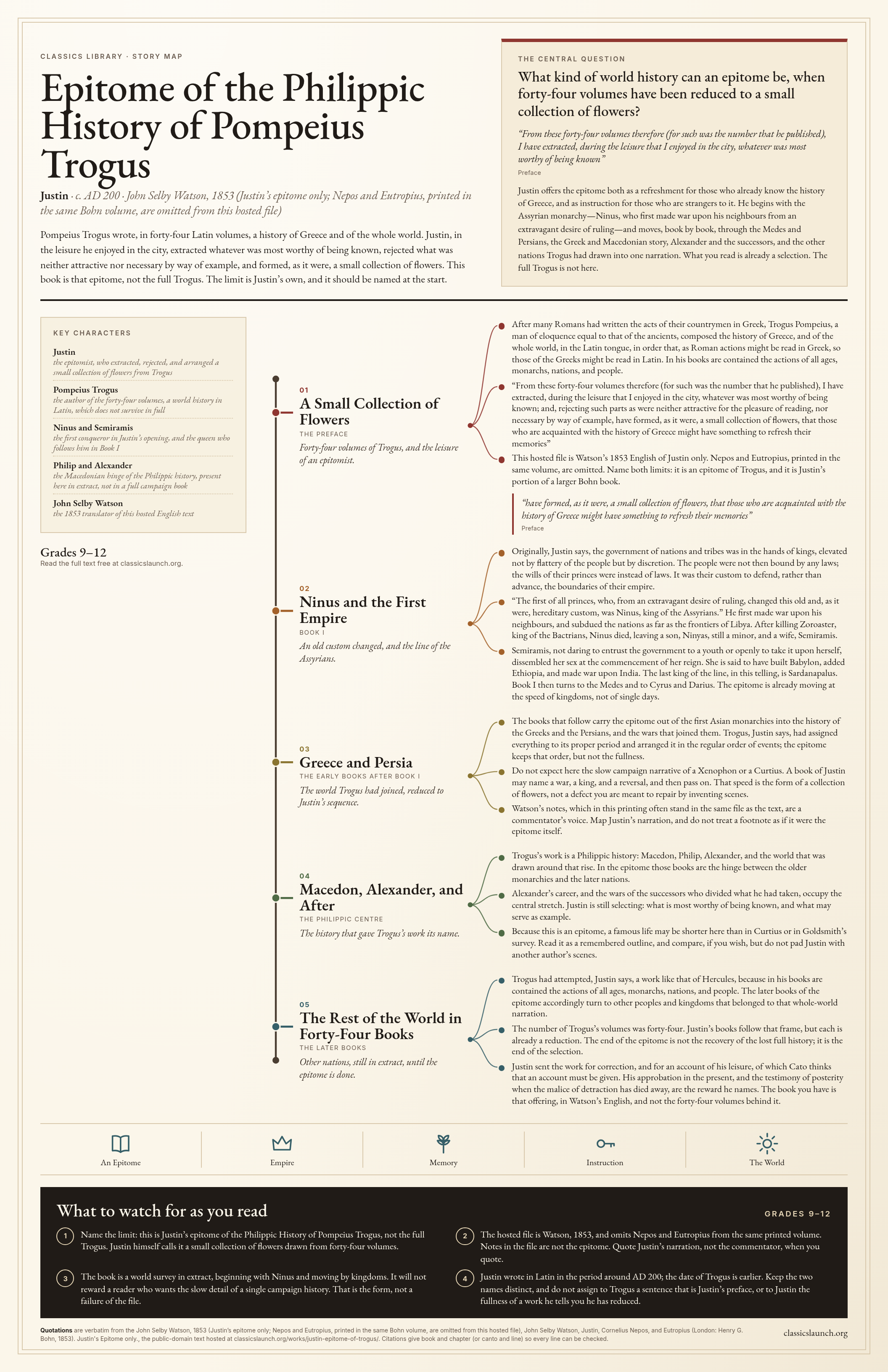
Epitome of the Philippic History of Pompeius Trogus: A Story Map
The PDF is one tabloid page (11 × 17 in). On letter paper, choose “Fit to page.”
Pompeius Trogus wrote, in forty-four Latin volumes, a history of Greece and of the whole world. Justin, in the leisure he enjoyed in the city, extracted whatever was most worthy of being known, rejected what was neither attractive nor necessary by way of example, and formed, as it were, a small collection of flowers. This book is that epitome, not the full Trogus. The limit is Justin’s own, and it should be named at the start.
The central question
What kind of world history can an epitome be, when forty-four volumes have been reduced to a small collection of flowers?
“From these forty-four volumes therefore (for such was the number that he published), I have extracted, during the leisure that I enjoyed in the city, whatever was most worthy of being known”
Justin offers the epitome both as a refreshment for those who already know the history of Greece, and as instruction for those who are strangers to it. He begins with the Assyrian monarchy—Ninus, who first made war upon his neighbours from an extravagant desire of ruling—and moves, book by book, through the Medes and Persians, the Greek and Macedonian story, Alexander and the successors, and the other nations Trogus had drawn into one narration. What you read is already a selection. The full Trogus is not here.
- 01
A Small Collection of Flowers
The preface
Forty-four volumes of Trogus, and the leisure of an epitomist.
- After many Romans had written the acts of their countrymen in Greek, Trogus Pompeius, a man of eloquence equal to that of the ancients, composed the history of Greece, and of the whole world, in the Latin tongue, in order that, as Roman actions might be read in Greek, so those of the Greeks might be read in Latin. In his books are contained the actions of all ages, monarchs, nations, and people.
- “From these forty-four volumes therefore (for such was the number that he published), I have extracted, during the leisure that I enjoyed in the city, whatever was most worthy of being known; and, rejecting such parts as were neither attractive for the pleasure of reading, nor necessary by way of example, have formed, as it were, a small collection of flowers, that those who are acquainted with the history of Greece might have something to refresh their memories”
- This hosted file is Watson’s 1853 English of Justin only. Nepos and Eutropius, printed in the same volume, are omitted. Name both limits: it is an epitome of Trogus, and it is Justin’s portion of a larger Bohn book.
“have formed, as it were, a small collection of flowers, that those who are acquainted with the history of Greece might have something to refresh their memories”
- 02
Ninus and the First Empire
Book I
An old custom changed, and the line of the Assyrians.
- Originally, Justin says, the government of nations and tribes was in the hands of kings, elevated not by flattery of the people but by discretion. The people were not then bound by any laws; the wills of their princes were instead of laws. It was their custom to defend, rather than advance, the boundaries of their empire.
- “The first of all princes, who, from an extravagant desire of ruling, changed this old and, as it were, hereditary custom, was Ninus, king of the Assyrians.” He first made war upon his neighbours, and subdued the nations as far as the frontiers of Libya. After killing Zoroaster, king of the Bactrians, Ninus died, leaving a son, Ninyas, still a minor, and a wife, Semiramis.
- Semiramis, not daring to entrust the government to a youth or openly to take it upon herself, dissembled her sex at the commencement of her reign. She is said to have built Babylon, added Ethiopia, and made war upon India. The last king of the line, in this telling, is Sardanapalus. Book I then turns to the Medes and to Cyrus and Darius. The epitome is already moving at the speed of kingdoms, not of single days.
- 03
Greece and Persia
The early books after Book I
The world Trogus had joined, reduced to Justin’s sequence.
- The books that follow carry the epitome out of the first Asian monarchies into the history of the Greeks and the Persians, and the wars that joined them. Trogus, Justin says, had assigned everything to its proper period and arranged it in the regular order of events; the epitome keeps that order, but not the fullness.
- Do not expect here the slow campaign narrative of a Xenophon or a Curtius. A book of Justin may name a war, a king, and a reversal, and then pass on. That speed is the form of a collection of flowers, not a defect you are meant to repair by inventing scenes.
- Watson’s notes, which in this printing often stand in the same file as the text, are a commentator’s voice. Map Justin’s narration, and do not treat a footnote as if it were the epitome itself.
- 04
Macedon, Alexander, and After
The Philippic centre
The history that gave Trogus’s work its name.
- Trogus’s work is a Philippic history: Macedon, Philip, Alexander, and the world that was drawn around that rise. In the epitome those books are the hinge between the older monarchies and the later nations.
- Alexander’s career, and the wars of the successors who divided what he had taken, occupy the central stretch. Justin is still selecting: what is most worthy of being known, and what may serve as example.
- Because this is an epitome, a famous life may be shorter here than in Curtius or in Goldsmith’s survey. Read it as a remembered outline, and compare, if you wish, but do not pad Justin with another author’s scenes.
- 05
The Rest of the World in Forty-Four Books
The later books
Other nations, still in extract, until the epitome is done.
- Trogus had attempted, Justin says, a work like that of Hercules, because in his books are contained the actions of all ages, monarchs, nations, and people. The later books of the epitome accordingly turn to other peoples and kingdoms that belonged to that whole-world narration.
- The number of Trogus’s volumes was forty-four. Justin’s books follow that frame, but each is already a reduction. The end of the epitome is not the recovery of the lost full history; it is the end of the selection.
- Justin sent the work for correction, and for an account of his leisure, of which Cato thinks that an account must be given. His approbation in the present, and the testimony of posterity when the malice of detraction has died away, are the reward he names. The book you have is that offering, in Watson’s English, and not the forty-four volumes behind it.
- An Epitome
- Empire
- Memory
- Instruction
- The World
What to watch for as you read
Grades 9–12- Name the limit: this is Justin’s epitome of the Philippic History of Pompeius Trogus, not the full Trogus. Justin himself calls it a small collection of flowers drawn from forty-four volumes.
- The hosted file is Watson, 1853, and omits Nepos and Eutropius from the same printed volume. Notes in the file are not the epitome. Quote Justin’s narration, not the commentator, when you quote.
- The book is a world survey in extract, beginning with Ninus and moving by kingdoms. It will not reward a reader who wants the slow detail of a single campaign history. That is the form, not a failure of the file.
- Justin wrote in Latin in the period around AD 200; the date of Trogus is earlier. Keep the two names distinct, and do not assign to Trogus a sentence that is Justin’s preface, or to Justin the fullness of a work he tells you he has reduced.
Every quotation is word for word from the John Selby Watson, 1853 (Justin’s epitome only; Nepos and Eutropius, printed in the same Bohn volume, are omitted from this hosted file) hosted in this library and is checked against that text each time the site is built. Citations give book and chapter (or canto and line).